
Differences Between The Deal and Off Campus Season 1
Comparative Analysis of Elle Kennedy’s The Deal and Amazon Prime’s Off Campus Season 1


Introduction
The adaptation of literary works into television series is a complex process that involves not only translating narrative content from one medium to another but also reimagining characters, themes, and pacing to suit the demands of episodic storytelling and contemporary audiences. Elle Kennedy’s The Deal (2015), the inaugural novel in her bestselling Off-Campus series, has garnered a devoted following for its nuanced exploration of trauma, consent, romance, and collegiate life. In 2026, Amazon Prime released Off Campus Season 1, a highly anticipated adaptation that both honors and reinterprets Kennedy’s original work. This report provides a comprehensive, in-depth comparison of The Deal and its screen counterpart, focusing on narrative changes, character portrayals, pacing, thematic adjustments, and the broader implications of adaptation choices. Drawing on a wide array of critical reviews, interviews, fan reactions, and direct textual analysis, the report elucidates the creative decisions that shaped the series and their impact on both new viewers and established fans.
Adaptation Overview: Fidelity and Philosophy
The process of adapting The Deal for television was guided by a dual imperative: to remain faithful to the emotional core and character dynamics of the novel while making necessary adjustments for a visual, episodic format and a 2026 cultural context. Showrunner Louisa Levy and her team, including co-creator Gina Fattore, approached the adaptation with a clear understanding that certain elements—particularly the novel’s extensive internal monologue and first-person narration—could not be directly translated to screen. Instead, the series sought to “externalize” character motivations and emotional beats through dialogue, visual storytelling, and new scenes.
Author Elle Kennedy herself expressed satisfaction with the adaptation’s approach, noting that while some changes were inevitable, the series succeeded in capturing the “larger feel of the Briar universe,” including its slow-burn romance, ensemble friendships, and emotional complexity. Kennedy emphasized that the adaptation’s success lay not in strict fidelity to every plot point, but in its ability to evoke the same feelings and relationships that endeared the books to readers.
Plot Changes and Structural Differences
Meeting and Setup
In The Deal, Hannah Wells and Garrett Graham’s relationship is initiated through an academic connection: Garrett notices Hannah after she aces an ethics exam he fails, leading him to seek her out as a tutor. Their “deal” is straightforward—Hannah will tutor Garrett in exchange for his help in making her crush, Justin Kohl, notice her.
The series, however, opts for a more visually dynamic and comedic introduction. Hannah first encounters Garrett by accidentally walking in on him in the hockey rink showers, immediately establishing a tone of awkward banter and physical comedy. While the academic connection remains, this change sets a brisker, more outwardly dramatic tone for their relationship, aligning with the demands of episodic television.
Justin Kohl: From Football Player to Musician
One of the most significant plot changes is the reimagining of Justin Kohl. In the novel, Justin is a football player—an archetypal jock who represents the unattainable crush for Hannah. The show transforms Justin into a musician, the front-man of the campus band After Hours. This shift is not merely cosmetic; it fundamentally alters the dynamics of Hannah’s attraction and the narrative’s use of music as a motif. By making Justin a musician, the series forges a more organic connection between him and Hannah, who is herself a music major. Their collaboration on songwriting for the Pop Showcase becomes a central subplot, externalizing Hannah’s creative and emotional journey in a way that is visually and aurally engaging for viewers.
Showrunner Louisa Levy and author Elle Kennedy both endorsed this change, noting that it made Hannah’s crush more believable and allowed the show to dramatize her artistic struggles and growth. Josh Heuston, who portrays Justin, emphasized that the musician angle gave his character more emotional depth and a distinct identity, moving beyond the “bad boy on campus” trope.
The Kiss Scene: Dean vs. Logan
A fan-favorite scene in the book involves Hannah kissing Dean Di Laurentis to prove to Garrett that she is not affected by their fake relationship. In the series, this moment is reassigned to John Logan, Garrett’s best friend. This change serves a dual purpose: it foregrounds Logan’s unrequited feelings for Hannah, which are explored more deeply in the show, and sets up narrative threads for future seasons, particularly Logan’s own romantic arc in The Mistake.
The decision to swap Dean for Logan was deliberate. According to Levy, it allowed the writers to “collapse” two narrative functions—providing comic relief and establishing Logan’s crush—into a single, efficient scene. Antonio Cipriano, who plays Logan, noted that the change added complexity to his character and heightened the stakes for his future storyline.
The Breakup: Financial Blackmail vs. Psychological Fear
Perhaps the most consequential divergence between book and show lies in the third-act breakup. In The Deal, the breakup is orchestrated by Garrett’s father, Phil Graham, who threatens to cut off Garrett financially unless Hannah ends the relationship. Hannah, believing she is protecting Garrett’s future, complies, leading to a period of heartbreak and misunderstanding. The “hands-off” rule—Garrett warning other men to stay away from Hannah—is played for both comedy and drama in the novel.
The series, however, updates this plotline to reflect contemporary realities in college athletics. With the advent of Name, Image, and Likeness (NIL) rights and direct revenue sharing for student-athletes, the notion that Phil could control Garrett’s future through financial threats is no longer credible. Instead, the show grounds the breakup in Garrett’s psychological struggle: after violently confronting Hannah’s abuser on the ice, Garrett fears he is becoming like his abusive father and breaks up with Hannah to protect her from himself. This change not only modernizes the narrative but also deepens Garrett’s character arc, shifting the focus from external manipulation to internal conflict.
The “Hands-Off” Rule: From Edict to Rumor
In the novel, Garrett’s “hands-off” rule is an explicit, if problematic, assertion of control—he warns the campus to stay away from Hannah, leading to comedic and dramatic fallout. The show, recognizing the misogynistic undertones of this plot point, reframes it as a misunderstanding: rumors circulate that Garrett has issued such a ban, but he explicitly denies it when confronted by Hannah, affirming her autonomy and agency. This adjustment reflects evolving cultural attitudes toward consent and gender dynamics, and was widely praised by critics and fans alike for its sensitivity.
Timeline and Structural Adjustments: Dean and Allie’s Accelerated Arc
A notable structural change in the series is the acceleration of Dean Di Laurentis and Allie Hayes’s romance. In the books, their relationship unfolds in The Score, the third installment, after Hannah and Garrett’s story is resolved. The show, however, introduces and develops their secret fling within Season 1, culminating in a dramatic cliffhanger involving Allie’s hookup with Hunter Davenport, Dean’s nemesis. This narrative compression serves multiple functions: it enriches the ensemble dynamic, sets up future seasons, and provides a parallel romantic arc that contrasts with Hannah and Garrett’s .
Showrunner Louisa Levy explained that this decision was driven by the desire to create a more interconnected, ensemble-driven series, akin to Bridgerton, where each season spotlights a different couple but all characters remain in play. By bringing Dean and Allie’s story forward, the show ensures narrative momentum and emotional investment across multiple arcs.
Character Portrayals: Depth, Divergence, and Development
Garrett Graham: From Flawless Hero to Flawed Human
In The Deal, Garrett is depicted as a near-perfect romantic hero—confident, charming, and unwaveringly supportive. While he grapples with the trauma of his father’s abuse, his actions are consistently “green flag,” making him an aspirational figure for readers.
The series, as articulated by actor Belmont Cameli and showrunner Louisa Levy, intentionally complicates Garrett’s character. Cameli sought to portray Garrett as a “flawed individual like anybody else,” emphasizing his emotional messiness, vulnerability, and moments of poor judgment. This humanization makes Garrett more relatable and grounds his relationship with Hannah in mutual growth rather than idealization. The show also foregrounds Garrett’s struggle with anger and his fear of inheriting his father’s violence, culminating in the pivotal breakup scene.
Hannah Wells: Agency, Trauma, and Artistic Voice
Hannah’s characterization in both book and show is defined by her resilience, wit, and passion for music. The novel, written in first-person, provides intimate access to her thoughts, insecurities, and healing process. Her trauma as a sexual assault survivor is handled with care, informing her relationships and creative ambitions without defining her.
The series, constrained by the loss of internal monologue, compensates by externalizing Hannah’s struggles through dialogue, performance, and visual storytelling. Ella Bright’s portrayal emphasizes Hannah’s agency and complexity, particularly in scenes where she confronts her trauma, navigates creative block, and asserts her desires. The show expands on Hannah’s musical journey, culminating in the original song “Girl That I Am,” which serves as both a narrative and emotional climax. Critics and viewers praised the series for its sensitive, authentic depiction of trauma and healing, with particular acclaim for the scenes between Hannah and her mother and her best friend Allie.
Supporting Characters: Expanded Roles and New Dynamics
Dean Di Laurentis and Allie Hayes
In the books, Dean and Allie’s romance is a slow-burn subplot that unfolds after the main couple’s story. The show accelerates their arc, giving them significant screen time and emotional depth in Season 1. Their secret fling, emotional vulnerability, and eventual conflict with Hunter Davenport add layers of drama and anticipation for future seasons. Mika Abdalla (Allie) and Stephen Kalyn (Dean) both highlighted the fun and challenge of exploring their characters’ backstories and emotional journeys earlier than in the source.
John Logan: From Comic Relief to Emotional Complexity
Logan’s role is notably expanded in the series. While he is primarily a supportive friend and comic relief in the novel, the show delves into his family dynamics, introducing a younger sibling, Jules, and shifting the source of familial dysfunction from an alcoholic father to a mother in rehab. Logan’s unrequited feelings for Hannah are made more explicit, setting up his future storyline and adding emotional complexity to his interactions with Garrett and the rest of the group.
Tucker, Beau, Jules, and Hunter
Other supporting characters receive varying degrees of expansion or alteration. Tucker, originally the oldest and most mature of the group, is reimagined as the youngest in the show to accommodate the series’ timeline. Beau Maxwell, a peripheral figure in the books, is given a richer backstory and a more prominent role as Dean’s childhood friend, enhancing the ensemble dynamic and foreshadowing future plotlines. Jules, Logan’s non-binary sibling, is an original creation for the show, serving as a campus gossip and adding diversity to the cast. Hunter Davenport, who becomes a major character in the Briar U spinoff novels, is introduced early as a source of conflict for Dean and Allie, deviating significantly from his book trajectory.
Justin Kohl: Emotional Depth and Musical Motif
As previously discussed, Justin’s transformation from football player to musician not only alters his relationship with Hannah but also provides a vehicle for exploring themes of artistic ambition, vulnerability, and rejection. Josh Heuston’s performance, including live musical numbers, adds a new dimension to the character and the series’ overall tone.
Key Scenes: Relocation, Alteration, and Invention
The Kiss Scene
The relocation of the pivotal kiss scene from Garrett’s bedroom (book) to the gym/weight room (show), and the substitution of Logan for Dean as the recipient of Hannah’s “prove a point” kiss, exemplifies the adaptation’s approach to reimagining iconic moments. The change not only serves narrative efficiency but also deepens character arcs, particularly Logan’s.
The Pop Showcase
In the novel, the winter showcase is a duet competition with a classmate named Cass, and the scholarship at stake is a motivating factor but not central to the plot. The show elevates the showcase to a climactic event, tying Hannah’s scholarship, creative block, and emotional journey together. The collaboration with Justin, the introduction of original songs, and the final solo performance all serve to externalize Hannah’s internal struggles and growth.
The Duos Party and Drunk Shakespeare
Both the Duos party and the Drunk Shakespeare event are inventions of the series, designed to provide ensemble scenes, comic relief, and opportunities for character interaction. These additions contribute to the show’s “early 2000s CW” vibe and help establish the broader social world of Briar University.
The Confrontation with Hannah’s Abuser
The confrontation with Hannah’s abuser is significantly altered for television. In the book, Garrett encounters one of the abuser’s friends and confronts him in a hallway. The show stages the confrontation during a high-stakes hockey game, raising the dramatic tension and providing a public, visceral display of Garrett’s protective instincts and internal conflict. This change amplifies the emotional stakes and serves as the catalyst for the breakup.
Thematic Adjustments: Trauma, Consent, Masculinity, and Redemption
Trauma and Healing
Both the novel and the series center on Hannah’s journey as a survivor of sexual assault. The adaptation is widely praised for its sensitive, nuanced portrayal of trauma—not as a plot device, but as an ongoing process of healing, agency, and self-discovery. The show avoids graphic depictions, focusing instead on the psychological and emotional aftermath, the importance of support systems, and the reclamation of agency through music and relationships.
Consent and Communication
Consent is a recurring theme in both versions, but the series foregrounds it through explicit dialogue and visual cues. Scenes depicting Hannah and Garrett negotiating boundaries, seeking verbal and nonverbal consent, and prioritizing emotional safety are handled with care and authenticity. Dean’s advice to Garrett about prioritizing Hannah’s comfort, and the show’s avoidance of the “hands-off” rule as an explicit edict, reflect contemporary conversations about healthy relationships and agency.
Masculinity and Redemption
Garrett’s arc is reoriented in the series to focus on his struggle with inherited violence and the fear of becoming his father. This psychological dimension adds depth to his character and reframes the narrative of redemption—not as saving Hannah, but as learning to confront and heal his own wounds. The show also explores alternative models of masculinity through the ensemble, depicting vulnerability, emotional openness, and mutual support among the male characters.
Friendship, Family, and Chosen Community
The adaptation expands on the theme of chosen family, emphasizing the bonds among the hockey housemates and their friends. Scenes of communal support, shared meals, and mutual aid reinforce the idea that healing and growth occur within supportive communities, not in isolation.
Pacing and Episodic Structure vs. Novel Pacing
Novel Pacing: Intimacy and Gradual Development
The Deal unfolds at a measured pace, allowing readers to linger in the characters’ internal worlds and witness the gradual evolution of relationships. The first-person narration provides access to nuanced emotional shifts, slow-burn chemistry, and the incremental building of trust and intimacy.
Series Pacing: Compression and Cliffhangers
The series, constrained by an eight-episode structure, compresses certain plotlines and accelerates relationship arcs. Conversations and developments that span chapters in the novel are condensed into single scenes or episodes. New scenes are inserted to create episode-specific climaxes and cliffhangers, maintaining momentum and viewer engagement. The result is a brisker, more outwardly dramatic narrative that sometimes sacrifices the slow-burn intimacy of the source material for ensemble dynamics and plot propulsion.
Dialogue and Key Quote Changes
A notable casualty of adaptation is the loss of iconic internal monologue and key lines. For example, the book’s memorable line “Hannah’s trust, meet Garrett’s hands” is replaced in the series by Garrett telling Hannah to trust him. While the show attempts to honor the spirit of such moments, the absence of direct access to character thoughts necessitates more explicit dialogue and visual storytelling. Both Ella Bright and Belmont Cameli acknowledged the challenge of conveying emotional beats without the benefit of internal narration, relying instead on performance and subtext.
Narrative Perspective and the Loss of Internal Monologue
The transition from first-person novel to third-person television inherently entails the loss of internal monologue—a defining feature of The Deal. This shift has significant implications for character development, emotional resonance, and narrative subtlety. The series compensates by externalizing internal conflicts through dialogue, music, and visual cues, but some fans and critics noted a reduction in the depth and intimacy of character exploration. The trade-off is a more ensemble-driven, visually dynamic narrative that prioritizes action and interaction over introspection.
New Scenes and Additions Created for TV
The adaptation introduces several original scenes and subplots, including the Drunk Shakespeare event, the Duos party, expanded roles for Beau and Jules, and the early introduction of Hunter Davenport. These additions serve to flesh out the ensemble, provide comic relief, and set up future storylines. They also contribute to the show’s distinctive tone, blending romance, comedy, and drama in a manner reminiscent of early 2000s teen dramas.
Omissions from the Novel and Their Narrative Impact
Certain scenes and details beloved by book fans are omitted or altered in the series. The Breaking Bad bonding scene, the “SexyBack” ringtone, and the more gradual development of Hannah and Garrett’s relationship are either trimmed or replaced. While some omissions are necessitated by pacing and format, others reflect conscious choices to modernize the narrative, avoid problematic tropes, or streamline the ensemble focus. Reactions to these omissions are mixed, with some fans lamenting the loss of specific moments and others appreciating the adaptation’s willingness to innovate.
Author and Showrunner Commentary and Rationale
Both Elle Kennedy and Louisa Levy have been candid about the adaptation process. Kennedy emphasized her trust in the creative team and her desire to see the relationships and emotional dynamics preserved, even if specific plot points changed. Levy articulated the challenges of translating first-person introspection to screen and the necessity of updating certain plotlines—such as the financial blackmail and “hands-off” rule—to reflect contemporary realities and sensibilities. Both highlighted the importance of honoring the emotional truth of the story over strict fidelity to the text.
Casting Choices and Actor Interpretations
The casting of Belmont Cameli (Garrett), Ella Bright (Hannah), Mika Abdalla (Allie), Stephen Kalyn (Dean), Antonio Cipriano (Logan), and others has been widely praised for capturing the essence of their characters. Both Cameli and Bright immersed themselves in the source material, seeking to balance fidelity to the books with their own interpretations. The ensemble’s chemistry, particularly between the core couples, is cited as a major strength of the series. Notably, the casting of a younger actor for Hannah (Ella Bright, 19) sparked some discussion, but Bright addressed concerns by emphasizing her preparedness and the supportive environment on set.
Music, Soundtrack, and Performance Elements
Music plays a far more prominent role in the series than in the novel, both as a narrative device and as a means of externalizing character emotions. The soundtrack features a mix of original songs, covers, and mainstream hits, with Ella Bright and Josh Heuston performing as their characters. The Pop Showcase serves as a narrative and emotional climax, with Hannah’s original song “Girl That I Am” symbolizing her journey of healing and self-acceptance. Showrunner Louisa Levy and music producer Alana Da Fonseca collaborated closely with the cast to develop authentic musical identities for Hannah and Justin, further integrating music into the fabric of the series.
Legal and Cultural Context Influencing Changes (NCAA, NIL)
The adaptation’s most significant plot change—the removal of Phil Graham’s financial blackmail—was directly influenced by recent legal developments in college athletics. The Supreme Court’s Alston decision (2021) and subsequent NIL (Name, Image, and Likeness) policies have fundamentally altered the landscape, allowing student-athletes to profit from endorsements and, as of 2025, receive direct revenue sharing from universities. The show acknowledges this reality, depicting Garrett as a potential recipient of lucrative brand deals and endorsements, and grounding his conflicts in psychological rather than financial stakes. This modernization enhances the story’s credibility and relevance for contemporary audiences.
Visual Storytelling, Cinematography, and Tone Shifts
The series employs a vibrant, cinematic visual style, with dynamic camera work, expressive lighting, and carefully curated set design to evoke the collegiate atmosphere of Briar University. The tone balances romance, comedy, and drama, with moments of levity interspersed with intense emotional beats. Visual motifs—such as the ice rink, music venues, and communal spaces—reinforce themes of community, vulnerability, and transformation. The show’s aesthetic has been compared to early 2000s teen dramas, appealing to both nostalgic millennials and new viewers.
Reception: Fan Reactions and Critical Reviews
The reception to Off Campus Season 1 has been overwhelmingly positive, with both critics and fans praising its sensitive handling of trauma, authentic character dynamics, and ensemble storytelling. The series amassed over 36 million viewers within its first 12 days, becoming a cultural phenomenon and sparking widespread discourse about consent, healing, and collegiate romance. While some book purists expressed disappointment at specific omissions or changes, many acknowledged the necessity of adaptation and lauded the show’s ability to evoke the emotional core of the source material. The early renewal for a second season and the enthusiastic engagement on social media attest to the series’ success and cultural impact.
Implications for Future Seasons and Book Continuity
By accelerating certain storylines (notably Dean and Allie’s romance) and introducing new characters and conflicts, the series has set the stage for a more ensemble-driven, interconnected narrative in future seasons. Showrunner Louisa Levy has confirmed that Season 2 will focus on Dean and Allie, diverging from the book order but providing narrative continuity and emotional payoff for viewers. The groundwork laid for Logan’s eventual romance with Grace, as well as the expanded roles for supporting characters, ensures a rich tapestry of stories moving forward. The adaptation’s willingness to innovate while honoring the spirit of the books bodes well for its continued success and relevance.
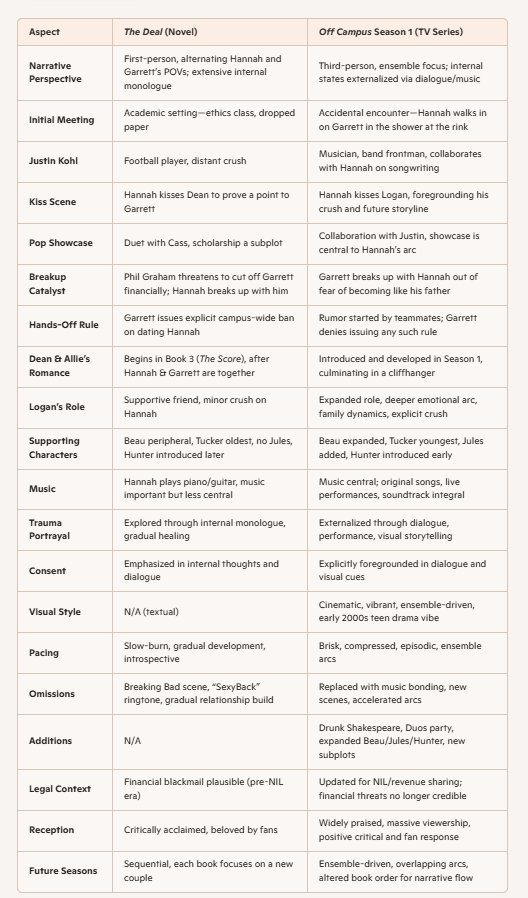
Detailed Analysis of Table Metrics
The comparison table above distills the most salient differences and similarities between The Deal and Off Campus Season 1. Each point reflects a deliberate adaptation choice, shaped by the constraints and opportunities of television, contemporary cultural norms, and the creative vision of the showrunners.
Narrative Perspective: The shift from first-person to third-person, and from internal monologue to externalized emotion, is perhaps the most fundamental change. While some intimacy is lost, the ensemble focus allows for richer secondary arcs and a broader exploration of the Briar University world.
Character Arcs: The reimagining of Justin, the acceleration of Dean and Allie’s romance, and the expansion of Logan’s role all serve to create a more interconnected, dynamic narrative. These changes also set up future seasons and ensure that each character’s journey is given space to develop.
Thematic Adjustments: The adaptation’s handling of trauma, consent, and masculinity reflects both the source material’s strengths and the evolving expectations of contemporary audiences. The avoidance of problematic tropes (e.g., the “hands-off” rule) and the emphasis on agency and healing are particularly noteworthy.
Pacing and Structure: The compression of plotlines and the insertion of new scenes are necessary adaptations for episodic storytelling. While some fans miss the slow-burn intimacy of the novel, the show’s brisk pacing and ensemble arcs have been widely embraced.
Music and Visual Storytelling: The elevation of music from a subplot to a central narrative device is a masterstroke, allowing the series to externalize Hannah’s internal journey and provide emotional climaxes that resonate with viewers.
Legal and Cultural Context: The adaptation’s responsiveness to changes in NCAA and NIL policies demonstrates a commitment to realism and relevance, ensuring that the story remains credible and engaging for a 2026 audience.
Conclusion
The adaptation of Elle Kennedy’s The Deal into Amazon Prime’s Off Campus Season 1 exemplifies the challenges and rewards of translating beloved literary works to screen. Through a combination of fidelity to character dynamics, thoughtful modernization, and creative innovation, the series succeeds in honoring the spirit of the source material while forging its own identity. The narrative changes, character portrayals, pacing adjustments, and thematic refinements reflect both the demands of television and the evolving cultural landscape. The result is a series that resonates with both longtime fans and new viewers, offering a nuanced, emotionally rich exploration of trauma, consent, love, and community.
As the series moves forward, its willingness to adapt, innovate, and engage with contemporary issues bodes well for its continued success and cultural impact. The interplay between book and screen, between fidelity and reinvention, ensures that both versions can be “loved in their own individual ways,” as star Ella Bright aptly put it. In the end, Off Campus stands as a testament to the enduring power of story, the importance of adaptation, and the transformative potential of love and healing.
Bibliography
Elle Kennedy Opens Up On ‘Off Campus’ Book Series and Her Favourite ...
Off Campus Author Addresses Surprise Book Changes in Season 1
The Deal Summary and Study Guide | SuperSummary
The Deal (Off-Campus Book #1) Ending Explained - The Review Geek
Off Campus Book vs Show: Every Major Change From The Deal Explained
Off Campus Season 1's Biggest Book Changes (& How They Affect Season 2)
Off campus vs the deal: 8 key differences between the books
‘Off Campus’ Star Josh Heuston Breaks Down Musician Justin Kohl: “I ...
‘Off Campus’ Star Josh Heuston Talks Justin Kohl As A Musician
'Off Campus' Season 1's Biggest Book Changes From 'The Deal'
Off Campus: 8 Book And TV Show Differences - refinery29.com
Off Campus' Antonio Cipriano explains why major Logan scene is ...
Off Campus vs The Deal: 8 key differences between the books
Off Campus Ending Explained: Do Hannah and Garrett end up together in ...
How Has NIL Changed College Sports: Legal and Tax Impact
How NIL Is Affecting College Sports: Rights and Risks
Belmont Cameli On Why 'Off Campus' Changed Garrett & Hannah's Breakup
Off Campus: episode 08 “The Line Change” – review
Allie and Dean (TV Series) | Off-Campus Wiki | Fandom
One Off Campus Couple Officially Justifies Changing The Order Of The ...
'Off Campus' Major Shake-up With Dean and Allie in Season 2 Makes ...
Hannah Wells (Book Series) | Off-Campus Wiki | Fandom
How 'Off Campus' Sparked Discourse About Sexual Assault
Inside the Music of 'Off Campus': Finding Hannah's Voice & More
Why is Beau portrayed differently in Off Campus Season 1 than in Elle ...
Hannah’s Trust Meet Garrett’s Hands… - YouTube
How To Write Internal Monologue (Without Overdoing It)
Internal Monologue Examples And Tips – Jericho Writers
'Off Campus' Character Ages & School Years In The Books Vs. Show - Bustle
Off Campus Season 1 soundtrack: Complete list of songs and music listed ...
About the Creator
Kristen Barenthaler
Curious adventurer. Crazed reader. Librarian. Archery instructor. True crime addict.
Instagram: @kristenbarenthaler
Facebook: @kbarenthaler
Enjoyed the story? Support the Creator.
Subscribe for free to receive all their stories in your feed. You could also become a paid subscriber, letting them know you appreciate their work.
Comments
There are no comments for this story
Be the first to respond and start the conversation.