
Did Nolan Just Kill the Soul of The Odyssey?
From Sea-Salt Jokes to PTSD: The Cost of Cinematic Greatness
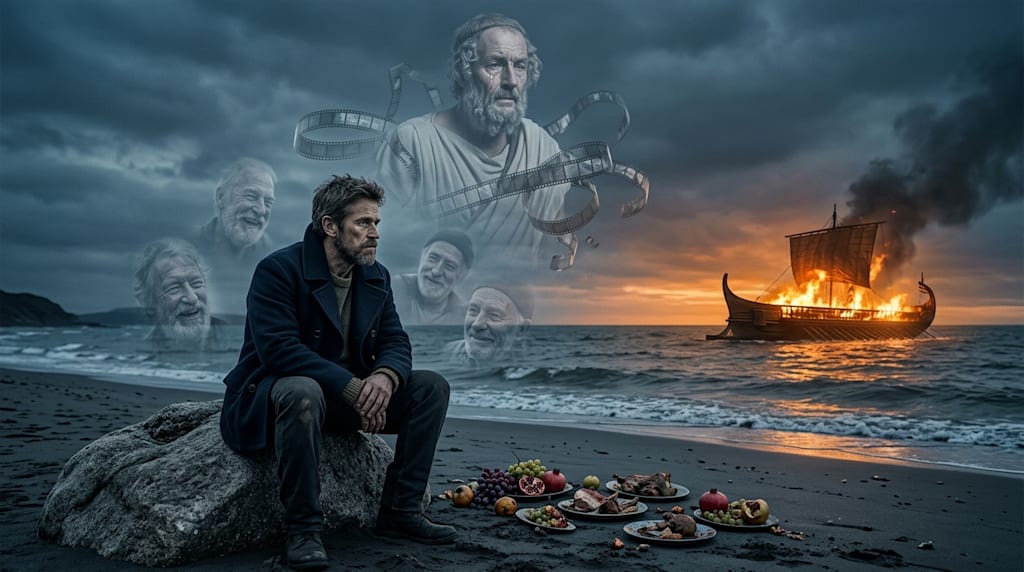
From Oppenheimer to The Odyssey, A Classical Disenchantment as Award-Season Strategy
When Christopher Nolan announced that he would adapt Homer's Odyssey for IMAX on a $250 million budget, classical scholars and cinephiles allowed themselves a moment of excitement. Then Emily Wilson—whose English translation Nolan consulted during production—published her takedown in the London Review of Books, and the first promotional materials revealed a tone of unrelenting solemnity. A less comfortable truth took shape: what we are about to watch is not the Mediterranean folk epic of puns, divine adultery, and absurd sea yarns, but a modern intellectual's confessional dressed in ancient Greek costume.
Why did Nolan systematically erase the humour, the eroticism, and the absurdity? To say "he wants an Oscar" is too simple. Behind that choice lies a triple bind: a compulsive need for cognitive order, a quiet ideological substitution, and a hard-nosed play for Hollywood's most expensive currency.
I. The Tyranny of Order: Nolan Cannot Abide Chaos
Homer's Odysseus carries the epithet Polytropos—the man of many turns. He is cunning, greedy, lustful, boastful. After blinding the Cyclops, his pride gets the better of him; he shouts out his real name and draws Poseidon's curse. This multiplicity is the lifeblood of the Greek worldview: gods are capricious, heroes are flawed, fate is a joke with a punchline.
Nolan's cinema runs in the opposite direction. Memento's disarray, Inception's architecture, Tenet's entropy reversal—all of them orbit a single obsession: control and determinacy. In his grammar, time is a calculable geometry; characters move like precision gears. Humour breaks that rhythm. Absurdity lets in noise.
So the "Nobody" pun after the giant's blinding disappears. A street-level joke would shatter the cathedral hush Nolan builds with his IMAX frames. He does not need a sailor; he needs a walking chronometer. He does not want roasted meat and campfire banter; he wants a face permanently creased by war. Static heaviness suits his dynamic lens.
II. The Demotion of the Divine: From Polytheistic Pleasure to Monotheistic Guilt
You will never find a sex scene in Nolan that feels like joy. You will certainly not find Athena delaying dawn so that Odysseus and Penelope can linger in each other's arms. This is not modesty. It is ideological instinct.
Greek polytheism is a religion of the body. Eros is sacred offering; appetite is a hymn. Circe turns men into pigs; Odysseus beds the witch for a year; Calypso's cave is prison and paradise at once. These episodes are a brute reconciliation between man and nature. Nolan's world, by contrast, carries the residue of monotheism: pleasure is superficial; only suffering has moral heft.
He rewrites Odysseus's homecoming from "reclaiming kingship and carnal reunion" to "post-war PTSD therapy." Penelope is no longer the shrewd queen who unravels her loom each night to outwit a hundred suitors; she becomes a suffering cipher awaiting redemption. Sex in Nolan's frame appears only as murder (Agamemnon) or terror. Bodily joy interferes with soul‑searching. He packs Homer's earthy vitality into a Christian mould of guilt.
III. The Currency of Capital: Trading "Seriousness" for Filmmaking Freedom
The Oscar observation is not wrong, but it misses half the picture. The award is not the goal; it is the credential that buys creative autonomy.
Oppenheimer swept seven Oscars and gave Nolan a proven formula: historical weight + technical spectacle (IMAX film) + moral gravity = a blank cheque from studios. When he asks for $250 million to adapt an ancient Greek poem, he cannot say, "I want to make a sea adventure full of dirty jokes and absurd gags." That gets tossed into the "genre" bin. He must pitch it as a meditation on humanity's war guilt.
So the vivid food—roasted meats, wine, fresh fruit—vanishes. The pleasure of eating is not "high art." The divine interventions are cut to a single Athena, reduced to a trauma-induced hallucination, because "illusion" sounds more intellectual than "miracle." Nolan signals to the financiers: this is not Homer; this is Saving Private Ryan meets Apocalypse Now in ancient Greece. He uses ascetic seriousness as collateral for unrestricted shooting privileges. Homer's humour is the first sacrifice in that deal.
IV. The Price: A Monument with Nothing Inside
Nolan's Odyssey will be a technical marvel—every frame a classical oil painting. But as Wilson laments, he has built a monument and lost the dinner.
The most moving moment in the original is small. After all his trials, Odysseus reaches home, sees his old servant, and does not weep into his arms. He eats a meal. He takes a bath. This simple act—clinging to the flesh even with doom overhead—is the core that has kept the epic alive for three thousand years. Nolan's ending is the opposite: Odysseus renounces the throne, sails away with his wife into self‑exile. He turns a triumphant return into a penitential flight.
Epilogue: Nolan Shoots Nolan, Not Homer
Nolan knows Homer. That is precisely why his betrayal is deliberate. His Odyssey is not a tribute; it is a reanimation of classical bones to house the soul of a contemporary intellectual.
He takes the old sea‑rover—the joker, the lecher, the glutton, the trickster—and turns him into a modern moral prisoner in a three‑piece suit (even if the suit is a chiton). This is not a question of better or worse. It is a substitution of substance. When the screen‑Odysseus furrows his brow at the horizon, we are not looking at the hero of Troy. We are looking at Nolan himself—the man who broods over time, who seeks redemption in celluloid chemistry, who cannot let his characters laugh.
And in this utterly solemn epic, we will not hear Homer's great, salt‑tinged, wine‑stained laugh across the centuries. Perhaps that is the price that today's most ambitious filmmakers pay for their claim to "greatness."
About the Creator
Jin
Writer of reamstories
https://reamstories.com/jin
Enjoyed the story? Support the Creator.
Subscribe for free to receive all their stories in your feed. You could also become a paid subscriber, letting them know you appreciate their work.
Comments
There are no comments for this story
Be the first to respond and start the conversation.