
Deleted Scene Reveals The Claytons' Fates In Tarzan (1999)
In the 1999 animated adaptation of Tarzan, the titular character's parents die offscreen during the first few minutes of the movie. Now, however, a deleted scene shows the events leading up to that tragic incident.

When one thinks of Disney movies, the first thing that comes to mind is that they're child friendly. Such a statement rings true based on how popular they are with the demographic; keep in mind, though, that several Disney movies have fairly dark twists, too.
Recent films by the billion-dollar conglomerate have been tamer in content, but back in the 90s, quite a few geared towards younger audiences included mature elements such as violent deaths. One movie in particular reinforces our point, Tarzan (1999).
The animated adaptation of Edgar Rice Burroughs ' story follows a jungle-faring boy as he discovers the human world. In Tarzan's journey of self-discovery, he learns that his parents met a tragic fate, which is why he wound up stranded in the jungle.
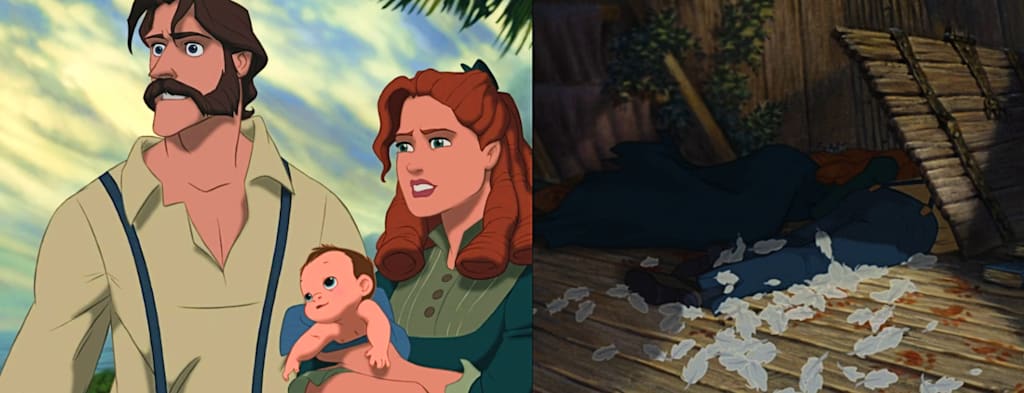
In the theatrical cut, the audience doesn't see exactly how they perish. Their deaths happen offscreen following a leopard attack. We get a glimpse of their corpses lying slightly out of view behind a turned-over table when a curious ape goes searching. That's it, though. Audiences drew their own conclusions with the scene being so ambiguous, but there's always been a clear answer to the night's events.
Fortunately, for interested fans, a deleted scene shown in early-stage storyboards sheds light on how Tarzan's parents tragically died, and it's almost exactly what one expects from a leopard attack.
At about 2:20 seconds into the deleted scene compilation, the sequence begins. In it, the family patriarch is trying to defend himself against a stalking leopard. Tarzan's father loads his makeshift shotgun-rifle, but misses his target when the leopard pounces. Shadowy silhouettes of Sabor raising its claws over the father's head point to a bloody demise, explaining what happened on that fateful evening.
There are, however, distinct differences from the theatrical cut in the unseen content.
For one, Tarzan's mother is not in the deleted scene. Only his father is present during the leopard attack, which raises yet another question: Did Sabor murder Tarzan's mother before killing his father? The notion of a leopard killing one person, tracking down their traveling partner, and following suit isn't all that difficult to visualize. Those jungle-faring animals are known for stalking prey, tracking from an unseen position, waiting for the opportune moment to strike. Perhaps the vicious man-eater in Tarzan's story murdered the matriarch while out in the woods and proceeded to follow a grieving husband back to his home after the attack. A previous encounter would explain why their shotgun was in disrepair. Long periods of simply sitting unused wouldn't cause the armament to break down, but a physical fight with an aggressive animal might.
Considering Disney's decision to leave out the bloody death of Tarzan's father, it makes sense that the production team would cut the mother out altogether. Assuming she was casually strolling through the forest and became a leopard's meal, that might be too dark for children to absorb/process. In nature, such an incident happens and is par for the course in wild environments. But in a contained story like Tarzan, the presenter can dispense with realistic accuracy to better suit the audience. Besides, what testing group is going to react positively to bloody deaths in the first minutes of a children's film?
What's interesting about the deleted sequence is that Disney even contemplated inserting a man-eater into their story. The production team would've known that children would primarily be watching. Why would they expose them to brutality and violence? Of course, the logical explanation is that oversight is to blame.
Compared to now, regulations surrounding films were much laxer in the 90s. Offensive content still got flagged by censors, but themes that prompted viewers to consider more mature subject matter slipped by. There's logic to the practice as well. We can't shield children from reality forever, so they eventually have to learn about death. That's why movies like Tarzan (1999) and Flubber (1997) included minor character deaths, despite knowing the conversations that would follow at home. "Why did Weebo have to die?" or "Are Tarzan's mommy and daddy okay?" are the kinds of questions that parents would have to answer for their children. There's nothing wrong with that—it's simply easier to complain about complicated subject matter than to talk through things. The protests of LGBTQ+ stories in Disney movies are a perfect example.
While they never seek to groom or indoctrinate, conservatives like to make the claim that's what those stories do. In reality, certain parents don't want to discuss those themes because having to means explaining why their own prejudices come from a place of hate. It's very difficult to clarify why characters are preaching acceptance while you practice opposing values at home. You'd almost have to place yourself in the bad-guy role. What parent is going to do that, especially one who's already pushed prejudiced ideals onto their children?
Regardless, Disney continues to challenge boundaries—whether overtly or directly. The creative liberties Shawn Levy had with Deadpool and Wolverine director speak to such a claim. No one expected Disney to allow so much illicit content to be in the theatrical cut of one of their feature films, but things like pegging, cocaine use, and gratuitous violence made it into the movie. The company still has work to do when it comes to censoring content, because instances like watering down Pleakley in Lilo and Stitch (2026) were conservative influences bleeding in. Hopefully, though, one day, a character in drag won't be too offensive for general audiences.
Tarzan (1999) is currently streaming on Disney+.
About the Creator
Allie Z.
I cover most entertainment related topics and am venturing into journalism.
Enjoyed the story? Support the Creator.
Subscribe for free to receive all their stories in your feed.
Comments
There are no comments for this story
Be the first to respond and start the conversation.