
Custom AI solutions for business: When should companies build instead of buy?
Custom AI solutions
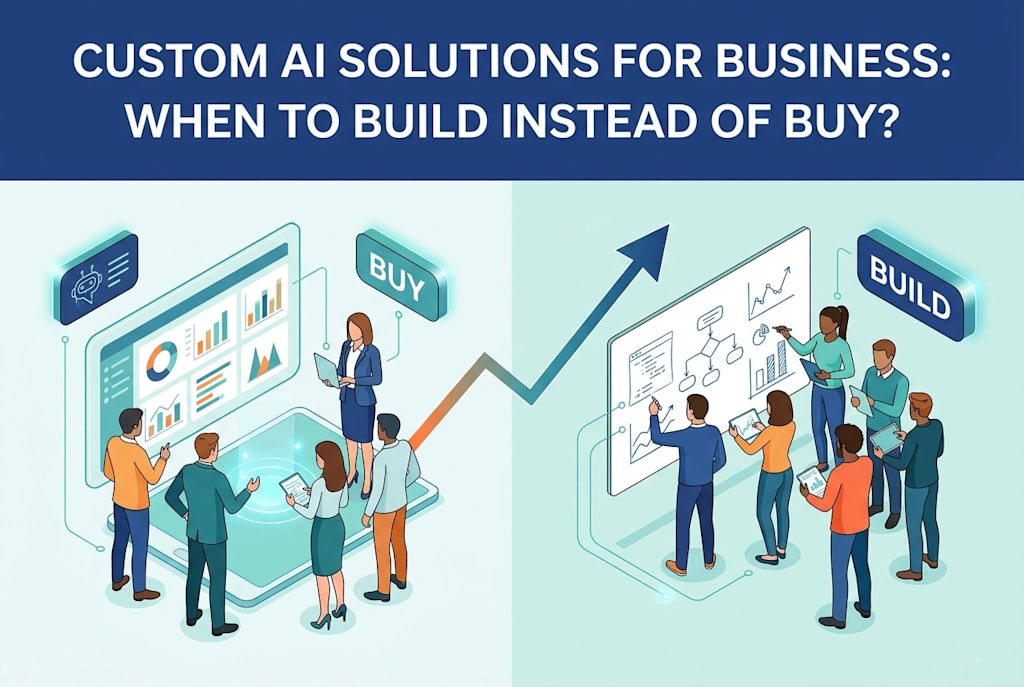
66% of organizations say they achieved productivity improvements with AI, and now more than 40 per cent of OpenAI's revenue comes from enterprise customers, according to Deloitte's State of AI in the Enterprise report. But there is a more subtle change underway: Businesses are reassessing their need for and approach to in-house versus purchased solutions.
According to industry data, the number of enterprise AI use cases deployed via third-party solutions has grown to approximately 76%, from a near 50/50 split two years ago. But when do a custom AI solution make sense? The "short answer": When the AI hits your competitive moat. All other purchases are typically a matter of choice.
What Are Custom AI Solutions?
Custom AI solutions are AI systems created, trained, and deployed with specific data, workflows, and objectives of a particular business. A company does not use a prefabricated SaaS tool, but collaborates with an AI development company to create models, agents or pipelines specific to their own business processes. This frequently involves generative AI development, RAG systems, fine-tuned LLMs, and comprehensive AI development from data infrastructure to APIs and front-end interfaces. The "off-the-shelf" AI is quick and easy to install and is less expensive. Custom AI is slower in the beginning but will have better long-term protection.
Build vs. Buy: A 2026 Decision Framework
It's a point made at Citi's annual AI Summit: companies are now following a relatively narrow strategy for internal builds on key differentiators, with vendors handling the rest. Here's the thinking that went into that decision.
Build a Custom AI Solution When:
- Your data is your edge. General tools diminish the power of your moat if that moat is proprietary data or operational signals.
- Your workflows are non-standard. Standard agents fail when there are no documented workflows in enterprises to map to vendor tools.
- Compliance and data residency matter. Custom deployment and audit trails are required in regulated industries such as healthcare, finance and defence.
- You need deep integration. In most cases, AI integration with legacy ERP or custom databases will involve the help of custom AI integration services to link them together.
- Long-term unit economics favor it. Per-token vendor pricing is linear. With a well-designed custom system, the speed gets sub-linear after a certain volume.
Buy an Off-the-Shelf AI Tool When:
- The use case is generic. There are already well-established provider solutions for drafting emails, conducting meetings, and standard chatbots.
- Speed matters more than ownership. Vendor-led AI deployments outperform internal builds 2:1 in success rate, per Q1 2026 enterprise data.
- You lack data maturity. No custom AI will clean up the messy data. While making repairs to the foundation, use a vendor tool.
- The capability is fast-moving. The update frequency of the foundation models might be monthly, and wrappers acting around these models tend to become outdated.
2026 Trends Reshaping the Build-vs-Buy Question
1. Agentic AI Goes Mainstream
According to the 2026 Enterprise AI survey carried out by WRITER, 52% of the employees are using AI agents, and 97% of executives state that their company deployed such agents in the past year. Simple agentic workflows are available for purchase; multi-step agents with proprietary business logic are likely to require custom development.
2. The ROI Gap Is Widening
Just 29% of executives are achieving any meaningful ROI with AI initiatives. The four common attributes of the winners are: AI aligned to revenue goals, governance designed prior to scale, business teams involved in driving AI application, and the project viewed as an organizational redesign instead of a tooling refresh.
3. Cost and Vertical AI Push Custom Builds
It is now commonplace to use cost levers such as token quotas and dynamic model routing. Saving up to 40% to 70% over making a call to the Frontier APIs for each task. AI is also being integrated into devices and edge environments, a space that is seldom suitable for a SaaS product, in other sectors such as manufacturing, logistics, and defence.
Practical Decision Factors
Run your use case through these five questions:
- Strategic value: Will the AI capability be relevant to the business in 5 years time?
- Data readiness: Have clean, available, well-labelled data for training and the foundation of the system?
- Total cost of ownership: Have you accounted for the 3 year build, maintain and improve costs?
- Talent access: Do you have ML engineers and MLOps capability in-house, or will you partner with an AI development company?
- Time to value: Is it okay if the business can wait for 6 to 9 months or do they need the value within weeks?
When the answers involve strategic use cases with data and long-term perspectives, it's typically a custom build. When they refer to commodity capabilities, purchase and proceed.
The Hybrid Approach Most Companies Land On
Most businesses in 2026 won't be all build or all buy. It's a portfolio. The foundation models from OpenAI, Anthropic, or Google are the starting point, followed by vendor SaaS for common productivity applications, and finally, custom AI solutions for the 2–3 workflows that truly differentiate the company. AI consulting services can assist in determining what capabilities go into each bucket.
Frequently Asked Questions
1. How much does a custom AI solution cost?
The price of a custom AI project is in the range of $50,000 to $500,000, depending on the complexity and depth of data incorporation. For enterprise platforms with multi-agent systems, larger systems can cost over $1 million.
2. How long does it take to build a custom AI solution?
The time required to get a production-ready build is usually 3-9 months. Proof of concept can be delivered in 4-8 weeks. Typically, a complex generative AI development with fine-tuning and integration takes 6 months or more.
3. Is generative AI development always custom?
No. Vendor APIs are suited for many use cases such as chatbots, content drafting, content summarization, and more. When your needs involve domain-specific output, proprietary data grounding, or system integration, then custom generative AI development comes in very handy.
4. What's the difference between AI integration services and AI development services?
AI integration services integrate current AI tools and APIs into your stack. AI Development Services create new AI or AI agents or AI systems from the ground up. Both are required in many projects.
5. Should small businesses build custom AI?
Usually no. Mature SaaS AI solutions offer greater value to small businesses. Where a business possesses unique data, repetitive high-volume workflows, or a product that is integral to the experience with AI, custom AI development becomes worth the effort.
Final Thoughts
The build-vs-buy discussion isn't about the efficacy of AI. It's about where AI will be most useful to your business. Purchase the commodity goods. Construct what is special about you. For companies seeking a partner to understand and implement this or to build a new AI solution, they can consider AI Development Services for full-stack AI development, generative AI development, AI consulting services, and AI integration services.
About the Creator
Enjoyed the story? Support the Creator.
Subscribe for free to receive all their stories in your feed.
Comments
There are no comments for this story
Be the first to respond and start the conversation.