
Black Sails and Borrowed Medicine
Chapter 1 -The Medicine That Wasn’t From Here

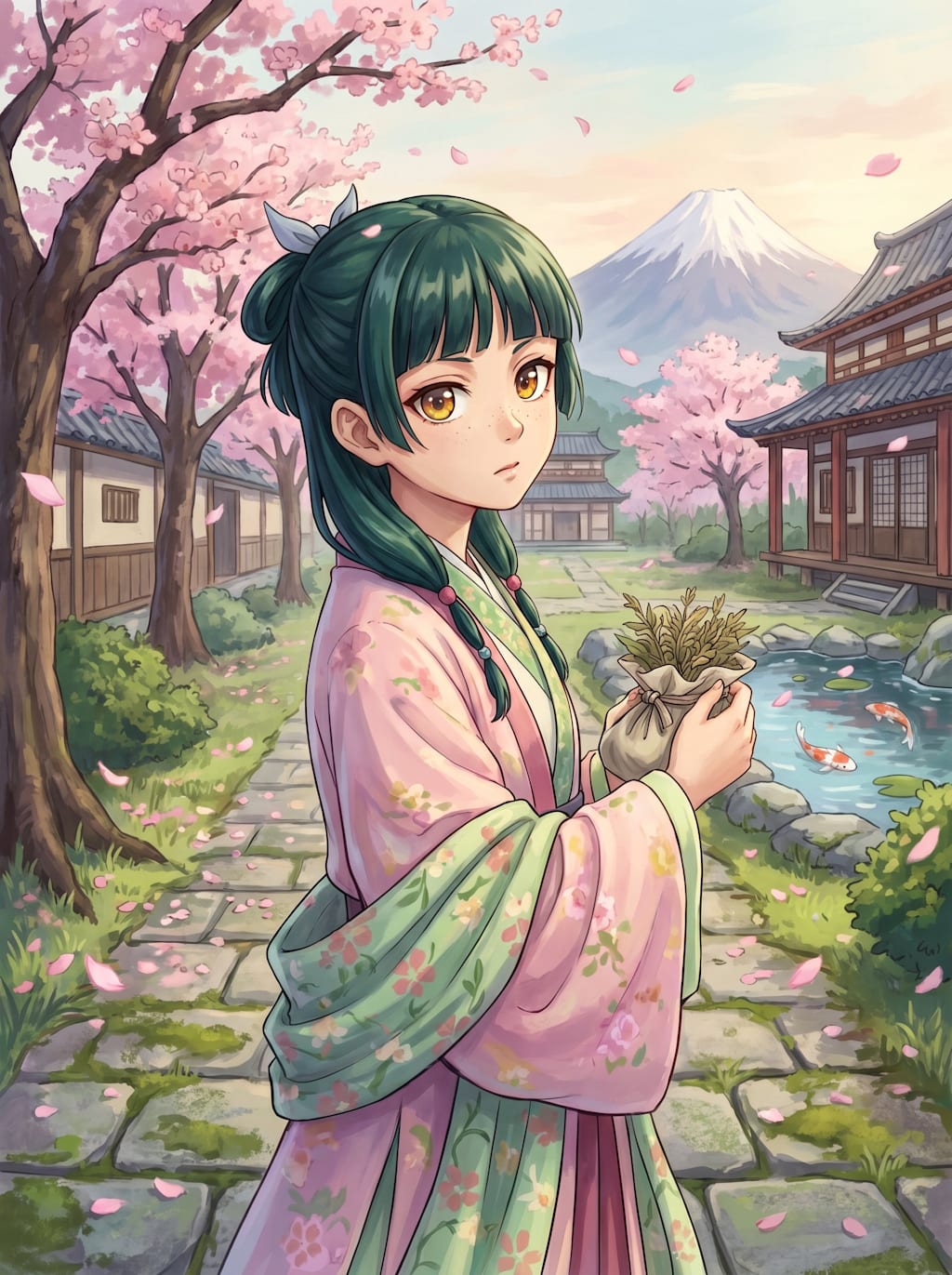
The jar did not belong there.
Maomao noticed it the way a cat notices a fly in a silent room. It sat half-buried behind bundles of dried roots and paper-wrapped powders, glass catching a stray spear of light that slipped through the shutters. The rest of the shelves in the old storeroom were a chaos she understood at a glance: known labels, familiar dust, the comforting scent of mold and herbs. This little thing was wrong.
She put down the inventory slate and reached for it.
The glass was cool under her fingers. Whoever had sealed it had used a stopper she didn’t recognize—dark, almost black material, smooth and faintly oily. Maomao turned the jar under the light. The liquid inside clung to the sides a heartbeat longer than it should, viscous but not quite as thick as oil. A strange shade, too; not the clear amber of medicines, not the dark brown of decoctions, and not the clouded milk of poisons that attacked the stomach.
She twisted the stopper and lifted it to her nose.
The scent was wrong as well. Not the clean bite of alcohol or vinegar, not the comforting bitterness of herbs. There was a sharpness to it, like metal left in the rain, but underneath that—salt, something wild and open, with a faint trace of smoke.
“This is curious,” Maomao murmured.
No label on the glass. No note tucked under the shelf, nothing in the storeroom records about a new delivery. It was just here, like a piece in the wrong part of a puzzle.
She dipped a slender wooden spatula into the liquid and watched how it dripped. One, two, three… the drops stretched thin before falling, leaving a faint sheen on the wood.
Not quite oil. Not quite water.
She wiped the spatula on a cloth, then lit a candle, letting a droplet fall near the flame. The vapor curled up almost invisibly, but her nose twitched. There it was again—that strange, wild scent, like wind blowing through a harbor she’d never seen, bringing salt and something animal.
There was only one way to know more.
Maomao set the jar on the table, steady and deliberate. She rinsed a porcelain cup, poured a measure of clean water into it, then used the tip of the spatula to carry over a single, glistening drop from the jar. It bled out into the water in a lazy spiral, not quite dispersing, not quite staying whole.
“Just a little,” she said to herself. “If it is a poison, better I learn its nature.”
She raised the cup and touched it to her lips, taking the smallest possible sip, no more than would wet her tongue. She held it in her mouth, eyes half-lidded, and let it sit.
The first impression was faintly bitter, then oddly cool, like sucking on a pebble from a mountain stream. A moment later a warmth bloomed at the back of her throat—and then spread, a thin line trickling down her spine and out along her limbs.
Maomao swallowed and set the cup down.
She pressed two fingers to the inside of her wrist, counting. One, two, three—pulse slightly faster than before, but not dangerously so. Her breathing was steady. No constriction in the throat, no sudden nausea. She flexed her fingers; sensation was normal. If it was a poison, it was subtle.
“Interesting,” she murmured. “Again.”
Another tiny sip. She tilted her head back this time, letting the taste roll over her tongue. The metallic note was stronger now, mingled with that impossible scent of salt and smoke. Her ears began to ring, not painfully, just a low hum at the edge of hearing.
She checked her pulse again, tapping out the rhythm.
Faster. Not enough to worry yet, but enough to record. She mentally filed away the progression. Initial warmth, mild tachycardia, auditory distortion. No visible rash. No burning in the throat.
The hum grew louder.
The walls of the storeroom seemed to pull away from her by a finger’s width, as if someone had quietly stretched the room in all directions. Her vision sharpened around the edges—each speck of dust in the air suddenly distinct, spinning slowly in shafts of sunlight. The candle flame elongated, then wavered strangely, as though underwater.
Maomao frowned.
“That’s not…typical.”
She pushed off the table to stand. Her feet found the floor, but the angle was wrong. She had the peculiar sensation of walking on a slope that wasn’t there. The ceiling dipped and swayed overhead, beams bending like reed stalks in a wind she couldn’t feel.
Hallucinogen? But the onset was too fast and the symptoms didn’t match the usual culprits. Her heart wasn’t pounding in panic, yet the room rocked like a ship in a storm.
Ship?
The thought came with a smell—stronger now, flooding in through a crack she hadn’t noticed. Salt. Tar. Cold, clean air rushing over open water.
Her fingers groped for the edge of the table and met nothing. The wood she knew was there had shifted half a step to the side, or she had. Her body couldn’t quite agree with itself on where it belonged.
“Ah,” she said, blinking hard, “this might actually be dangerous.”
The humming rose, filling her head, her chest, her bones. Her knees buckled, and Maomao pitched forward, reaching blindly for anything solid.
Her hand met glass.
The jar tipped.
The last thing she saw was the liquid inside twisting up toward her, stretching along the curve of the glass in a way that liquid should not move, like a tendril reaching out to greet her. The hum became a roar, then—
Nothing.
____________________________________________________
She woke to the sound of birds.
Not the caw of crows that haunted palace eaves, nor the shrill chirp of the little things that nested in the rafters. These calls were different—higher, clearer, woven into a chorus that floated on air far cleaner than any courtyard she’d known.
Her cheek itched.
Maomao opened her eyes and found herself nose-to-nose with a blade of grass.
It tickled her skin, green and sharp and very much unlike the dusty floorboards she expected.
Slowly, carefully, she pushed herself up onto her elbows.
Grass. A whole field of it, whispering around her sleeves. In the distance, low rolling hills cupped a scatter of houses with dark, sloping roofs. The sky overhead was painfully blue. The air was cool and carried the faint scents of woodsmoke, damp earth, and something else—farther away, but distinct.
Salt again. Real this time, not a ghost in a jar.
Maomao blinked once, twice. Then she sat all the way up and pressed her fingers to the inside of her wrist.
Pulse: present. A little fast, but not the flutter of panic. She touched her forehead. No fever. No slick sweat on her palms. Her breathing was even.
Her clothes, however, were not right.
She looked down.
Instead of the rough, practical robes she’d worn in the storeroom, she was wrapped in a plain kimono she had never seen before. The fabric was slightly coarser than palace issue, dyed a soft, smoky blue. The collar crossed correctly. The under-robe was the right length. Someone had taken the time to dress her properly.
Her fingers pinched the sleeve, rubbing the weave between thumb and forefinger. The sewing was neat but utilitarian. Country work, not palace finery.
Maomao’s eyes narrowed.
She did not remember anyone touching her after the room had begun to tilt. For that matter, she did not remember leaving the room.
She looked around again, slower this time.
The houses in the distance had wooden sliding doors and tiled roofs, their silhouettes sharp against the hills. A narrow road ran along the edge of the field toward what looked like a village, lined with weathered fences and the occasional stone marker. Beyond, the faint glimmer of water suggested a river or inlet.
The architecture wasn’t entirely unfamiliar. She’d seen drawings of distant provinces. But the proportions were off, the curving rise of the eaves, the shape of the lanterns hanging from a roadside post. The script on a nearby wooden sign was close to her own characters, yet a stroke here, a flourish there, made them look just slightly wrong.
“Not a fever dream,” she said quietly. Her voice sounded small in the open air. “Unless my imagination has grown unreasonably industrious.”
She stood.
The world stayed where it was supposed to. The grass bent under her bare feet; the ground felt real and solid. No echoing hum in her bones now, just the distant, steady murmur of village life.
Her hand drifted automatically to her waist, checking for the little leather pouch she habitually carried. It was there, tied neatly over the sash of this unfamiliar kimono. The knot was competent. Whoever had dressed her had either left it in place or retied it as it had been.
Inside, her fingers found the familiar shapes of wrapped powders, tiny vials, a folded scrap of paper covered in her own cramped handwriting.
At least she wasn’t entirely without tools.
Maomao brushed grass off her knees and began walking toward the village.
The road was hard-packed earth, rutted by cart wheels and edged with wild plants. She spotted at a glance several types she recognized—or half-recognized. A low-growing herb whose leaves resembled those used for calming stomachs, though the underside was paler than she’d expect. A tall, spindly plant with clusters of tiny white flowers, fragrant in a way that made her think of fever remedies.
“Relatives,” she murmured, crouching to pinch a leaf between her fingers. The scent was close, almost right, but not quite. Different soil, different sky, perhaps. Or a different world entirely.
A group of women passed her, laughing softly among themselves, baskets balanced on their hips. Their garments matched hers in cut and style. One glanced her way, eyes flicking over Maomao’s plain kimono and bare feet, then moved on without comment.
Maomao listened to their voices fade.
The dialect was strange, but not impenetrable. Words she knew were threaded through phrases she didn’t. Close enough that context did most of the work, far enough that she would need time to adjust.
Not entirely lost, then. Just…misplaced.
She reached the first of the buildings—a small wayside shrine, its wooden frame aged to a silvery gray. Paper talismans fluttered under the eaves, ink strokes bold and unfamiliar. A faint curl of incense smoke drifted from a stone basin, carrying the scent of resin and something sharper.
She paused, inhaled, and catalogued automatically.
Resin—pine, perhaps. A bitter note that reminded her of a certain temple blend used for purification. Nothing immediately alarming, though she filed it away.
Ahead, a cluster of houses surrounded a central space where a handful of stalls had been set up. Vendors called out to passing villagers in sing-song voices. Steam curled from a pot where someone was ladling broth. Children darted between adults, shrieking with laughter.
It looked almost like any other village market.
Maomao took a step forward.
Someone screamed.
The sound knifed through the low hum of conversation. Heads turned. A woman near the edge of the square stumbled backward, clutching at the sleeve of the man beside her. On the ground in front of them, a young man had fallen to his knees.
He gasped once, shoulders convulsing, then toppled onto his side.
For a heartbeat, everyone froze. Then the air filled with shouts.
“Again—”
“It’s the curse—”
“Don’t touch him!”
Maomao’s feet were already moving.
She slipped through the ring of onlookers before they could decide whether to stop her. The fallen man lay on his back, eyes wide and unfocused, chest heaving. His lips had taken on a faint bluish cast. Sweat soaked his brow.
“Don’t!” someone hissed. “You’ll catch it!”
Maomao ignored them.
She knelt at his side, fingers going straight to his neck. Pulse: rapid, thready. She moved her hand to his chest, watching the rise and fall. Breaths short, shallow. No rattling in the lungs, at least not yet.
“Help me roll him,” she said, not looking up.
No one moved.
“He’ll choke if he vomits,” she added, sharper. “Unless that’s what you want from your curse.”
Shame and fear warred in the faces above her. After a moment, an older man stepped forward, hands shaking, and helped her turn the patient onto his side.
Maomao pried open the man’s mouth briefly, checking for obstructions. His tongue was damp, discolored at the edges with a faint purplish tinge. No obvious swelling in the throat. She let his head rest on his arm and moved her attention to his skin.
Bruises marred his neck and upper chest, not the blotchy randomness of someone who’d taken a fall or been struck. They traced faint lines, almost like ink brushed under the skin, following paths she recognized from her own crude meridian drawings.
Her brow furrowed.
That was wrong.
She pressed along his ribs, then down his abdomen, mapping warmth and tension. He groaned weakly at one point, muscles clenching under her hand.
“Recently ill?” she asked the air around them. “Anything before this?”
“He said his head hurt yesterday,” the older man stammered. “Just a little. Told him to rest. This morning he came to the market and then—then—”
“Has anyone else had the same marks?” Maomao asked.
Murmurs stirred the ring of villagers.
“On the neck…yes, I saw on old Goro…”
“And that girl from the river—”
“They died quickly,” someone whispered. “The curse takes them before sunset.”
Curse.
Maomao’s mouth tightened.
She pinched the skin near one of the bruises, feeling the resistance, the heat. Not surface-level. Something deeper, woven in.
“Water,” she said. “Cool, not too cold. A cloth. And if you have any herbs for fever, sniff them for me.”
They hesitated again.
“He’s going to die,” she added, very evenly, “whether you stand here or help me. If it is a curse, your gods can scold me later.”
That did it.
A woman bolted toward a nearby house. Another man fetched a bucket. Within moments, she had water at her side and a damp cloth in her hand. Someone thrust a small bundle of leaves at her, wrapped in cloth.
“For fever,” they said. “We always use this.”
Maomao brought it to her nose. The smell was close to a herb she knew—good for lowering temperature and easing pain—but with that same subtle wrongness she’d noticed in the plants along the road.
Still, it was something.
She dampened the cloth and laid it across the man’s forehead, then used another to wipe down his arms and chest, cooling the overheated skin. With her free hand, she gently opened his jaw, tucking a carefully measured shred of the herb inside his cheek where it could slowly leach into the blood.
Not enough to choke him. Enough to test.
“Breathe,” she murmured, more to herself than to him. “In. Out. Don’t make this more complicated than it needs to be.”
His breaths stayed shallow for a time. Then, gradually, they lengthened by a sliver. His pulse under her fingers remained too fast, but after a few dozen counts, she felt a subtle easing in the frantic flutter.
The bruises did not fade.
But they also did not spread as quickly as she would have expected from the villagers’ fearful description.
She filed that away.
“Is—he…?” the older man asked.
“Not dead,” Maomao said. “Yet.”
A collective exhale rippled through the crowd.
She adjusted the cloth, wrung it out, and laid it again. Her mind ticked over the details.
Patterned bruising along meridians. Rapid onset. Fever, shortness of breath. No obvious swelling of the throat, no smell of common toxins on his breath. A herb that helped fever didn’t seem to make things worse.
This didn’t match any plague she knew. It didn’t quite match poison either—or rather, it matched the idea of several poisons layered together and set to spring in order.
Too neat. Too specific.
She glanced up at the watching villagers.
“How long has this…curse been happening?” she asked.
“A few weeks,” someone said. “First in the next village. Then here. Always the same. They say it’s punishment from the gods.”
“Or someone with too much free time,” Maomao muttered.
“What?”
“Nothing.”
She stroked the patient’s wrist again, feeling for that same frantic rhythm. It was still there. But his breathing had steadied enough that she could risk leaving him with instructions—to change the cloth, to keep him on his side, to call her if his pattern changed.
Her pattern. The thought made her snort inwardly. She had been here less than an hour and already she was acting as if this was her village.
“Who is your doctor?” she asked, straightening. “Surely someone has tried something before the gods.”
The villagers exchanged uneasy glances.
“We have a healer,” one said at last. “But he says this is beyond him. There is…” He trailed off, eyes flicking toward the road leading out of the square. “There is also a foreign doctor. In the port. They say he is…strange.”
Strange. Foreign. Doctor.
“Strange how?” Maomao asked.
“He cuts people open,” another muttered. “Fixes them from the inside. Some say he moves their insides without leaving wounds at all. A demon in human skin.”
Maomao’s fingers stilled on the cloth.
A doctor who cut people open. A doctor who could fix internal problems without obvious incisions. A doctor in a land that smelled of salt and smoke and things she did not recognize.
Her heart gave a small, inconvenient skip.
“Does this demon have a name?” she asked quietly.
“The men in the port call him Captain,” the older villager said. “Others call him…Trafalgar. Trafalgar Law.”
The name meant nothing to her. The combination of titles did.
A captain. A doctor. A foreigner.
Maomao looked down at the unconscious man at her feet, at the bruises that followed familiar paths in unfamiliar ways. She looked back toward the road that led, presumably, to this port where the demon doctor worked.
Her lips curved, just slightly.
“This is troublesome,” she said. “And very interesting.”
She squeezed the patient’s wrist one more time, as if confirming to herself that his life still clung there. Then she rose, dusted off her unfamiliar kimono, and turned her gaze toward the sea.
Whoever this Trafalgar Law was, if he truly could see inside bodies, then he might have answers she didn’t.
And if he was meddling with poisons that could make a person fall out of their own world, he owed her an explanation.
She started walking.
About the Creator
Sun Pirate Essasys
I write about what One Piece teaches us about politics, trauma, community, and the real world we live in — and I write cross‑anime fanfiction about tired adults, found family, and slow‑burn healing (Sanji × Tohru, Law × Maomao, and more).
Enjoyed the story? Support the Creator.
Subscribe for free to receive all their stories in your feed.
Comments
There are no comments for this story
Be the first to respond and start the conversation.