
BlackBerry: The Keyboard Kings Who Dismissed Jobs’s "Toy" ⌨️📵
From 20% market share to zero: The high cost of ignoring the future.

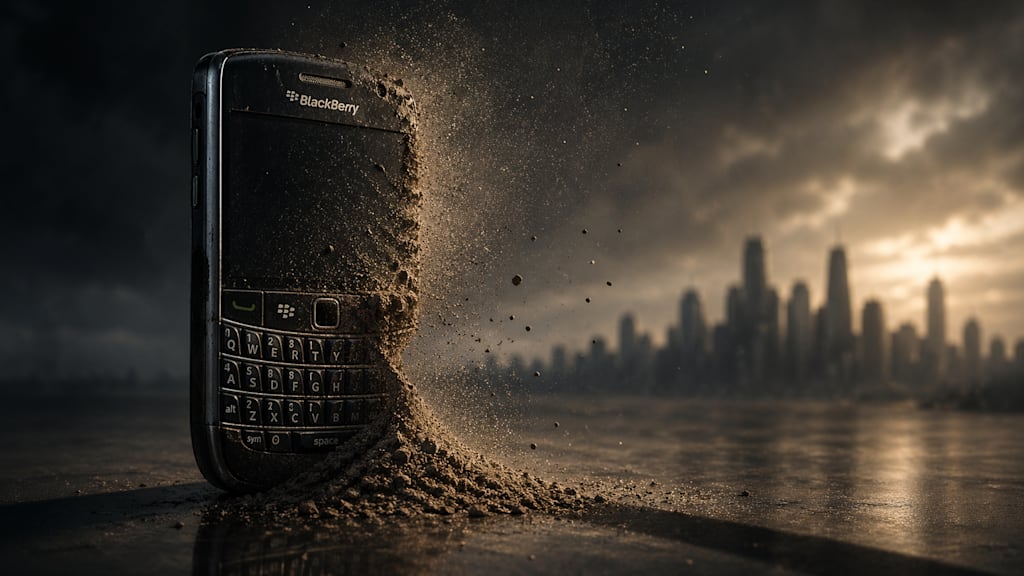
Not long ago, I wrote to you about the sad end of Sony Ericsson—a giant that believed a great camera and the Walkman logo would be enough to rule the world 🎸📸. That story showed that even the coolest brand can vanish if it stops understanding its users' needs. As it turns out, Sony Ericsson wasn’t alone. BlackBerry, a true business legend, met an almost identical fate, though their fall was even more spectacular 📉. This is a story of how massive arrogance and overconfidence can blind even the smartest leaders.
The World at the Feet of the "Berry" 🍇👑
Let’s go back to 2007. If you were a serious businessman, politician, or celebrity back then, you didn’t just carry any phone. You had to have a BlackBerry. Those phones, with their signature full keyboard below the screen, were more than just a tool—they were a status symbol 💼✨. Barack Obama used them, Wall Street brokers used them, and Hollywood’s biggest stars used them.
These devices were nicknamed "CrackBerry" 🥴 because they were so addictive that people couldn't stop checking their emails even during family dinners. BlackBerry had everything the market wanted at the time: unprecedented data security, the best email service in the world, and a legendary battery that could last for several days of intense work 🔋. It seemed that nothing could defeat them.
The Day the World Cracked in Half 🍎💥
On January 9, 2007, Steve Jobs took the stage in San Francisco and introduced the iPhone to the world. For us, it was a historical moment—the beginning of the era we know today. But for BlackBerry’s CEOs at the time—Mike Lazaridis and Jim Balsillie—it was a reason for... a loud laugh 😂.
Their reaction was a textbook example of "leader’s hubris." Instead of analyzing the threat, they publicly mocked Apple. In the hallways and interviews, they repeated arguments that sound like a joke today:
"Nobody will want to type on glass" – they were dead certain that a physical, clicking keyboard was the only way to send messages quickly ⌨️.
"It’s just a toy" – they claimed the iPhone was a gadget for kids to watch movies on, not a serious tool for a professional 🧸.
"The battery will die in a few hours" – they mocked the large, bright screen that consumed tons of energy, while their phones were efficient and minimalist 🔋🪫.
They were so sure they were right that they completely ignored the warning signs. They failed to notice that the world had stopped needing a "secure typewriter" and started craving a computer in their pocket 💻📱.
The Sony Ericsson Mistake, but on a Larger Scale 🔄
This is where BlackBerry’s story connects with the fate of Sony Ericsson, which I told you about recently. Both companies fell into the same trap: they focused on hardware, forgetting the soul of the modern phone—the software 🧠.
Sony Ericsson thought: "We’ll give people a better lens and they’ll love us." BlackBerry thought: "We’ll give people the best buttons and no one will leave us." Meanwhile, Apple (and shortly after, Google with Android) realized something brilliant: a phone is no longer a device for calling and texting. It is a platform 🌐.
BlackBerry slept through the app era. While iPhone users were starting to play Angry Birds, use the first mobile maps, or browse social media, BlackBerry owners could still mostly just... send emails 📧. The BlackBerry app store was a digital desert 🌵. Developers didn't want to create programs for their complex, closed, and outdated system.
A Desperate Move and the "Clicking" Screen 🖱️🆘
When BlackBerry’s executives finally realized the ground was slipping from under their feet, they panicked. Their answer to the iPhone was the BlackBerry Storm in 2008. This was the moment the company officially "jumped into an empty pool" 🏊♂️💨.
They wanted to catch up with the touch-screen trend, but they still loved that physical click so much that they created a... mechanical screen. The entire display bent under your finger and clicked like one giant button. The result? The phone was slow, it lagged, and the screen mechanism broke constantly 🛠️💢. Verizon, the largest carrier in the US, had to replace almost every unit sold. It was a PR blow from which the "Berry" never recovered.
A Lesson in Failure 🎓🏛️
In just a few years, BlackBerry’s smartphone market share plummeted from a massive 20% to a flat 0%. The company that once dictated terms to the entire tech world stopped producing its own phones in 2016.
Why am I writing about this? Because the story of BlackBerry, much like Sony Ericsson, teaches us humility. In the world of technology, there is no such thing as "too big to fail" 🏢🚫. If you stop listening to your users and start mocking your competitors' innovations as "toys," you are likely writing the final chapter of your own story.
Today, BlackBerry is just a sentimental memory and an exhibit in a tech museum 🏛️. And us? We all type on glass—exactly as Jobs predicted, and exactly as the "Keyboard Kings" couldn't, or simply wouldn't, imagine 🤳.
Do you think today’s giants, like Apple or Samsung, could also share this fate one day by ignoring some new "toy"? 🤔💬
About the Creator
Piotr Nowak
Pole in Italy ✈️ | AI | Crypto | Online Earning | Book writer | Every read supports my work on Vocal
Enjoyed the story? Support the Creator.
Subscribe for free to receive all their stories in your feed.
Comments
There are no comments for this story
Be the first to respond and start the conversation.