

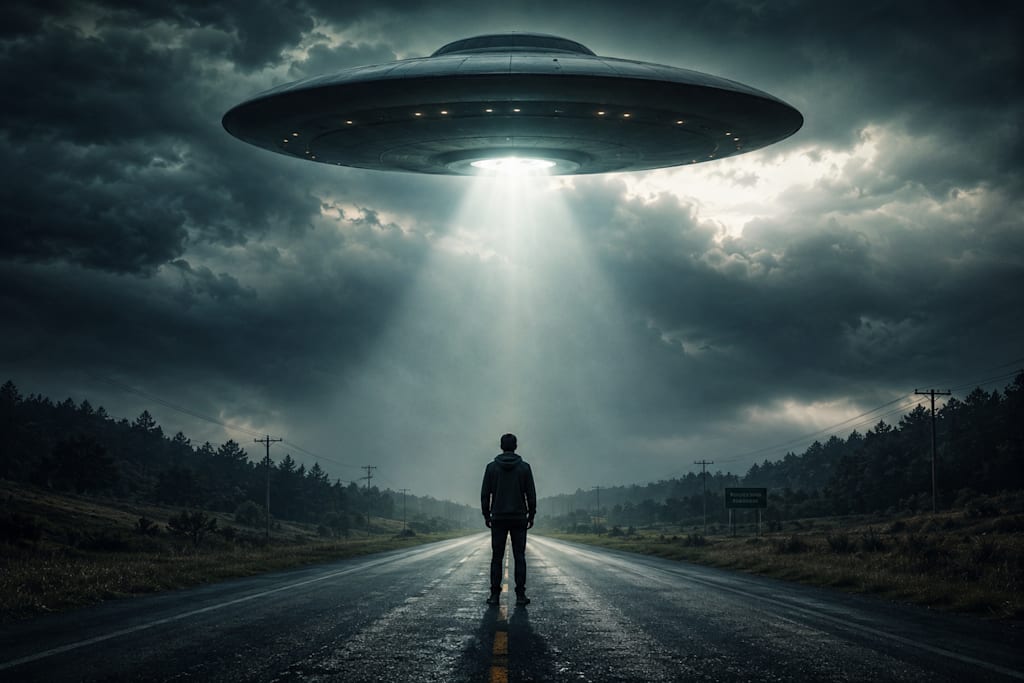
For decades, the subject of aliens and UFOs has fascinated humanity more than almost any other mystery. From old stories about strange lights in the sky to modern military footage released by governments, people around the world continue asking the same question: are we truly alone in the universe?
The idea of extraterrestrial life is no longer discussed only in science fiction movies. Today, scientists, governments, journalists, and ordinary people openly debate the possibility that intelligent life may exist beyond Earth. Some believe the evidence is slowly becoming impossible to ignore, while others argue that fear, imagination, and misinformation are creating confusion around unexplained events.
The truth behind aliens and UFOs may be far more complicated than people think.
The term UFO originally meant “Unidentified Flying Object.” In recent years, many officials started using the term UAP, which means “Unidentified Aerial Phenomena.” These names do not automatically mean alien spacecraft. They simply describe objects or movements in the sky that cannot immediately be explained.
Throughout history, humans have reported mysterious sightings. Ancient civilizations described strange objects in the heavens long before airplanes or satellites existed. Some people believe these stories prove that extraterrestrials have visited Earth for thousands of years. Others say ancient people simply misunderstood natural events such as comets, meteors, or unusual weather conditions.
The modern UFO era became famous after the 1947 Roswell incident in the United States. Reports claimed that an unknown object crashed near Roswell, New Mexico. The military initially announced that it had recovered a “flying disc” before quickly changing the explanation to a weather balloon. That sudden change created decades of suspicion. Many people still believe the government hid important information about alien technology or extraterrestrial bodies.
Since then, countless sightings have been reported worldwide. Pilots, soldiers, scientists, and civilians have all shared stories of strange objects moving at incredible speeds, disappearing suddenly, or performing maneuvers impossible for ordinary aircraft. Some reports were eventually explained as weather balloons, drones, experimental military technology, or optical illusions. Yet some cases remain unresolved even after investigation.
One major reason UFO discussions became serious again was the release of military videos by the United States Department of Defense. These videos showed unidentified objects moving in unusual ways while being tracked by Navy pilots. The footage quickly spread across social media and news outlets, reigniting public curiosity. However, unresolved does not automatically mean alien.
Experts often warn that humans naturally seek exciting explanations for mysteries. A strange light in the sky may look supernatural when viewed from far away or under stressful conditions. Psychological factors, camera distortions, radar errors, and classified military projects can all create confusion.
Still, many scientists argue that the universe is simply too large for Earth to be the only planet with life. Modern astronomy has discovered thousands of exoplanets orbiting distant stars. Some of these planets exist in what scientists call the “habitable zone,” where temperatures may allow liquid water to exist. Water is considered one of the key ingredients for life.
The universe contains billions of galaxies, and each galaxy contains billions of stars. Statistically, many researchers believe the chances of intelligent life existing somewhere else are extremely high. The real question may not be whether aliens exist, but whether they have ever reached Earth. This question creates both excitement and fear.
For some people, the idea of alien life represents hope and discovery. Humanity could learn advanced science, medicine, or technology from civilizations more advanced than our own. Contact with intelligent extraterrestrials could completely transform our understanding of religion, philosophy, and human history. Others fear the possibility deeply.
Movies and entertainment have shaped public imagination for decades. Alien invasion stories often portray extraterrestrials as dangerous beings who wish to conquer or destroy humanity. While these stories are fictional, they influence how people emotionally react to the topic. Fear of the unknown is natural.
Governments also approach the subject carefully because of national security concerns. Sometimes an unidentified object may actually belong to another country’s military technology. Admitting uncertainty about objects entering protected airspace can create public anxiety and political pressure.
Conspiracy theories add another layer of complexity. Some people believe world governments secretly communicate with extraterrestrials or hide crashed alien spacecraft in underground facilities. Others claim aliens are already living among humans. Despite the popularity of such theories online, there is still no publicly verified evidence proving these claims.
The internet has made the situation even more complicated. Videos, edited images, and artificial intelligence can easily create fake UFO sightings that look realistic. Social media spreads sensational stories rapidly, often before facts can be checked. As a result, many people struggle to separate genuine investigation from entertainment and misinformation.
Scientists generally prefer cautious approaches. Extraordinary claims require extraordinary evidence. Most researchers say that clear biological samples, undeniable spacecraft materials, or direct communication would be necessary before humanity could officially confirm extraterrestrial visitors.
At the same time, scientific curiosity remains strong. Organizations such as NASA continue searching for signs of life in space. Missions exploring Mars, Europa, and other celestial bodies aim to discover whether microbial life once existed or still exists beyond Earth. Radio telescopes also scan the universe for unusual signals that could indicate intelligent civilizations.
Interestingly, some experts believe the greatest challenge may not be finding aliens, but understanding them. If an advanced civilization exists millions of years ahead of humanity, their technology and communication methods might be impossible for us to fully comprehend. Humans from just a few centuries ago would struggle to understand smartphones, satellites, or the internet. In the same way, humans today may not fully understand an advanced extraterrestrial civilization.
There is also the possibility that intelligent life avoids contact intentionally. Some theories suggest advanced civilizations observe younger species quietly without interfering. Others believe the vast distances of space make direct interaction extremely difficult, even with advanced technology.
Religion and spirituality also influence how people view aliens. Some believers think extraterrestrial life would strengthen faith by showing the greatness of creation across the universe. Others fear it may challenge traditional interpretations of humanity’s special place in existence. Different cultures and religions may respond differently if extraterrestrial life were officially confirmed.
Despite decades of investigation, the truth remains uncertain. Humanity stands between skepticism and wonder. Some sightings have logical explanations, while others continue to puzzle experts. Scientific possibilities encourage open-mindedness, but the lack of definitive proof demands caution.
Perhaps the most important lesson from the UFO debate is that humans are deeply curious creatures. We constantly search for answers beyond our world because exploration is part of human nature. Whether aliens exist nearby, far away, or nowhere at all, the search itself reflects humanity’s desire to understand the unknown.
Maybe one day undeniable evidence will emerge and completely change civilization forever. Or perhaps many UFO mysteries will eventually receive ordinary explanations through science and technology. Until then, the subject of aliens and UFOs will continue living between reality, imagination, fear, and fascination.
The real question may not only be what is behind the scenes, but also why humanity is so determined to keep searching beyond the stars.
About the Creator
Keramatullah Wardak
I write practical, science-backed content on health, productivity, and self-improvement. Passionate about helping you eat smarter, think clearer, and live better—one article at a time.
Enjoyed the story? Support the Creator.
Subscribe for free to receive all their stories in your feed.
Comments
There are no comments for this story
Be the first to respond and start the conversation.