
Before Social Media There Was Spray Paint: 'Turk 182' A Pre-Internet Viral Hero
How Timothy Hutton, Bob Clark, and a Spray-Painted Revolution Tried to Turn New York Into a Modern-Day Robin Hood Story

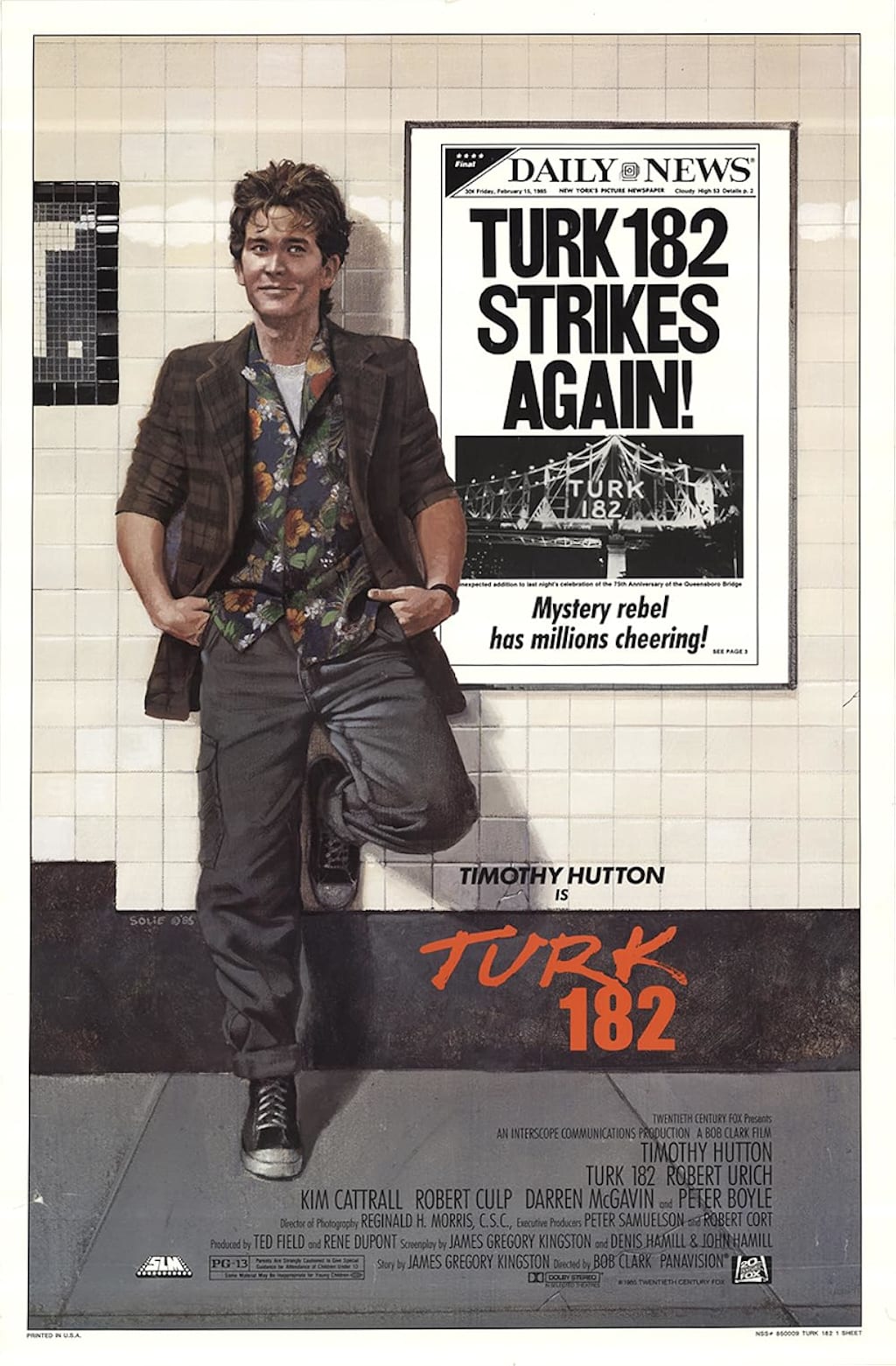
There are easier ways to make a movie about a kid taking on City Hall than sending your star 60 feet up the girders of the Queensboro Bridge.
But Turk 182! was never particularly interested in doing things the easy way.
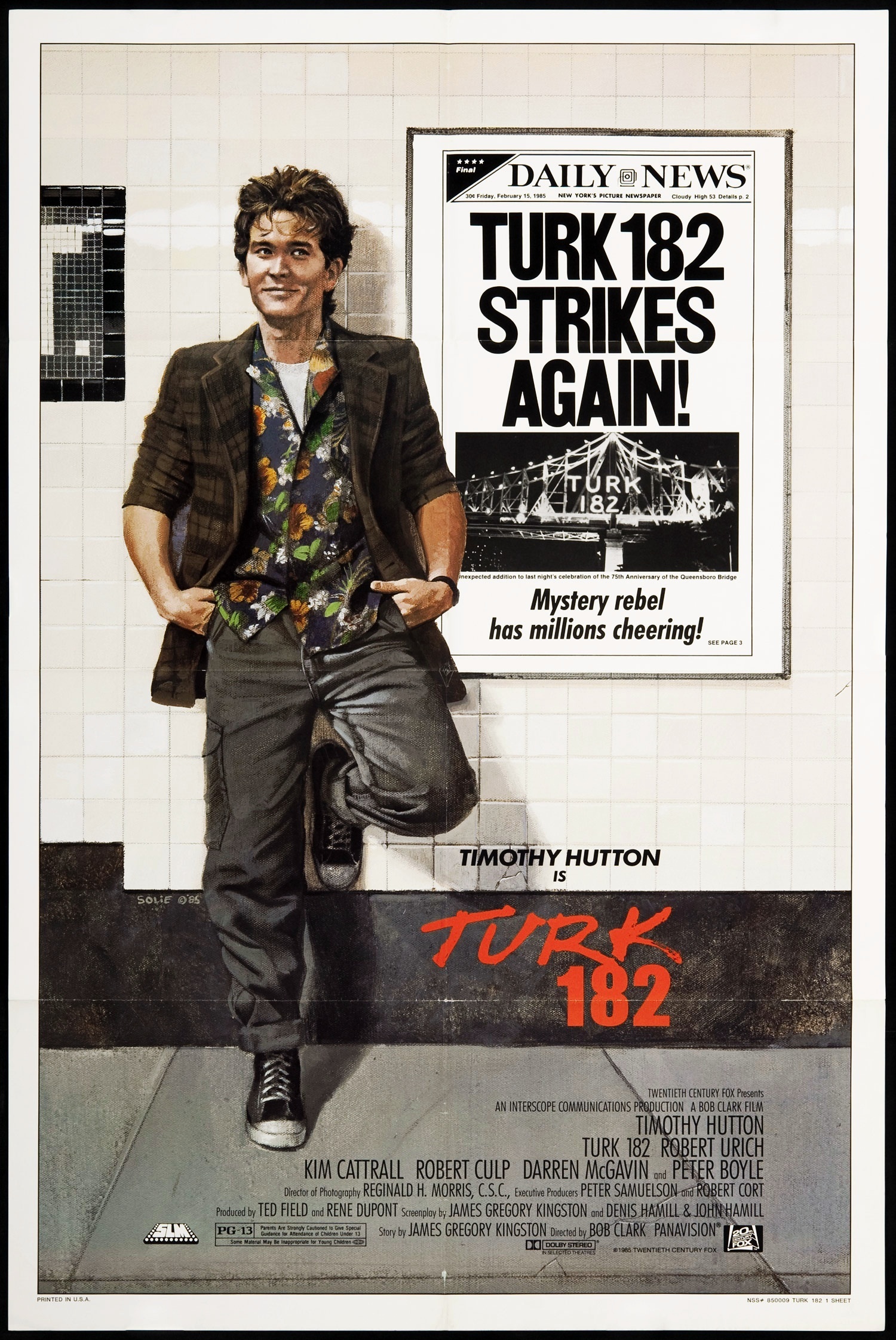
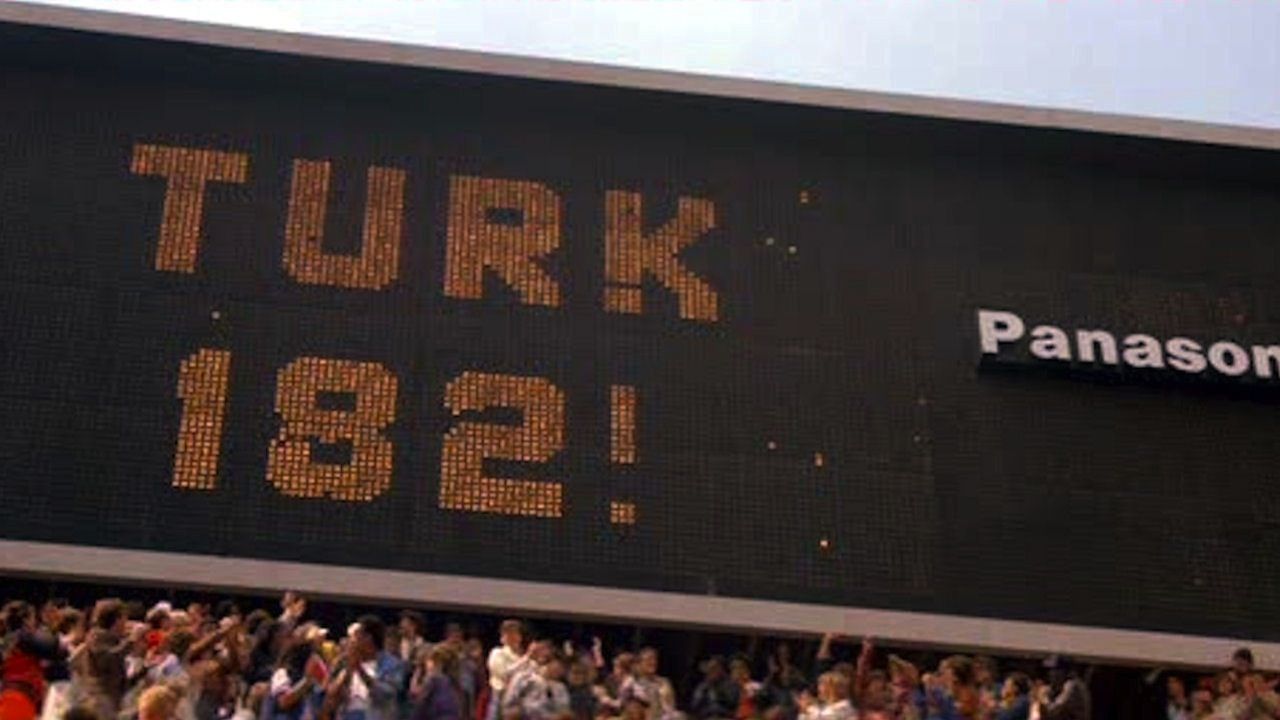
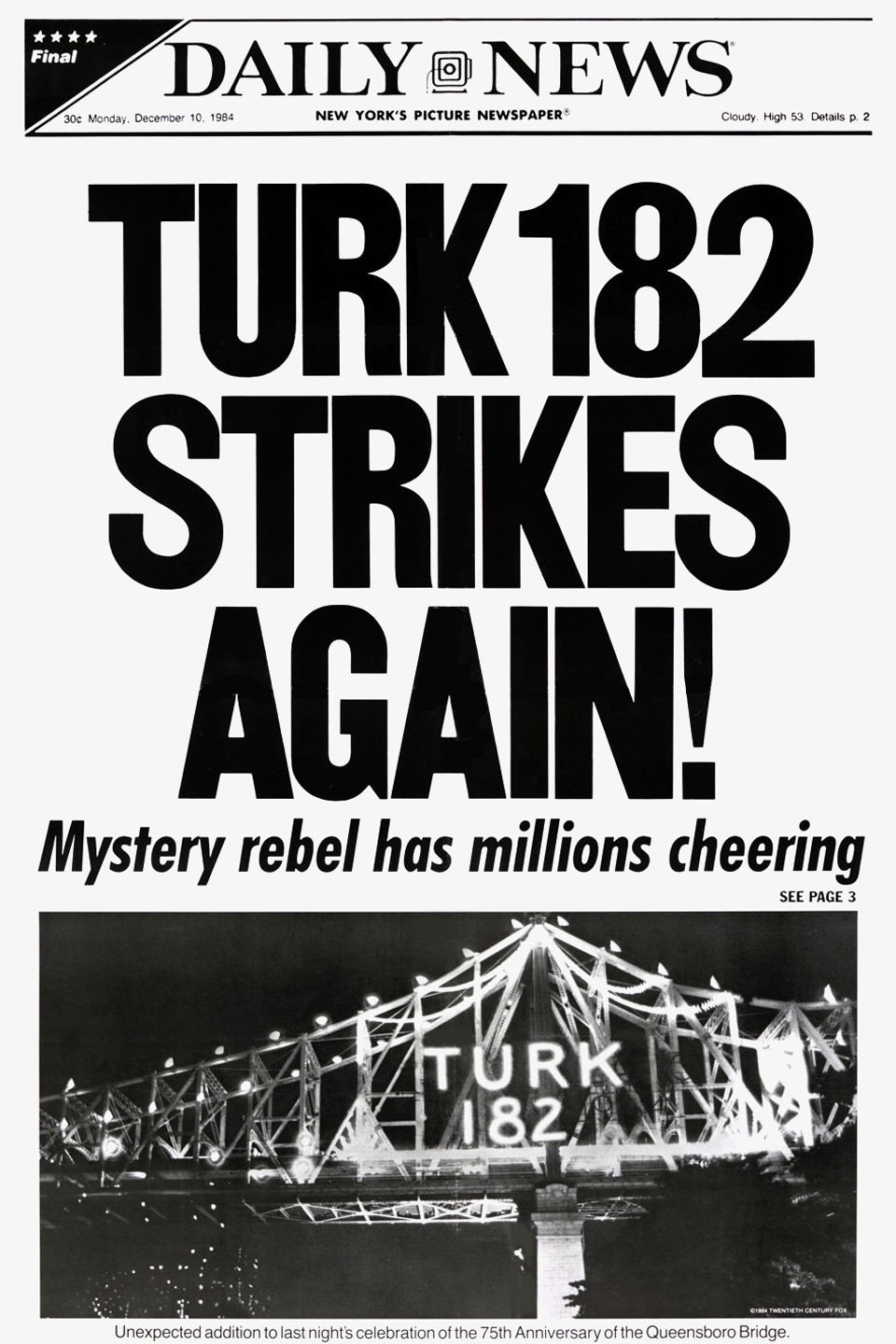
In 1984, Timothy Hutton climbed onto the bridge for a sequence that captured the film’s entire personality. Below him, a brass band played as a rally for the fictional mayor unfolded on Roosevelt Island. Above, Hutton was busy rearranging light bulbs on the bridge’s giant illuminated sign.
The original message read:
QUEENSBORO 1909–1984
The new message would read:
TURK 182!
Somewhere between the municipal infrastructure, the movie cameras, and the brass band, Bob Clark’s film found its visual thesis.
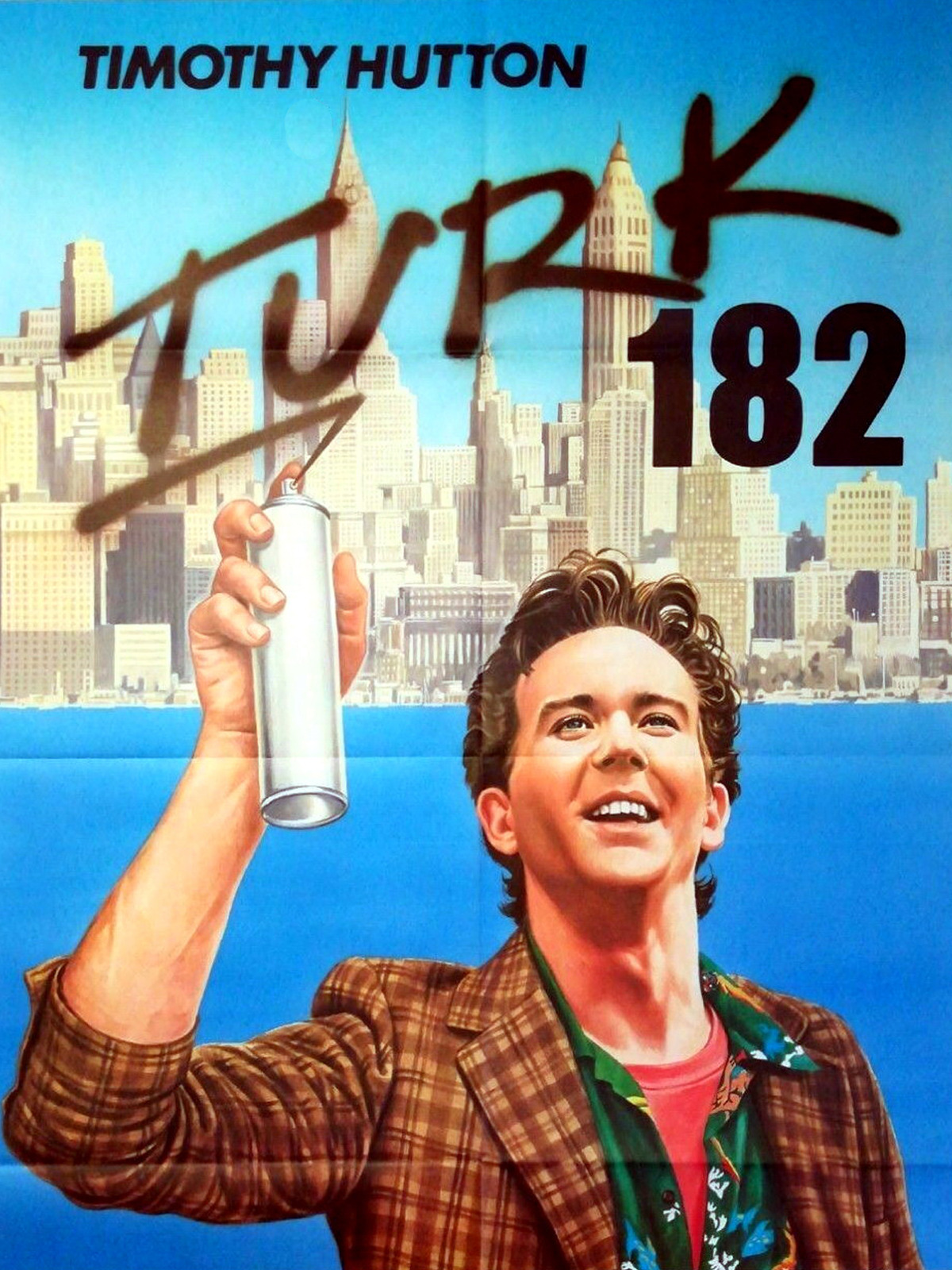
One young man. One can of spray paint. One very large middle finger to City Hall.
Released by 20th Century Fox on February 15, 1985, Turk 182! was a $15 million underdog fantasy about a kid who decides that if the system won’t listen to him, he’ll make himself impossible to ignore.
It was part Frank Capra, part comic-book adventure, part New York graffiti myth.
It was also a commercial disappointment.
But behind the movie’s familiar little-guy-versus-the-system premise was a surprisingly ambitious production, a screenplay that had been kicking around Hollywood for years, and a director who wanted to make something much bigger than a conventional teen rebellion picture.
Turk 182! may not have conquered the box office. But it remains a fascinating time capsule of a moment when Hollywood still believed a kid with a spray can could briefly make an entire city look up.
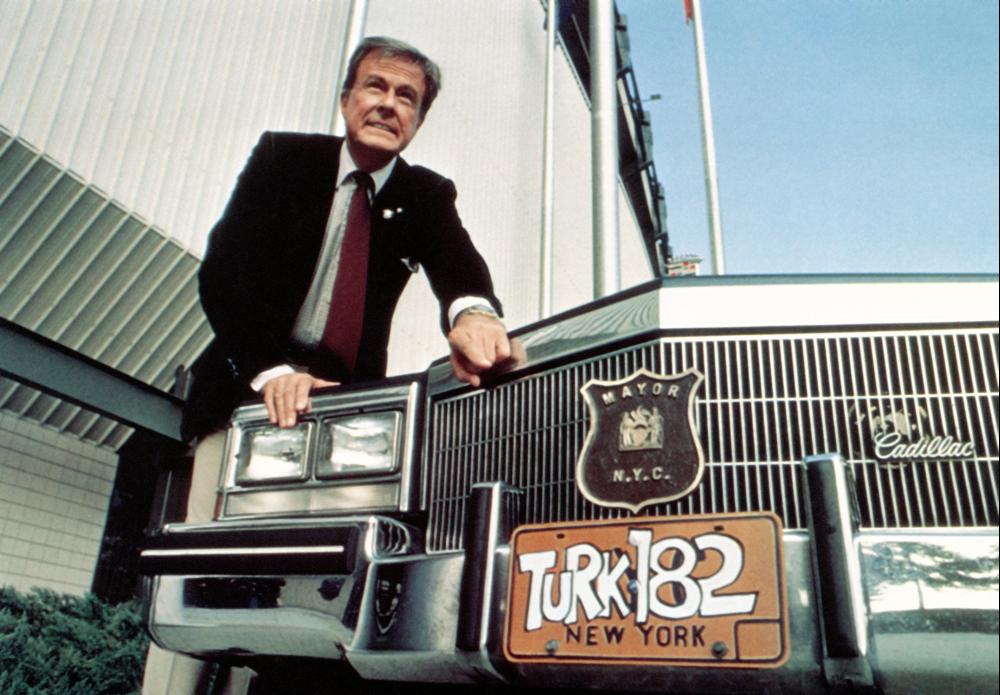
From the Bronx to City Hall
The idea for Turk 182! came from James Gregory Kingston, a Bronx hospital administrator who had spent years observing the city around him.
Kingston had witnessed the graffiti culture that was becoming part of New York’s visual identity. Among the real-life taggers he encountered was TAKI 183, whose name became associated with the city’s early graffiti movement.
For Kingston, graffiti wasn’t simply vandalism. It was a form of communication.
He believed that standing up for yourself—and sometimes being willing to be a little devious—could make people hear you.
That idea became the foundation for Turk 182!.
The story centers on Terry Lynch, a young New Yorker whose older brother, firefighter Jimmy Lynch, is injured while rescuing people from a burning building. When Jimmy is denied the benefits he believes he’s entitled to, Terry decides that the city needs to be held accountable.
His solution?
Become a graffiti artist with a message.
The tag “Turk 182!” begins appearing around New York, attached to increasingly elaborate acts of public embarrassment aimed at the mayor and his administration.
It’s a simple premise with a certain 1980s appeal: The government is corrupt, the little guy is being ignored, and the only way to get justice is to become a public nuisance.
Or, as I like to think of it, Robin Hood with a spray can.
A Long Road to the Screen
The screenplay was first optioned by Interscope in 1980, with Ted Field and Peter Samuelson involved in its development.
At one point, Dyan Cannon was interested in directing and starring in the film. The project would go through multiple rewrites, including work by John and Denis Hamill, before Bob Clark contributed to the final draft.
The story was eventually picked up by 20th Century Fox.
And suddenly, a movie about a kid spray-painting New York had a budget of approximately $14–15 million.
Which is a lot of money to spend on a kid spray-painting New York.
But that was part of the appeal. This wasn’t intended to be a small, gritty street picture. Clark wanted scale. He wanted movement. He wanted the city itself to become part of the story.
And he had the leading man to sell it.
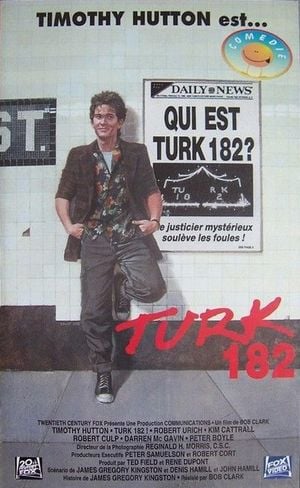
Timothy Hutton: The Oscar Winner as a Graffiti Robin Hood
When Turk 182! went into production, Timothy Hutton was only 23 years old.
He was also an Academy Award winner, having won the Oscar for Best Supporting Actor for Ordinary People in 1981.
A few years later, he was climbing the Queensboro Bridge to rearrange light bulbs.
Hollywood careers are funny things.
Hutton reportedly saw Turk 182! as a broader, comic-book-style story rather than a grim social drama. He described the character as a kind of modern-day Robin Hood.
That comparison makes sense. Terry isn’t trying to overthrow the government. He’s trying to embarrass a mayor into doing the right thing.
It’s a fantasy of individual power, where cleverness and determination can overcome the machinery of bureaucracy.
Hutton also enjoyed the physicality of the production. The film’s action sequences gave him the opportunity to do something closer to a James Bond movie than a conventional coming-of-age drama.
And then there was the accent.
Hutton wanted Terry’s New York speech to sound natural rather than like a cartoonish imitation of a New York kid. He described the dialogue as having a rhythm, a musical quality that was part of the character’s identity.
That matters because Turk 182! lives or dies on its sense of place.
This is not just any city. It’s New York in the mid-1980s, when graffiti, urban decay, civic corruption, and the mythology of the scrappy outsider were all part of the cultural landscape.
The film wanted to capture that energy.
Sometimes it does.
Sometimes it feels like a movie studio’s idea of what New York energy should look like.
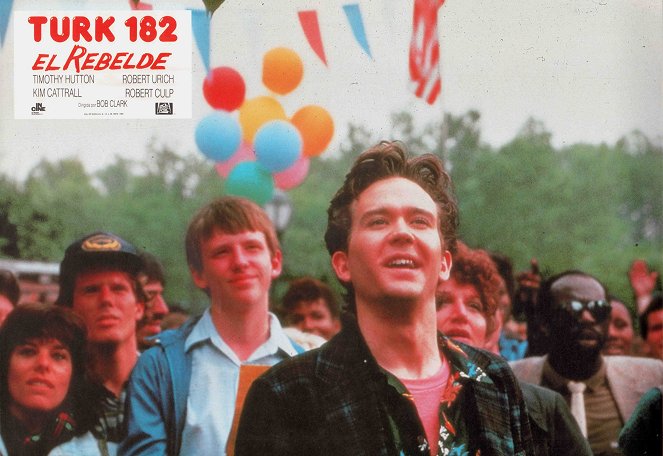
Bob Clark Wanted Something Bigger
Bob Clark is one of those directors whose filmography makes you wonder if he ever got bored.
He made Black Christmas. He made Porky’s. He made A Christmas Story. He made Rhinestone.
And then he made Turk 182!.
The man could move between genres with the confidence of someone who had never met a tonal shift he couldn’t at least attempt.
For Clark, Turk 182! was about scale.
He wanted what he described as a kind of Wagnerian largeness. The movie’s emotional and visual ambitions were meant to be bigger than life.
He drew on the swashbuckling energy of Douglas Fairbanks and the idealistic, one-man-against-the-system qualities of Frank Capra’s Mr. Deeds Goes to Town and Mr. Smith Goes to Washington.
But Clark also insisted that he was an “intense realist.”
That sounds like a contradiction until you understand what he meant.
The film’s ultimate triumph—one man shaping his destiny against impossible odds—was, in Clark’s view, an impossible fantasy.
The fantasy wasn’t that the system could be easily fixed.
The fantasy was that one person could still make a difference.
That’s a very 1980s idea. It’s also a very American one.
And Turk 182! was determined to turn it into a spectacle.
Making the City Look Up
The film shot in New York during 1984, with production taking place at Kaufman Astoria Studios and on major city locations.
The Queensboro Bridge sequence was one of the production’s most ambitious set pieces.
Hutton’s stunt work high above the city wasn’t just a matter of getting a good shot. It was a practical demonstration of the movie’s willingness to put its star in physically demanding situations.
Below, the mayoral rally played out with the kind of civic pageantry that makes a New York movie feel like a New York movie.
Above, Terry Lynch was literally rewriting the city’s landmark.
It was a wonderful image.
The machinery of power celebrates itself below while a kid in the girders changes the message overhead.
That’s Turk 182! in one shot.
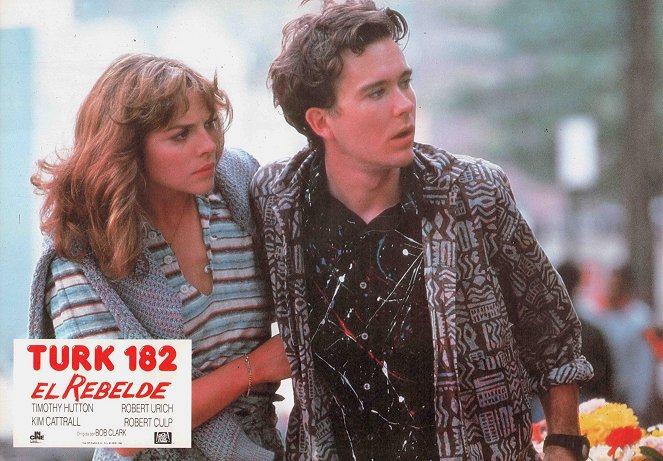
The film’s supporting cast included Robert Urich as Jimmy Lynch and Robert Culp as the mayor. Kim Cattrall played Terry’s friend and ally, Diane.
Cattrall, who had already appeared in Porky’s and Police Academy, reportedly appreciated that her character was written as something more substantial than a decorative girlfriend.
She also had a personal connection to former New York Mayor John Lindsay, whom she unsuccessfully tried to cast as the film’s mayor.
Imagine that.
A movie about a fictional New York mayor being humiliated by a graffiti artist, with the real former mayor of New York potentially playing the guy getting humiliated.
Hollywood is a strange place.
The Release: A $15 Million Underdog
Turk 182! opened nationwide on February 15, 1985.
It was one of the earlier films to carry the new PG-13 rating, which had been introduced by the MPAA in 1984.
The rating made sense. This was a movie aimed at a younger audience, but it also wanted to be an action picture with some adult themes involving corruption, injury, and the abuse of power.
The problem was that the film’s ambitions were bigger than its audience.
With a budget of approximately $15 million, Turk 182! needed to find a substantial audience.
Instead, it earned roughly $3.6 million domestically.
That is not a small disappointment.
That’s the kind of box-office result that makes a studio executive stare at a wall for a while.
The movie had a recognizable star, a popular director, a big New York setting, and a premise that seemed tailor-made for the Reagan-era appetite for individualism.
But audiences didn’t exactly storm the theaters to join Terry Lynch’s revolution.
And the critics were not particularly kind.
The Critics Were Not Feeling the Revolution
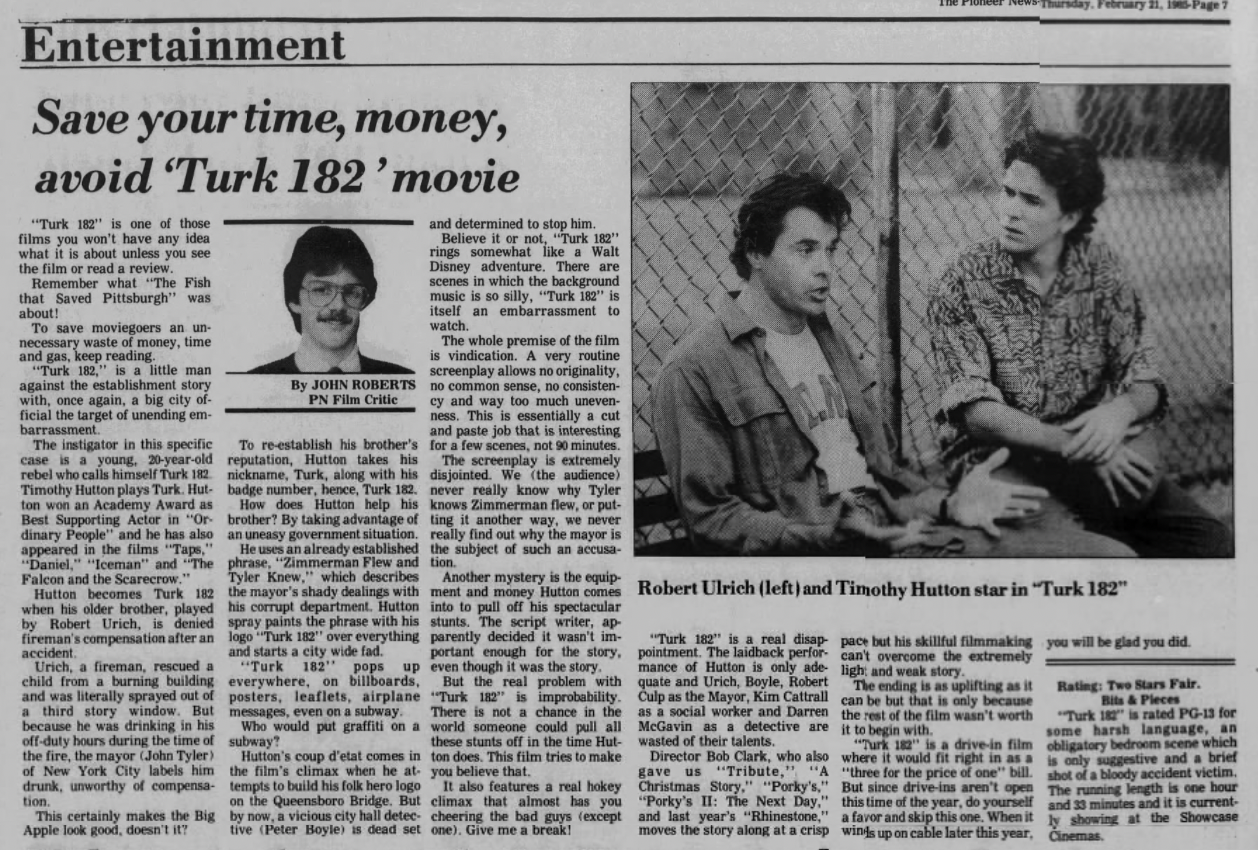
The critical response to Turk 182! was largely negative.
Gene Siskel gave the film zero stars and called it “laughably bad.”
Roger Ebert gave it one star out of four, arguing that the movie had a high-concept idea without a real story to support it.
The Los Angeles Times described the film as garbled and sitcom-like.
These are not the kinds of reviews that make a movie’s marketing department excited.
The film’s problems were fairly easy to identify.
The story’s logic is often stretched beyond the breaking point. The tone jumps between broad comedy, action adventure, social commentary, and sentimental family drama.
And while the film wants us to believe that Terry’s campaign is a dangerous act of rebellion, it also wants us to enjoy the spectacle of it all.
The result is a movie that sometimes feels like it can’t decide whether it’s a political satire or a comic-book fantasy.
That said, there were some positive notes.
Janet Maslin found Hutton watchable, and Variety praised the performances and the brotherly bond at the center of the story.
The movie also received Razzie nominations for Robert Urich and its score.
Which feels a little harsh.
Not because the score is necessarily great, but because Turk 182! is clearly trying to be something. It isn’t a lazy movie. It’s an ambitious one that doesn’t always know how to control its ambitions.
There’s a difference.
The Problem With Being a Hero
The central idea of Turk 182! is that one person can force the system to respond.
It’s an appealing idea.
It’s also a dangerous one, at least from a storytelling perspective.
Because once the movie establishes that Terry can get away with increasingly elaborate acts of public disruption, the stakes become difficult to maintain.
If he’s just a kid with a spray can, how is he pulling off all of this?
If he’s a criminal mastermind, why does the movie keep presenting him as an ordinary kid?
If he’s a Robin Hood figure, where is the line between righteous protest and self-indulgent vandalism?
The film doesn’t always have answers.
But I don’t think that means the premise is bad.
It means the movie is more interested in the fantasy of resistance than the practical mechanics of it.
And that’s where the Capra influence becomes important.
In Mr. Smith Goes to Washington, the hero is an idealist who believes the system can still be made to work.
In Turk 182!, the hero is an idealist who has decided that the system needs to be embarrassed into working.
It’s a subtle difference.
And it tells you a lot about the decade.
A Movie About New York, Made in New York
One of the most interesting things about Turk 182! is how much it depends on its setting.
The movie isn’t just using New York as a backdrop. It’s using the city’s architecture, media, politics, and public spaces as part of its storytelling.
The graffiti tag becomes a kind of urban communication system.
Terry’s message spreads because the city itself becomes the canvas.
This is pre-internet activism. There are no hashtags, no viral videos, no social media campaigns.
There is only paint, public space, and the willingness to make yourself impossible to ignore.
That gives Turk 182! a particular kind of charm today.
The movie’s fantasy is rooted in a world where a person could still disrupt the public conversation with a few well-placed acts of defiance.
Of course, the film also exaggerates that power.
In reality, most graffiti artists do not get to rewrite a city’s illuminated landmarks while a brass band plays beneath them.
But that’s the point.
Turk 182! isn’t a documentary about graffiti.
It’s a movie about the dream of being heard.
The Legacy of Turk 182!
The film’s commercial failure didn’t exactly make it a major part of the 1980s movie conversation.
But it has developed a modest following among fans of underdog stories, New York movies, and films that wear their hearts on their sleeves.
And I can understand why.
There’s something appealing about the sheer sincerity of Turk 182!.
It isn’t cynical.
It isn’t trying to be cool in the modern sense.
It genuinely believes that a kid can make a difference.
Even when the plot becomes ridiculous, the movie’s emotional investment in Terry’s cause is real.
Timothy Hutton gives the role an energetic, restless quality. Robert Urich brings warmth to the injured firefighter at the center of the story. The New York locations give the film an atmosphere that couldn’t be replicated on a soundstage.
And then there’s the tag itself.
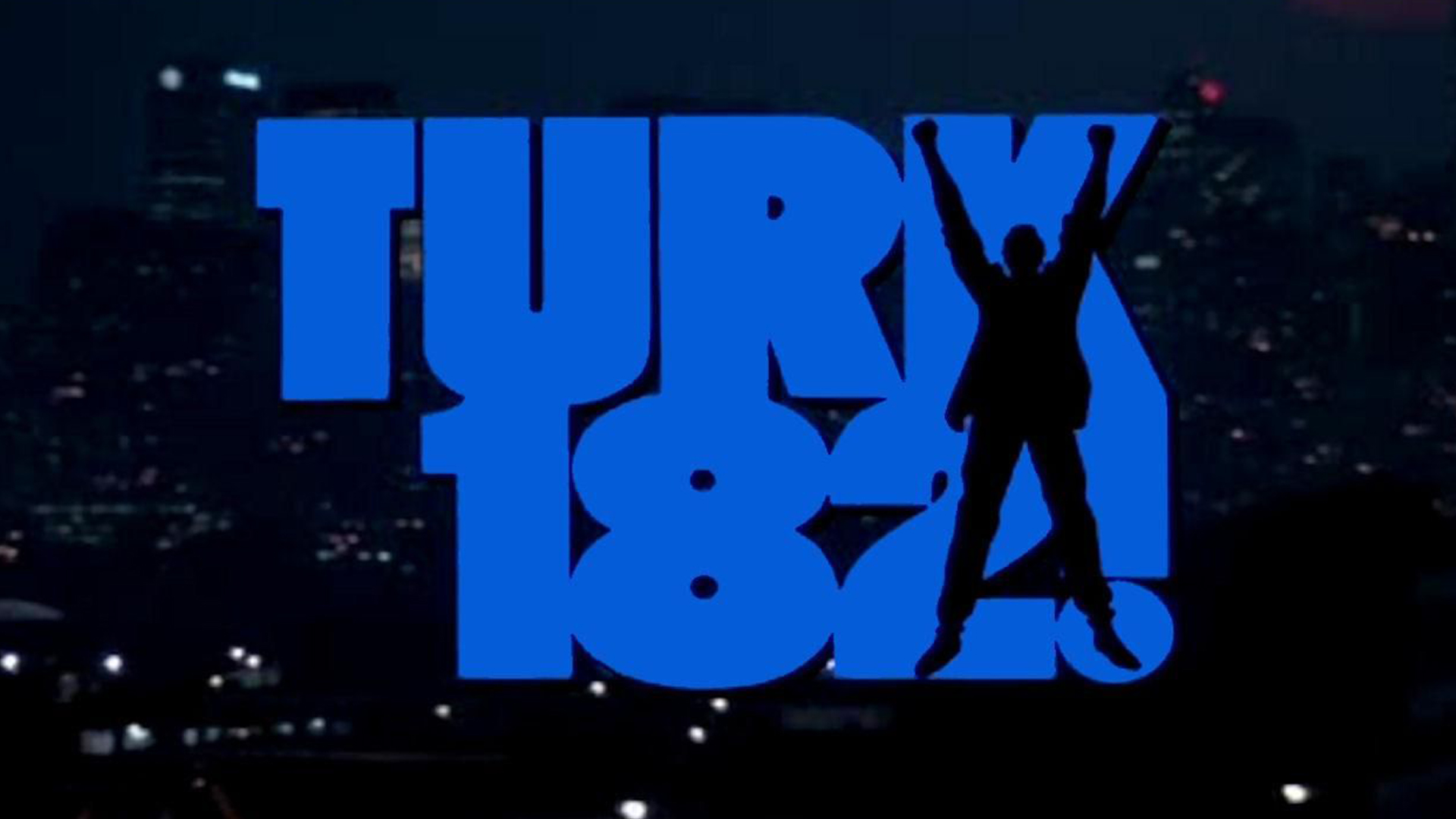
TURK 182!
It sounds like something that should have become a cultural phenomenon.
A mysterious name. A number. A citywide message.
The kind of thing that might have inspired copycats, T-shirts, or a generation of graffiti artists.
Instead, it became the title of a movie that most people forgot.
But the tag still works.
It still carries the idea of anonymous resistance. Of someone deciding that if nobody is listening, then perhaps the walls should speak.
The Movie Bob Clark Couldn’t Quite Make
I think Turk 182! is most interesting when viewed as a movie caught between two different impulses.
On one side, you have the Capra fantasy.
The individual can still stand up to the system. The little guy can still embarrass the powerful. The city can still be moved by one person’s determination.
On the other side, you have Bob Clark’s “intense realist” approach.
The world is complicated. The system is powerful. The ultimate triumph is an impossible fantasy.
The movie never quite resolves that tension.
It wants to be both a realistic New York story and a comic-book adventure.
It wants to be a political satire and a family drama.
It wants to be a big Hollywood spectacle and a personal story about two brothers.
And sometimes those things work against each other.
But that’s also what makes the film worth revisiting.
There are plenty of movies that are technically better made than Turk 182!.
There are movies with tighter scripts, more coherent tones, and fewer plot holes.
But Turk 182! has something that many of those movies lack.
It has a very specific kind of ambition.
The ambition to make a movie where a graffiti tag becomes a citywide cause.
Where a kid can embarrass a mayor.
Where a brass band can play beneath a bridge while a young man rewrites the city’s history in lights.
That’s a pretty wonderful idea.
Even if the movie doesn’t always know what to do with it.
Final Thoughts: Look Up
I keep coming back to that Queensboro Bridge sequence.
Timothy Hutton, 60 feet up in the girders, rearranging light bulbs while the city celebrates below.
It’s such a perfect image for Turk 182!.
The movie wants to believe that the individual can still make a difference. That the little guy can still get the last word. That a kid with a spray can can briefly make the whole city look up.
And for a few minutes, the movie makes that fantasy feel real.
Turk 182! may not have conquered the box office. It may not have impressed the critics. It may be a little too broad, a little too sentimental, and a little too willing to ask us to ignore the logic of its own story.
But it remains a vivid snapshot of a moment when Hollywood still believed in the power of the underdog.
A movie where the hero is a graffiti artist.
A movie where the city is the canvas.
A movie where the message is simple:
If nobody will listen, make them look up.
About the Creator
Movies of the 80s
We love the 1980s. Everything on this page is all about movies of the 1980s. Starting in 1980 and working our way the decade, we are preserving the stories and movies of the greatest decade, the 80s. https://www.youtube.com/@Moviesofthe80s
Enjoyed the story? Support the Creator.
Subscribe for free to receive all their stories in your feed.
Comments
There are no comments for this story
Be the first to respond and start the conversation.