
Batwara 1947 Review: Sunny Deol’s Lahore 1947 Retitled Drama Is Powerful but Divisive
Subtitle: Sunny Deol delivers a commanding performance in Rajkumar Santoshi’s emotional Partition drama, but its old-school filmmaking and unusual message may divide modern audiences.

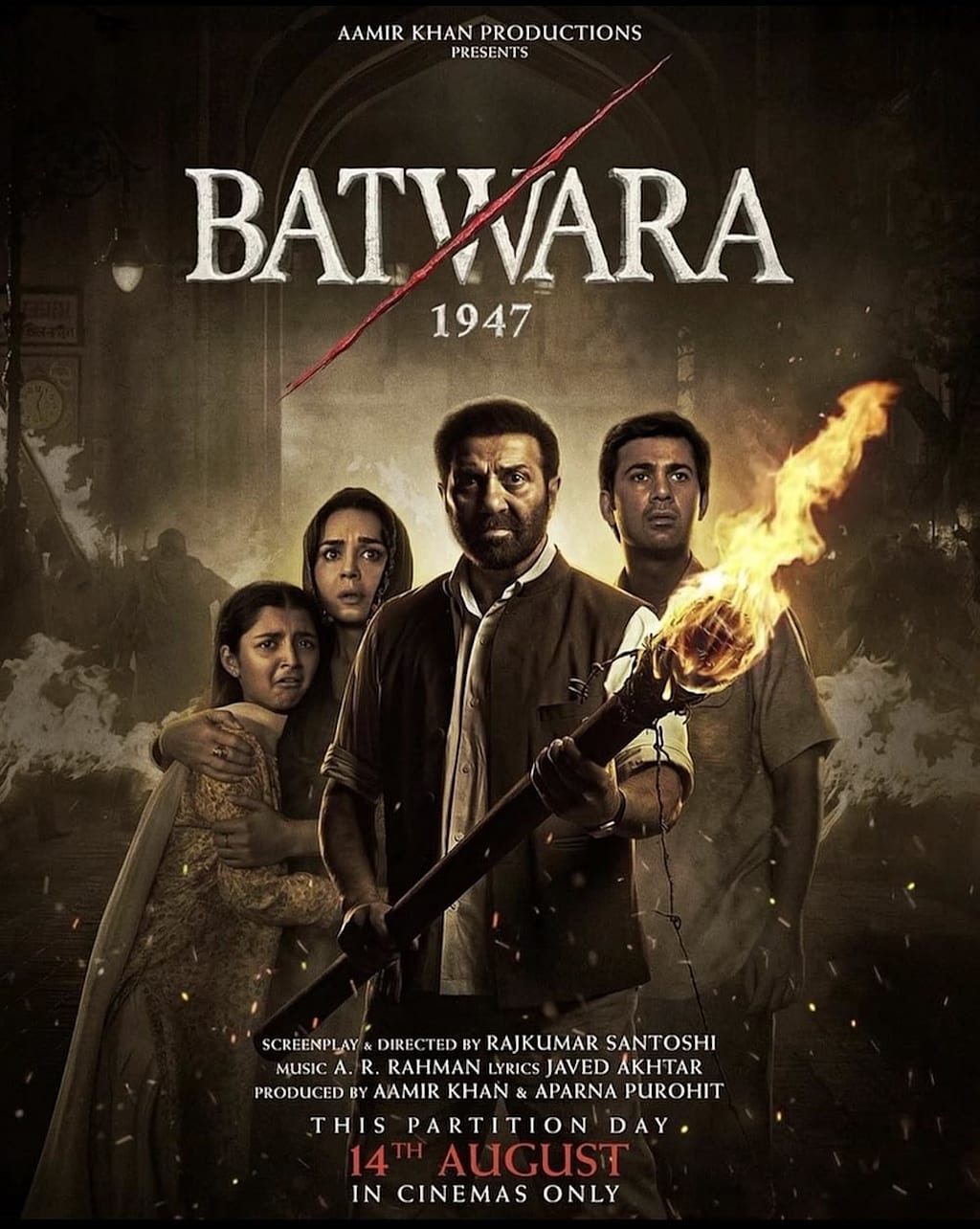
Remember when this film was called Lahore 1947? That title somehow felt perfect. Then came the change to Batwara 1947, and now that the film has finally arrived in theatres, one thing is clear: the new title is strangely appropriate because the movie itself is likely to divide audiences.
The Sunny Deol-starrer was originally announced as Lahore 1947 before being retitled Batwara 1947. Directed by Rajkumar Santoshi and backed by Aamir Khan Productions, the film released on August 14, 2026.
But the biggest question after watching it is simple: Was 2026 the right time for a film like Batwara 1947?
Your answer to that question may decide whether you love the movie or walk away disappointed.
Batwara 1947 Is Not Gadar 3 — And That Is the Biggest Surprise
Anyone watching the trailer could easily expect another explosive Sunny Deol Partition drama in the style of Gadar. The setting is familiar, Sunny Deol is back in a larger-than-life role, and India-Pakistan history once again forms the backdrop.
But Batwara 1947 takes a very different route.
This is less about defeating an enemy nation and more about fighting hatred itself.
Set around the Partition era, the film explores families being uprooted, homes changing hands and religious identity gradually becoming more important than human relationships. At the centre of it all is a question the movie repeatedly asks: Can a country be divided without dividing humanity?
The film includes disturbing violence and emotionally difficult moments, particularly involving crimes against women. Sunny Deol's character eventually becomes an important force in the fight for justice, but his battle is not as straightforward as the typical hero-versus-villain setup.
Sunny Deol Takes a Huge Risk With His Image
This is where Batwara 1947 becomes genuinely interesting.
Sunny Deol could easily have repeated the formula audiences already associate with him — angry speeches, nationalism, massive action sequences and a clearly defined enemy.
Instead, his character questions hatred from multiple directions.
That choice is risky because a section of his fanbase may enter the theatre expecting another Tara Singh-style performance. What they get is a much more emotional and restrained Sunny Deol.
There are still powerful dialogues.
There are still moments when his screen presence seems too large for the frame.
And yes, there are action scenes where the old-school Rajkumar Santoshi-Sunny Deol combination suddenly comes alive.
But those moments are surrounded by long stretches of emotional drama.
You have to feel this film more than cheer for it.
Sunny Deol and Shabana Azmi Are the Heart of the Film
Some of the strongest portions of Batwara 1947 come from the scenes involving Sunny Deol and Shabana Azmi.
Their characters may appear different on the surface, but their battles are surprisingly similar. Both are prepared to stand against crowds, religious prejudice and social pressure when humanity is at stake.
Their scenes deliberately slow the movie down.
For viewers raised on fast cuts, constant action and instant payoffs, that pacing may become frustrating. But audiences comfortable with older Hindi dramas may find these portions emotionally rewarding.
Shabana Azmi especially brings enormous weight to the story. Early reactions to the film have also highlighted her performance alongside Sunny Deol.
And for anyone who believes Sunny Deol can only perform by shouting, Batwara 1947 gives him several quieter moments that challenge that stereotype.
Preity Zinta Makes an Emotional Comeback
Seeing Preity Zinta back in a major theatrical Hindi film is another highlight.
Instead of simply using her comeback for nostalgia, the movie gives her emotional material that fits the world of the story.
She still possesses the warmth and natural screen presence audiences remember, and seeing her opposite Sunny Deol again adds another layer of nostalgia without completely taking attention away from the story.
Ali Fazal, meanwhile, has comparatively limited screen time but manages to leave an impact whenever he appears.
The cast also includes Karan Deol and Abhimanyu Singh.
Where Batwara 1947 Falls Behind
The biggest problem is the villains.
Rajkumar Santoshi has created memorable antagonists in the past, and that automatically raises expectations. Here, the negative characters rarely feel powerful enough to stand opposite Sunny Deol.
At times it feels like they are performing villainy rather than naturally becoming threatening characters.
When your hero has Sunny Deol's screen presence, the villain needs equal weight. Batwara 1947 never completely achieves that balance.
The visual treatment may also divide viewers.
Certain scenes deliberately carry a 1990s Hindi cinema flavour. Camera angles, dramatic staging and even some emotional transitions can occasionally resemble television serial storytelling.
That appears to be an intentional retro approach, but intention does not automatically make it work for everyone.
For some viewers it will feel nostalgic.
For others it will simply feel dated.
The Music Chooses Meaning Over Noise
The songs are another example of the film's old-school personality.
Don't expect every track to become an instant chartbuster. The emphasis is more on lyrics, emotion and placement within the story.
A.R. Rahman composed the music, with lyrics by Javed Akhtar.
Not every song works equally well, but the soundtrack generally suits the film's emotional tone.
The background score becomes far more aggressive whenever Sunny Deol gets one of his big dialogue or action moments, giving the theatre exactly the kind of energy his fans expect.
Why Batwara 1947 May Struggle With Modern Audiences
The film arrived in a very different cinematic environment from the one in which classic Sunny Deol-Rajkumar Santoshi movies became iconic.
Audiences today are accustomed to faster storytelling, darker action and technically polished spectacle.
Batwara 1947 deliberately refuses to fully follow those trends.
That makes it brave — but also commercially risky.
Its opening also came amid tough competition from Awarapan 2, which generated stronger initial box-office momentum.
More importantly, Batwara 1947 is not really trying to become another Gadar. Its message is more complicated than that.
The movie argues that borders may divide countries, but hatred should not be allowed to divide human beings.
Some viewers will appreciate that message.
Others may reject the politics or presentation completely.
And perhaps that is exactly why Batwara is such an appropriate title.
Final Verdict
Batwara 1947 is not the Sunny Deol movie many fans will expect — and that is simultaneously its greatest strength and biggest weakness.
Sunny Deol's commanding screen presence, Shabana Azmi's emotional performance, Preity Zinta's comeback and Rajkumar Santoshi's old-school filmmaking create a distinctive atmosphere.
But slow pacing, weaker villains and a deliberately retro visual style prevent it from becoming a universally appealing blockbuster.
Still, there is sincerity behind what the filmmakers are trying to say.
It is a movie less interested in asking you to celebrate victory over somebody else and more interested in asking whether humanity can survive when politics, religion and borders take control.
For that ambition alone, it deserves attention.
Rating: 3/5 ⭐⭐⭐
About the Creator
parwinder singh
🎬 Movie & Entertainment Writer sharing reviews, ending explanations, story breakdowns, plot twists and hidden details from Bollywood, Hollywood, South Indian cinema, Korean dramas and OTT releases.
Enjoyed the story? Support the Creator.
Subscribe for free to receive all their stories in your feed.
Comments
There are no comments for this story
Be the first to respond and start the conversation.