
Backrooms: Its Disturbing Ending Explained
Backrooms presents a complexity that fascinates horror lovers

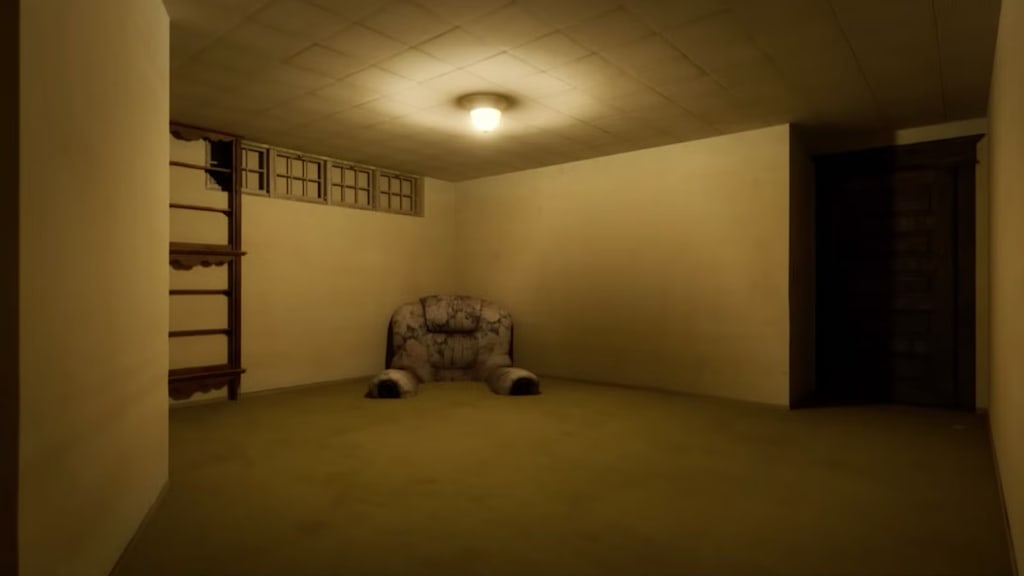
Backrooms is a liminal horror film directed by Kane Parsons. This story is leading the worldwide box office at the moment, largely thanks to its disturbing ending. Horror lovers are looking for an explanation to this incredible descent, full of complexities difficult to connect with each other.
Clark is a man who aspires to be an architect, but has ended up running a furniture store while battling his alcohol addiction. He also finds himself dealing with the aftermath of a divorce, attending sessions with his therapist, Mary.
As a result of their breakup, he has been sleeping on the floor of his establishment. Soon, Clark begins to notice that the lights in the store flicker when night falls. Once, while investigating in the basement, he sees a faint ray of light that seems to come out of the wall. That flash turns out to be a portal to another dimension, which manifests itself through distorted rooms that seem to extend endlessly.
Clark finds himself in a very peculiar situation: those endless rooms resemble empty workspaces. There are piles of furniture, tiny doors and strangely random objects that have no reason to be there.
The underground labyrinth begins to increasingly reflect a twisted version of Clark's mind. Its numerous doors lead him further and further inside, and Mary, who returns to look for her patient after a while without seeing him, also gets trapped in the Backrooms.
When Clark gets lost after mentioning the discovery of the portal in the basement, Mary, his psychologist, decides to investigate for herself.
That inquiry is not trivial. Mary carries her own burden with her: a mother with mental problems who kept her isolated with her during her childhood, until she was taken away. Driven by these memories, she enters the infinite corridors and finds Clark living there, surrounded by the inhabitants of that place: copies that space recreates from real people. The version that this alternate world created of Clark represents his darker side come true: a huge, deformed and aggressive creature.
The worst part
This narrative of liminal horror is approaching its bloodiest moment in the denouement. That being had already ended the lives of Clark's workers, Kat and Bobby, who were exploring the corridors with him when they were surprised. Clark tries to dialogue with the beast, but it mortally wounds him in the neck and throws itself after Mary. She manages to escape from the monster, but only to fall into the hands of the agents of the Async corporation, the company that investigates the phenomenon. While an agent of theirs interrogates her, the image changes to another part of the place: an imitation of Mary's childhood home and an altered version of her.
It is precisely in this edition where horror becomes something existential. These recreations of familiar scenarios and a double of Mary trapped in the place hint that the corridors function as a mirror of the people and objects of the real world. It is not clear if space is intrinsically evil, but the message the film offers is clear: it can become the personal hell of those who carry unhealed wounds. The film leaves as an enigma whether that final figure is a monstrous version of Mary or simply her lost and lonely mirror, like the other residents. History leaves this question unanswered intentionally to free the imagination of viewers.
The uncertainty even extends to the fate of the protagonist herself. At first glance, it seems that Mary manages to survive, but she is never seen to return through a portal to reality, and the Async facility itself where she is asked questions could be inside the corridors. That doubt opens the possibility for his return. If she really returned to the real world carrying such an experience with her, it is difficult to consider that neither she nor the entities that control the phenomenon leave the matter unresolved.
An unexpected conclusion
Backrooms shows a contradiction in its subject matter. All this examination of the outcome is contrary to the very essence of the project: the corridors seem to lengthen infinitely, and a clear ending would almost be a snub to that idea. The filmmaker maintains that the enigma is key in his proposal, while the film's production company has made it clear that it values the creator more than rushing with sequels.
If a new part of Backrooms is made, it will probably happen unhurriedly, providing some additional answers and, above all, many new unknowns.
About the Creator
Ninfa Galeano
Journalist. Content Creator. LGBT+ perspective 🏳️🌈
Enjoyed the story? Support the Creator.
Subscribe for free to receive all their stories in your feed.
Comments
There are no comments for this story
Be the first to respond and start the conversation.