
Apple: The Garage Dream That Changed the World
From two young visionaries in a California garage to one of the most powerful technology companies in history.
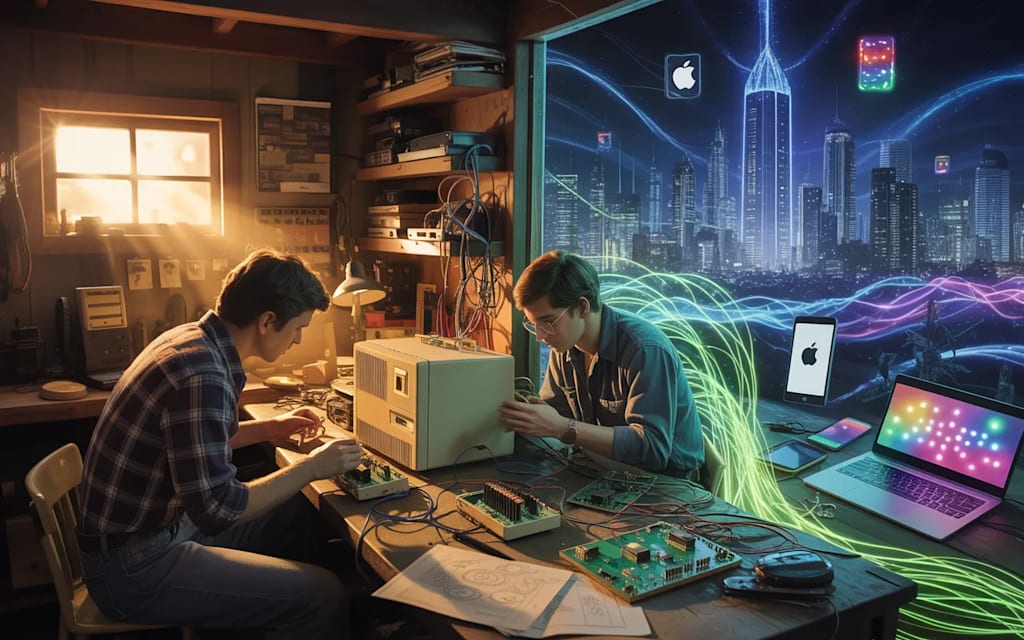
In the spring of 1976, in a quiet garage in Los Altos, two young men sat surrounded by wires, circuit boards, and impossible dreams. One was Steve Jobs, intense and visionary, with eyes that seemed to stare into the future itself. The other was Steve Wozniak, shy but brilliant, a wizard of electronics who could make machines sing with logic and code. Together, they would create something that would change the world forever: Apple Inc..
At the time, computers were not elegant devices sitting on polished desks. They were giant machines hidden inside universities and government buildings, understood only by experts. Ordinary people never imagined owning one. Technology felt distant, cold, and complicated.
But Steve Jobs imagined something different.
He believed computers could become personal companions—beautiful, simple, and powerful enough for everyone. While others saw machines for scientists, Jobs saw tools for artists, students, musicians, and dreamers. It was a radical idea in the 1970s.
The first product the young founders built was the Apple I, a simple computer board assembled mostly by hand. Ronald Wayne briefly joined them as a third founder, helping draft agreements and early plans. To fund the company, Jobs sold his Volkswagen van, while Wozniak sold his treasured calculator. They had little money, but they possessed enormous ambition.
The Apple I sold modestly, but it proved something important: people were interested in personal computing.
Then came the breakthrough.
In 1977, Apple introduced the Apple II, one of the first highly successful mass-produced personal computers. Unlike other machines of the era, it came in a sleek plastic case and displayed color graphics. Families, schools, and small businesses began buying it in large numbers. Suddenly, Apple was no longer a tiny garage startup—it was becoming a serious company.
The success brought wealth and fame almost overnight.
By 1980, Apple went public on the stock market. Employees who had once worked for modest salaries became millionaires. The company’s headquarters buzzed with energy, creativity, and competition. Young engineers worked late into the night, convinced they were shaping the future.
But success also created pressure.
Steve Jobs demanded perfection from everyone around him. He could inspire people to achieve the impossible, but he was also known for his fiery temper and relentless criticism. Employees both admired and feared him. Inside Apple, tension grew between innovation and stability.
Jobs became obsessed with a new project: creating a computer that anyone could use intuitively, without needing technical knowledge. Around this time, Apple engineers visited Xerox and saw experimental graphical interfaces controlled by a small pointing device called a mouse. Jobs immediately recognized the idea’s potential.
This inspiration led to the creation of the Macintosh.
In 1984, Apple unveiled the Macintosh with one of the most famous advertisements in history. Directed by Ridley Scott and aired during the Super Bowl, the commercial portrayed Apple as a revolutionary force challenging conformity and control.
When the Macintosh appeared on stage, it felt magical. It spoke, displayed graphics, and introduced millions to the graphical user interface. Though expensive and limited in power compared to later computers, it represented a giant leap toward modern computing.
Yet Apple’s rise was not smooth.
Sales struggled after the initial excitement. Internal conflicts intensified between Jobs and Apple’s leadership, especially CEO John Sculley, whom Jobs himself had recruited from PepsiCo. The board of directors worried that Jobs’ unpredictable behavior threatened the company’s stability.
In 1985, the unimaginable happened.
Steve Jobs was pushed out of Apple.
The company he had helped create no longer wanted him in charge.
For Jobs, it was devastating. He later described it as being fired from his own life’s purpose. Apple continued without him, producing computers and maintaining profits, but something essential seemed missing. The company gradually lost its identity. Competitors like Microsoft expanded rapidly, especially with the widespread success of Windows-powered PCs.
Meanwhile, Jobs founded a new company called NeXT and purchased a small animation studio that would later become Pixar. Though NeXT struggled commercially, Pixar transformed animation forever with films like Toy Story.
Back at Apple, the 1990s became increasingly difficult. The company released too many confusing products and failed to compete effectively with cheaper Windows computers. Profits declined. Market share shrank. Some experts believed Apple was nearing collapse.
Then came the turning point.
In 1997, Apple acquired NeXT, bringing Steve Jobs back to the company he had founded. At first he returned only as an advisor, but soon he became the company’s leader again.
Apple was close to bankruptcy when Jobs returned. Many products were canceled. Resources were limited. Morale was low.
Jobs acted decisively.
He simplified Apple’s product line, cutting dozens of projects. He formed an unexpected partnership with Microsoft, securing critical financial support. Most importantly, he reignited Apple’s culture of innovation and design excellence.
Soon, Apple introduced a colorful new computer called the iMac.
Unlike dull beige PCs, the iMac looked playful and futuristic, with transparent plastic shells in bright colors. Consumers loved it. Apple was profitable again.
But Jobs was aiming far beyond computers.
He believed technology should blend seamlessly with everyday life. In 2001, Apple launched the iPod, a sleek music player capable of carrying “1,000 songs in your pocket.” Combined with the iTunes Store, it transformed the music industry.
People everywhere suddenly carried Apple products in their pockets.
The company’s momentum accelerated.
Then, in 2007, Apple introduced the device that would redefine the modern world: the iPhone.
At the time, phones had physical keyboards and clunky software. Many experts doubted Apple could compete in the mobile market. But when Steve Jobs stepped onto the stage and revealed a touchscreen device that combined a phone, music player, and internet communicator, history changed instantly.
The iPhone was more than a product. It was a new way of living.
People could browse the web, watch videos, use apps, and communicate effortlessly from anywhere. Entire industries transformed around it. Companies rose and fell because of the smartphone revolution Apple helped ignite.
The App Store soon followed, creating opportunities for millions of developers worldwide. Small startups could suddenly reach global audiences through mobile applications. Apple became one of the most powerful companies on Earth.
Yet even during its triumph, tragedy approached.
Steve Jobs had been battling serious illness for years. Despite his declining health, he continued guiding Apple’s vision. In 2011, he resigned as CEO, handing leadership to Tim Cook.
Later that same year, Steve Jobs died.
The world mourned not only a businessman, but a visionary who had reshaped technology, communication, music, design, and culture itself.
Many wondered whether Apple could survive without him.
Under Tim Cook’s leadership, Apple continued growing enormously. The company expanded into new products and services, including the Apple Watch, AirPods, streaming services, and advanced custom chips powering Macs and iPhones. Apple eventually became one of the most valuable companies in history.
But the true story of Apple is not merely about wealth or devices.
It is about belief.
It began with a dream in a garage—a belief that technology could be human, beautiful, and accessible. Apple’s rise was built on creativity, risk-taking, failure, reinvention, and relentless ambition.
The company stumbled many times. It nearly disappeared. Its founder was exiled and later returned. Rivals challenged it constantly. Yet Apple kept evolving because it never stopped imagining what technology could become.
Today, millions of people around the world wake up to alarms on iPhones, work on MacBooks, listen to music through AirPods, and communicate through ecosystems Apple helped create. What started as a small experiment between two young dreamers became a global force that reshaped modern life.
And it all began in a garage, with two friends who believed the future could fit into the hands of ordinary people.
About the Creator
Enjoyed the story? Support the Creator.
Subscribe for free to receive all their stories in your feed.
Comments
There are no comments for this story
Be the first to respond and start the conversation.