
'Access Code' (1984): When 1984’s Techno-Paranoia Met a Shoestring Budget
A forgotten 1984 sci-fi thriller tried to tap into the fears of WarGames, 1984, and The Conversation. Unfortunately, the technology wasn’t the only thing that seemed to be malfunctioning.

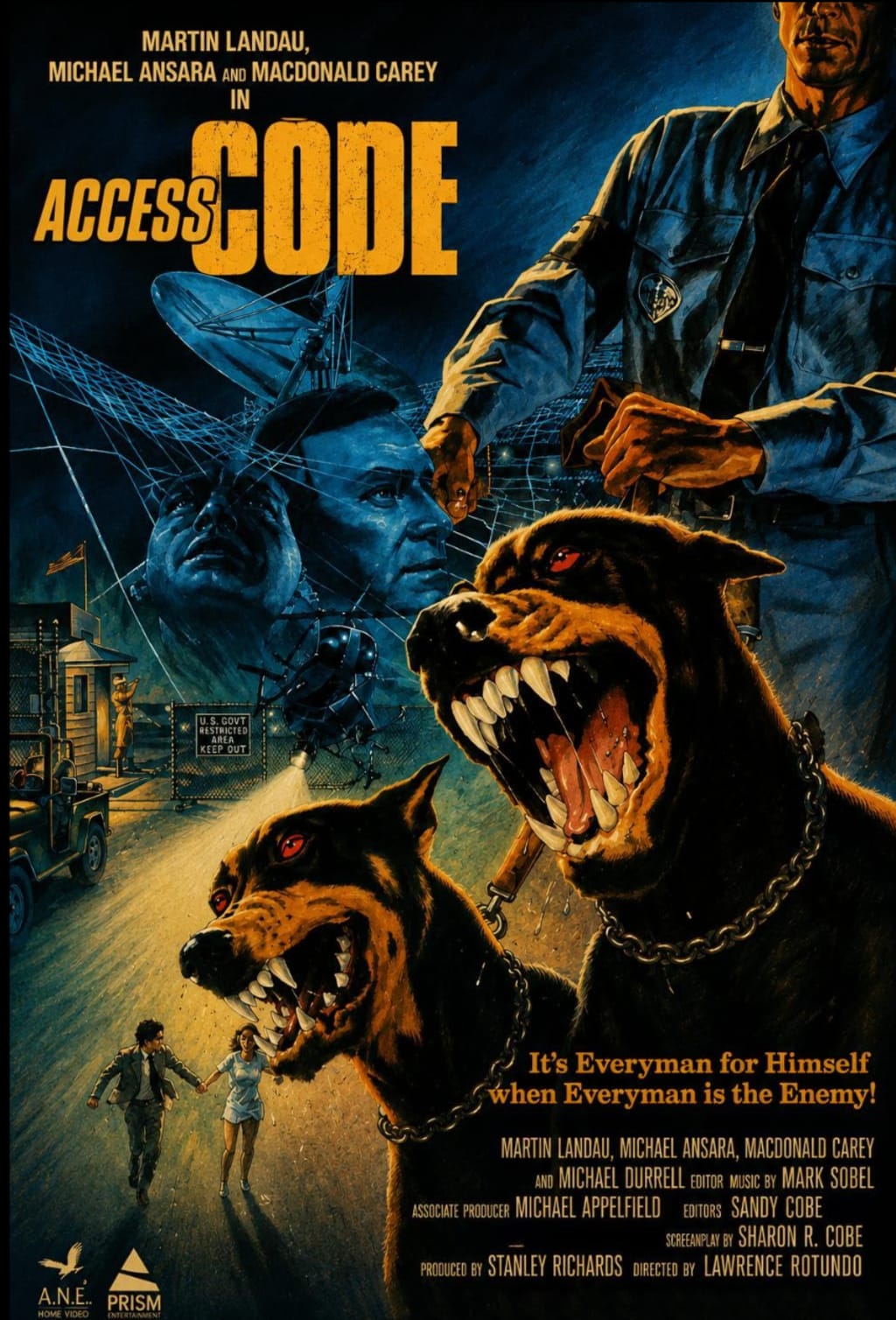
A Conspiracy Built on a Budget
There was something almost inevitable about a movie like Access Code arriving in the early 1980s.
The decade had barely begun, and Hollywood was already fascinated by the frightening possibilities of computers, satellite technology, nuclear weapons, and the increasingly blurry line between privacy and government surveillance. WarGames had turned computer hacking into a Cold War nightmare, while 1984 remained the ultimate shorthand for a future in which government could watch everything. Movies like The Parallax View and The Conversation had already demonstrated how paranoia could become compelling cinematic entertainment.
In 1984, director Mark Sobel decided to throw all of those ingredients into the same movie.
The result was Access Code, alternatively released in some international markets as Data Terror, a low-budget independent science-fiction thriller that wanted to be a grand conspiracy movie but often looked like it was being held together with whatever equipment happened to be available that day.
Sobel’s feature debut is a fascinating example of the kind of movie that could exist in the early home-video era. It had big ideas, recognizable actors, an appropriately paranoid premise, and just enough technical ambition to suggest a much larger production hiding somewhere underneath the surface.
Unfortunately, that larger production never quite arrived.

Welcome to the Surveillance State
The story begins with a nightmare scenario.
A mysterious organization has managed to seize control of the American nuclear launch system, threatening to plunge the world into nuclear war. The government responds by bringing former agent and computer programmer Michael Barnes (Michael Durrell) back into action.
Barnes soon finds himself caught up in a conspiracy involving a sophisticated satellite surveillance system capable of turning ordinary television sets into tools of mass observation.
Because apparently watching television wasn’t creepy enough in 1984.
Along the way, Barnes teams up with an investigative journalist played by Michael Napoli, while the political machinery surrounding the conspiracy includes Martin Landau as the head of the Agency, with Michael Ansara and Macdonald Carey appearing as senators caught in the middle.
On paper, this sounds pretty terrific.
Nuclear weapons. Computer technology. Government surveillance. Secret agencies. Journalists digging into conspiracies. Television being transformed into an instrument of control.
It’s practically a checklist of early-’80s paranoia.
The problem is that Access Code doesn’t always know what to do with all of it.
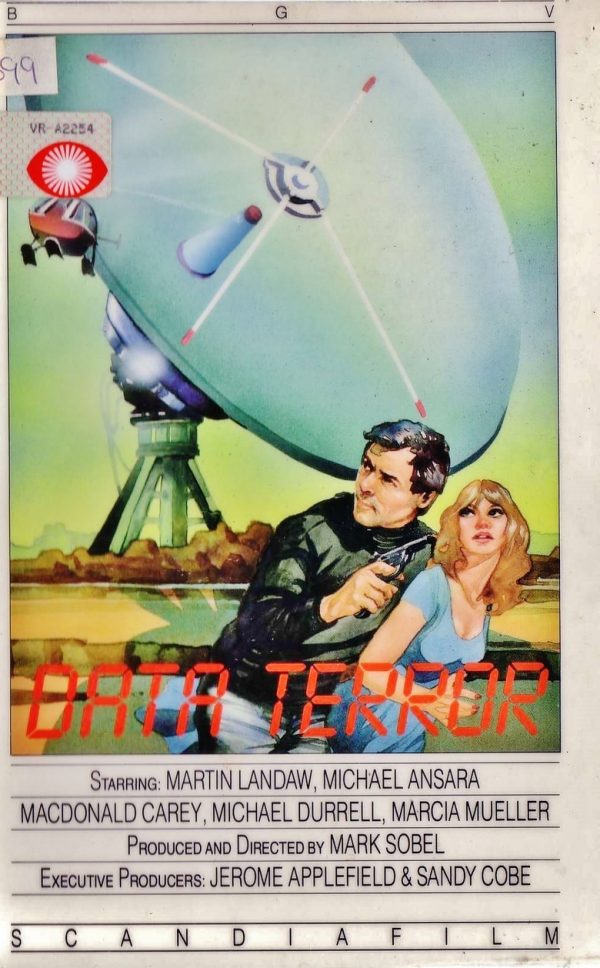
When WarGames Meets 1984
The most obvious comparison is WarGames, which had already demonstrated how terrifying computers could become when ordinary people gained access to systems they didn’t understand.
But Access Code isn’t really interested in the playful hacker adventure that made WarGames work. Its ambitions are considerably darker. It wants to explore the idea that technology has become so powerful that the people controlling it could potentially control society itself.
That’s where the influence of 1984 becomes apparent.
The movie is obsessed with surveillance and the erosion of privacy. It imagines a world in which television isn’t merely something we watch but something that can watch us back.
That’s an idea that feels remarkably prescient today.
Unfortunately, the movie’s execution isn’t nearly as sophisticated as its premise.
Much of Access Code consists of characters explaining what is happening to one another, discussing technology, trading information, and delivering increasingly dense bits of political exposition. The paranoia is there, but the tension often isn’t.
Instead of making us feel as though someone is watching us, the movie frequently makes us feel as though we’re watching people talk about being watched.
There’s a difference.
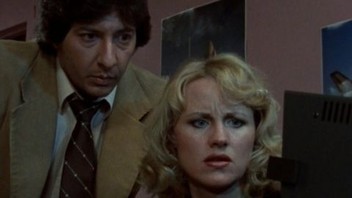
Making a Movie With Whatever Was Available
The production history of Access Code is almost as interesting as the movie itself.
Sobel served as director, producer, and editor, essentially functioning as a one-man production department. The film was produced under the Access Productions Inc. banner and shot at locations including Movietech Studios in Hollywood and the Valuzat Motion Picture Ranch.
It was independent filmmaking in its most stripped-down form.
There were pyrotechnics courtesy of Harry Woolman and early computer animation work by Brian Van Herzen. The production even attempted effects work that, while primitive, demonstrates just how much the filmmakers were trying to accomplish with limited resources.
One sequence reportedly destroys a telephone booth using little more than a simple negative-film reversal.
It’s the sort of effect that makes you appreciate what low-budget filmmakers were capable of improvising—and simultaneously reminds you exactly how low the budget was.
There were also reports that the production simply ran out of money before several important scenes could be filmed. That may help explain why the finished movie sometimes feels less like a completed feature than a collection of pieces that were assembled because there wasn’t enough money to shoot the missing ones.
The description “ragged patchwork” has been used in connection with the film, and it’s difficult to watch Access Code without understanding why.

Martin Landau Walks Into Another Movie
Perhaps the strangest thing about Access Code is seeing Martin Landau in the middle of it.
Landau had already spent decades establishing himself as one of Hollywood’s most respected character actors. His presence gives the movie an immediate sense of legitimacy, particularly when he’s surrounded by performers such as Michael Ansara and Macdonald Carey.
And yet Landau sometimes seems to have wandered in from a completely different production.
His performance is professional. The material around him often isn’t.
That’s not necessarily an insult to the filmmakers. Independent productions have always depended on experienced actors to help sell worlds that their budgets can’t quite afford to create.
In Access Code, however, the contrast is especially noticeable.
Landau brings the weight of a serious political thriller to a movie that occasionally looks like it was assembled in somebody’s garage.
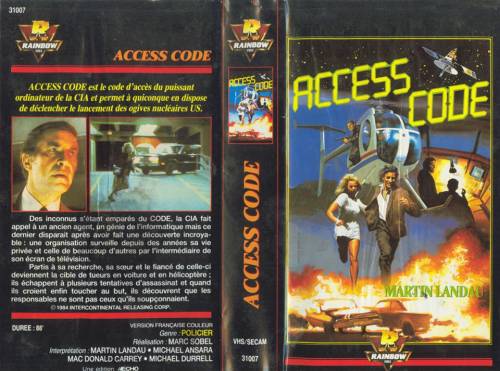
A Movie That Found Its Audience on VHS
Access Code never received the kind of theatrical release that might have given it a chance to compete with the major science-fiction and thriller films of its era.
Instead, it found its natural home in the rapidly expanding world of home video.
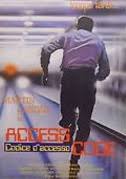
Prism Entertainment handled its U.S. distribution, and the film became one of those titles that could turn up on VHS shelves even though very few people had ever heard of it.
Internationally, it picked up different titles, including Access Code – Die totale Überwachung in Germany and Salainen tunnuskoodi in Finland.
That makes perfect sense.
This was precisely the sort of movie that could survive in the video store ecosystem. It didn’t need to compete with E.T., The Terminator, or WarGames at the multiplex. It simply needed a provocative title, a suitably ominous VHS cover, and a premise involving nuclear weapons and computers.
For a certain kind of video-store customer, that might have been enough.
Big Ideas, Small Movie
The frustrating thing about Access Code is that there really is a good movie buried inside it.
The filmmakers understood the anxieties of their time.
Nuclear war remained an ever-present fear. Computers were becoming increasingly important to everyday life while remaining mysterious to much of the public. Satellite technology seemed capable of accomplishing almost anything. And the idea of governments possessing unprecedented abilities to monitor ordinary citizens was no longer confined to science fiction.
Access Code understood all of that.
What it didn’t have was the money—or perhaps the script—to turn those ideas into a genuinely suspenseful thriller.
The dialogue tends to circle around the same information. The action sequences have a distinctly low-rent quality. The pacing can be lethargic. And the complicated conspiracy becomes increasingly difficult to follow.
Instead of building paranoia, the movie sometimes simply accumulates information.
That’s a shame because the central concept remains remarkably creepy.
The idea of a television becoming a surveillance device feels particularly interesting when viewed from the present day. In 1984, it was science fiction. Today, the relationship between screens, cameras, data collection, and privacy is considerably less hypothetical.

A Forgotten Piece of 1984
Today, Access Code is primarily remembered by collectors and fans of obscure 1980s genre cinema.
It never developed the cult reputation of WarGames, Videodrome, The Terminator, or even some of the decade’s more notorious direct-to-video oddities. It simply disappeared into the enormous VHS ecosystem that swallowed thousands of movies during the home-video boom.
That’s unfortunate, but it also makes the film worth rediscovering.
Access Code isn’t a lost masterpiece. It isn’t even particularly successful at doing what it sets out to accomplish.
But it is a fascinating time capsule.
This is a movie made at a moment when computers were becoming frightening, television was becoming increasingly powerful, and nuclear annihilation remained a terrifyingly plausible possibility. It captures those fears with all the subtlety of a filmmaker who has far more ambition than money.
And perhaps that’s what makes it interesting.
Access Code wanted to make the audience afraid of technology.
Instead, it accidentally made us aware of something else: just how difficult it was to make the future look convincing when you were working with the technology of the present.
For Mark Sobel, it was only the beginning. He would eventually move on to better-regarded projects, including Terminal Entry.
But his first feature remains an intriguing little relic of 1984—a movie that wanted to expose a terrifying conspiracy hiding inside America’s television screens.
It just couldn’t quite afford to show us what was hiding behind them.
About the Creator
Movies of the 80s
We love the 1980s. Everything on this page is all about movies of the 1980s. Starting in 1980 and working our way the decade, we are preserving the stories and movies of the greatest decade, the 80s. https://www.youtube.com/@Moviesofthe80s
Enjoyed the story? Support the Creator.
Subscribe for free to receive all their stories in your feed.
Comments
There are no comments for this story
Be the first to respond and start the conversation.