
Aakhri Sawal Ending Explained: Who Is Vicky Hegde and What Is the Truth Behind His Five Questions?
Sanjay Dutt’s political drama turns a student-professor clash into a national debate, but Vicky Hegde’s real identity changes the meaning of everything.

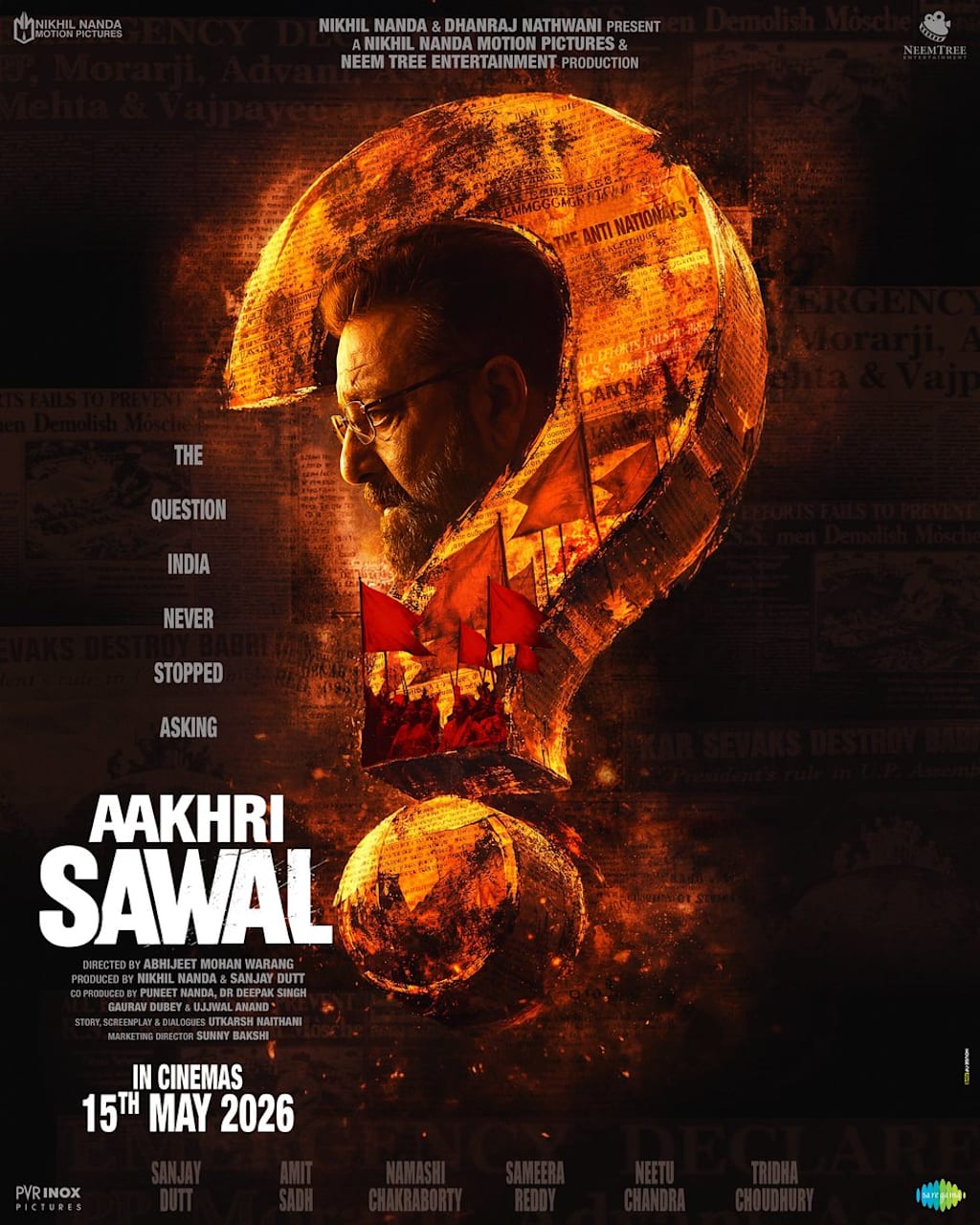
Spoiler Warning: This article contains major spoilers for Aakhri Sawal, including Vicky Hegde’s real identity and the final twist.
Aakhri Sawal is not structured like a conventional political drama. At its center is a conflict between a professor and his student, but as the story progresses, their academic disagreement grows into a national debate involving history, ideology, media and personal tragedy.
Professor Gopal Nadkarni and his student Vicky Hegde appear to stand on completely opposite sides. Gopal believes Vicky’s research about the RSS presents history from only one perspective, while Vicky is convinced that the questions raised in his thesis deserve answers.
What begins with a rejected thesis eventually leads to five controversial questions being discussed before the entire country.
But the biggest surprise of Aakhri Sawal is not hidden in any of those questions.
It is hidden in Vicky himself.
Why Does Gopal Nadkarni Reject Vicky Hegde’s Thesis?
The conflict begins when Vicky prepares a thesis criticizing the RSS and describing the organization as a threat to the country.
Vicky expects Professor Gopal Nadkarni to approve his research. Instead, Gopal refuses to sign it.
Gopal’s objection is not simply that Vicky disagrees with him. According to Gopal, research should examine different sides of history instead of beginning with a conclusion and then selecting information that supports it.
Vicky takes the rejection personally.
Their disagreement soon moves outside Gopal’s office, where other students begin watching and recording the confrontation.
When Vicky calls the RSS “anti-national,” Gopal loses his temper and slaps him.
That single moment changes everything.
A video of the slap spreads online, but viewers see only part of the confrontation. The context behind the argument quickly becomes secondary as social media, television channels and political voices begin choosing sides.
The film uses this moment to turn an academic dispute into a much larger ideological battle.
What Are Vicky Hegde’s Five Questions?
Vicky challenges Gopal to answer five questions.
He promises that if Gopal can successfully respond to them, he will withdraw his thesis. If Gopal cannot answer them, he wants his thesis approved.
The first questions are asked at the college, while the conflict eventually reaches a nationally televised debate.
Importantly, Aakhri Sawal presents these historical subjects through the arguments of its characters. The answers given by Professor Gopal should therefore be understood as part of the film’s political and dramatic viewpoint rather than as an independent historical fact-check.
Question 1: Why Was the RSS Banned in 1948?
Vicky’s first challenge concerns the period following Mahatma Gandhi’s assassination.
He connects Nathuram Godse with the RSS and asks Gopal whether the organization should therefore be held responsible for Gandhi’s death.
Gopal rejects that conclusion.
Within the film, he argues that Godse had previously been associated with the organization but was no longer part of it when Gandhi was assassinated. Gopal also points to the later lifting of the ban as part of his response.
This establishes the pattern that dominates the rest of the movie.
Vicky raises an accusation.
Gopal attempts to provide a different interpretation.
And the audience is placed between them.
Question 2: What Happened During the Emergency?
Vicky’s second question moves to the Emergency period beginning in 1975.
He questions the conduct of RSS members who were imprisoned during that time and suggests that attempts to negotiate their release showed weakness.
Gopal offers a different interpretation.
He describes such decisions as strategy rather than surrender, particularly because imprisonment also affected the families of those detained.
Once again, the movie is less interested in giving the audience a short answer than in creating a clash between two versions of the same history.
Before Vicky can continue with his remaining questions, the debate is interrupted.
But by then, the controversy has escaped the college.
How Does the Debate Become a National Event?
Television networks quickly realize that a live confrontation between Vicky and Gopal could attract enormous attention.
Journalist Aditya, a former student of Gopal, is asked to convince him to participate.
Gopal initially refuses.
He does not consider himself a television debater and has little interest in turning serious historical questions into entertainment.
Aditya, however, tells him that remaining silent may allow the public to assume that Vicky’s accusations are correct.
Gopal eventually agrees.
Meanwhile, Vicky is approached by people willing to provide political influence, funding and media support.
He refuses.
This scene becomes important later because it suggests that Vicky’s real objective is more complicated than simply becoming the public face of an anti-RSS campaign.
Question 3: What Does the Film Say About the Babri Masjid Demolition?
During the televised debate, Vicky’s third question concerns the 1992 Babri Masjid demolition.
He asks whether RSS involvement contradicts the organization’s claims about its values.
Gopal responds with the film’s interpretation of the Ram Janmabhoomi dispute, discussing religious belief, historical records and arguments surrounding the status of the disputed structure.
This is one of the movie’s most politically sensitive sequences.
Rather than treating Gopal’s statements as an objective conclusion, viewers should recognize that the sequence represents the position his character is defending inside the story.
The debate becomes increasingly intense, but Vicky still has two questions remaining.
Question 4: Where Was the RSS During the Tsunami?
The fourth question initially appears very different.
Vicky asks why an organization that claims to perform social service does not have more photographs, videos or public evidence showing its volunteers helping people during disasters such as the tsunami.
Gopal gives a simple response: according to him, genuine service does not require publicity.
Vicky demands proof.
Then a caller named Prashant joins the television program.
His revelation completely changes the emotional tone of the debate.
Prashant says that during the tsunami, Gopal lost his own son while helping other people.
He claims that he himself survived because Gopal helped save him.
For the first time, Vicky stops arguing.
The debate is no longer purely about historical documents or political ideology.
It has become deeply personal.
The film suggests that not every act of sacrifice is recorded by a camera and that personal memories can sometimes carry their own emotional weight.
Question 5: Who Killed Srinath?
The final question takes the story back to Palakkad, Kerala, in 2018.
Vicky asks about the brutal killing of a man named Srinath.
He claims that accusations had connected Srinath’s murder to the RSS and asks Gopal whether the organization was actually responsible.
Gopal refuses to answer directly.
Instead, he asks for a video to be played.
The footage shown inside the film depicts Srinath being attacked by a group of men. Gopal then uses details shown in the recording to argue for a different explanation of the killing.
But something about Vicky’s reaction immediately feels unusual.
He does not look surprised.
And that becomes the key to the entire ending.
Aakhri Sawal Ending Explained: Vicky Hegde’s Real Identity
After the five questions are completed, information reaches the television team revealing that Vicky Hegde is not who everyone believes he is.
The young man challenging Professor Gopal is actually connected directly to Srinath.
He is Srinath’s son.
This changes the meaning of the entire movie.
Vicky already knew far more about the fifth question than he had admitted.
That is why Gopal later realizes something was wrong.
The fifth question was never really asked because Vicky needed its answer.
He wanted the answer to be heard publicly.
Why Did Vicky Create the Entire Debate?
Vicky’s real plan was not simply to defeat Professor Gopal.
He wanted controversial questions surrounding the RSS to be discussed before a national audience.
Most importantly, he wanted the truth he believed he knew about his father’s death to come out somewhere it could no longer remain buried in private files or forgotten conversations.
To achieve that, he needed someone capable of answering him publicly.
That person was Professor Gopal Nadkarni.
So the apparent rivalry between teacher and student was much more complicated than it initially appeared.
Vicky challenged Gopal because he trusted that his professor would not run away from difficult questions.
In a strange way, his attack on Gopal was also evidence of his faith in him.
Why Did Vicky Choose Gopal?
This is one of the most interesting parts of the ending.
If Vicky simply wanted to attack the RSS, he could have accepted the political and media support offered to him.
Instead, he repeatedly insists on fighting on his own terms.
His real target is not necessarily Gopal as an individual.
Gopal is the person Vicky needs to make the larger conversation possible.
By publicly challenging a respected professor, creating controversy and forcing the debate onto national television, Vicky guarantees that millions of people will pay attention.
The five questions are therefore both genuine ideological challenges and part of a larger strategy.
What Happens to Vicky After the Debate?
The final scenes move the story forward by one month.
Vicky travels to Manipur with his mother and Sara.
Instead of ending with the television debate, the movie introduces another mission named Ashtalakshmi.
The reference to India’s northeastern states suggests that Vicky’s journey is not finished.
His conflict with Gopal was only one chapter.
The ending deliberately opens the door to another story involving identity, politics, history and the Northeast.
What Does the Ending of Aakhri Sawal Really Mean?
The central twist of Aakhri Sawal is that the student who appears determined to destroy his professor’s argument actually needs that professor to complete his mission.
Vicky’s five questions create conflict, but they also create conversation.
Gopal believes Vicky is challenging his knowledge.
The media believes it is witnessing an ideological battle.
Political groups believe Vicky can become useful to them.
But Vicky is playing a different game.
He wants millions of people to hear a story that might otherwise never receive that level of attention.
That is why the revelation that he is Srinath’s son is so important.
It transforms the fifth question from an academic challenge into a son’s deeply personal search for public recognition of his father’s story.
And the final Manipur sequence makes one thing clear:
For Vicky, Aakhri Sawal was never really the last question.
About the Creator
parwinder singh
🎬 Movie & Entertainment Writer sharing reviews, ending explanations, story breakdowns, plot twists and hidden details from Bollywood, Hollywood, South Indian cinema, Korean dramas and OTT releases.
Enjoyed the story? Support the Creator.
Subscribe for free to receive all their stories in your feed.
Comments
There are no comments for this story
Be the first to respond and start the conversation.