
A Time to Kill At 30: Revisiting a Powerful Story About Justice, Courage, and Equality
An in-depth retrospective of a legal thriller that confronted race, morality, and the pursuit of justice

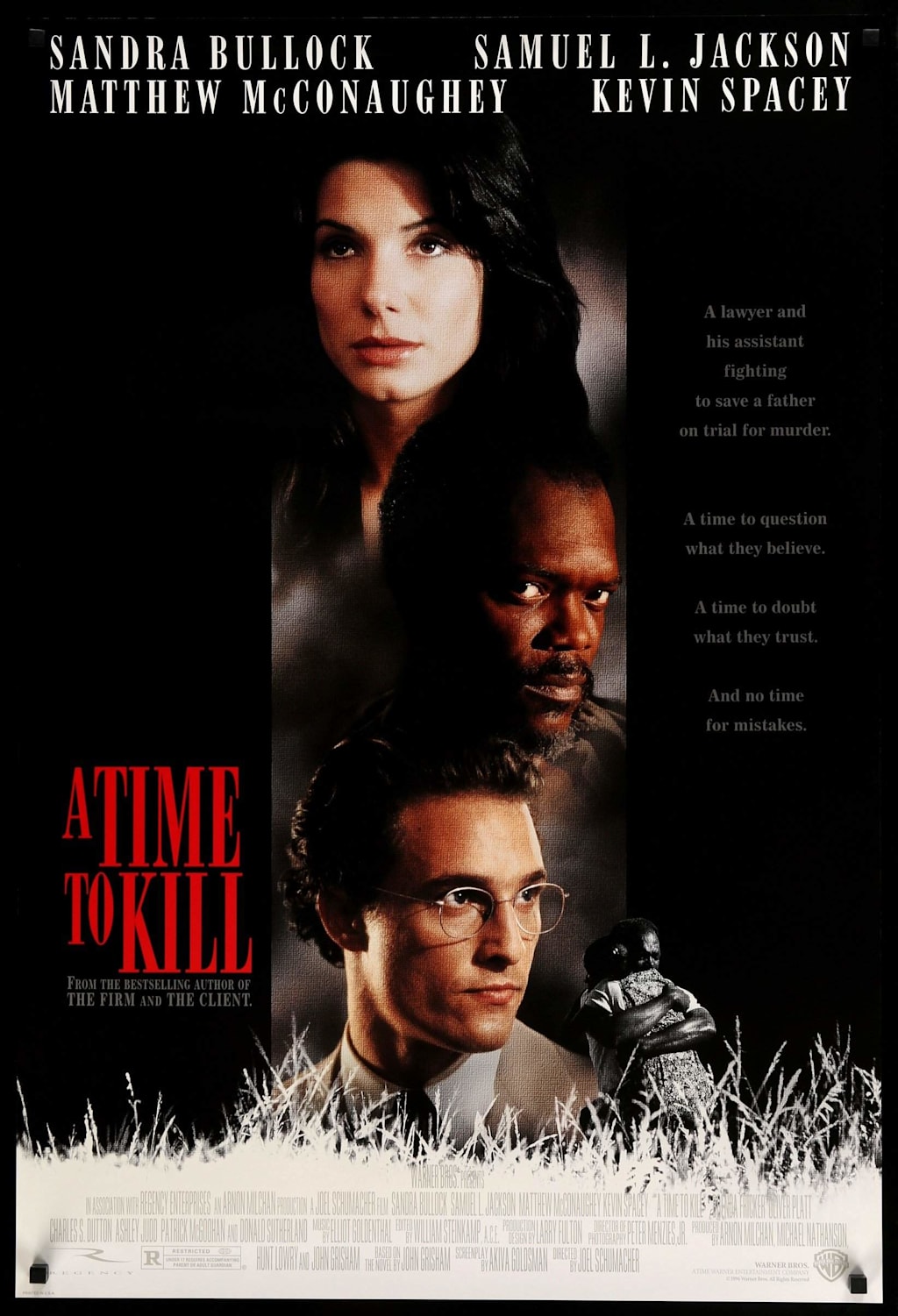
Standing Up for Justice: Plot Summary
Based on the novel of the same name by John Grisham, A Time to Kill centers on Carl Lee Hailey, a grieving Black father whose life is shattered after his 10-year-old daughter Tonya suffers a horrific act of violence. Driven by anger, grief, and a desire for revenge after the attack on his daughter, Carl Lee makes a decision that changes the course of his life forever. His actions ignite a controversial trial that forces young attorney Jake Brigance to confront deep racial tensions, questions of justice, and the moral boundaries between revenge and accountability.
The Performances Behind the Conflict
The performances in A Time to Kill help elevate the film’s exploration of justice, morality, and racial tension by bringing its complex characters to life. For example, Matthew McConaughey delivers a strong performance as Jake Brigance, portraying him as a young attorney willing to risk his career and safety to defend Carl Lee Hailey. Samuel L. Jackson gives one of the film’s most powerful performances as Carl Lee, capturing the character’s rage, heartbreak, and despair, especially during his conversation with Jake in jail, where he questions whether Jake truly sees him as a man.
Donald Sutherland brings wisdom and compassion to Lucien Wilbanks, serving as a mentor who guides Jake through the difficult case. Sandra Bullock portrays Ellen Roark as an ambitious and passionate young lawyer who helps Jake fight for justice despite the dangers surrounding the trial.
Nicky Katt and Doug Hutchison deliver chilling performances as Billy Ray Cobb and James Louis Willard, capturing their cruel and remorseless attitudes with disturbing effectiveness. Kiefer Sutherland portrays Freddie Lee Cobb as a man consumed by vengeance after his brother Billy Ray is killed by Carl Lee in a courthouse shootout.
Kevin Spacey portrays District Attorney Rufus Buckley as an ambitious prosecutor who sees Carl Lee Hailey’s trial as more than just a legal battle. While he argues for the importance of law and order, his desire for political advancement reveals that the case also serves his political ambitions.
Patrick McGoohan, Chris Cooper, and Charles S. Dutton also add depth to the film through their portrayals of Judge Omar Noose, Deputy Dwayne Looney, and Sheriff Ozzie Walls. McGoohan portrays Judge Noose as a stern but fair figure trying to maintain order during an extremely tense trial.
Cooper brings quiet empathy to Deputy Looney, portraying him as a law enforcement officer who refuses to let the circumstances surrounding the shooting erase his sense of humanity. Through Cooper’s restrained performance, Looney becomes a character who represents impartiality and understanding rather than simple judgment.
Meanwhile, Dutton delivers a commanding performance as Sheriff Ozzie Walls, portraying a man trying to protect his community while navigating the growing conflict surrounding the trial.
Supporting performances from Ashley Judd as Carla Brigance, Kurtwood Smith as Stump Sisson, and Brenda Fricker as Ethel Twitty further strengthen the film’s emotional impact. Judd portrays Carla as a loving but concerned wife who supports Jake while fearing the dangers the case brings to their family. Smith brings menace to Stump Sisson, a loyal follower of Freddie Lee Cobb who represents the threat of violence outside the courtroom. Fricker adds warmth and compassion as Ethel Twitty, helping highlight the human side of the conflict and the effect it has on the people caught in the middle.
A Trial of Darkness and Hope: The Defining Moments of A Time to Kill
A Time to Kill begins with one of the film’s most disturbing moments, as Billy Ray Cobb and James Louis Willard abduct Carl Lee Hailey’s young daughter Tonya and commit a horrific act against her. The brutality of this event establishes the emotional foundation of the narrative, showing the trauma that drives Carl Lee’s actions and setting the stage for the moral questions that follow.
Later, after Cobb and Willard are arrested, Carl Lee confronts the two men responsible for destroying his family’s life at the courthouse. Consumed by rage and heartbreak, he takes matters into his own hands before they can face trial. During the chaos, Deputy Dwayne Looney is injured while attempting to stop the attack, turning Carl Lee’s personal act of vengeance into a legal battle that divides the community.
In a quieter moment, Carl Lee later visits Deputy Looney in the hospital to apologize for injuring him. Looney accepts the apology, demonstrating compassion and reminding viewers that even amid violence and tragedy, forgiveness remains possible.
Another significant moment occurs when Freddie Lee Cobb meets with Stump Sisson and other members of the local Ku Klux Klan. Seeking revenge for his brother’s death, Freddie organizes efforts to intimidate those defending Carl Lee Hailey and influence the outcome of the trial, further escalating the racial tensions surrounding the case.
The conflict intensifies as the Ku Klux Klan targets Jake Brigance. They burn down Jake’s home (but luckily his wife and daughter had already left town before the attack) and carry out cross burnings outside the homes of others to send a brutal message to the community. Historically, cross burnings were used by the KKK as a method of psychological intimidation designed to threaten and silence those who opposed them. Ellen Roark, Ethel Twitty, and others involved in the case also become targets of threats and harassment.
Outside the courtroom, tensions reach a breaking point when a violent riot erupts between members of the Ku Klux Klan and supporters of Carl Lee Hailey, demonstrating that the trial has grown beyond a mere legal dispute and has become a symbol of the town’s deep racial divisions.
The most memorable moment comes during Jake Brigance’s closing argument. After days of intense testimony and a deeply divided courtroom, Jake delivers an emotional appeal that shifts the focus from the legal details of the case to the humanity behind it. By asking the jury to imagine Tonya Hailey as a white girl, Jake challenges them to consider how racial bias may have influenced their perception of the case.
Behind the Verdict: Facts You May Not Have Known About A Time to Kill
One interesting fact about A Time to Kill is that Woody Harrelson was originally considered for the role of Jake Brigance before Matthew McConaughey took on the part. According to an article from Deseret News in 1996, Harrelson revealed in an interview with USA Today that John Grisham had concerns about him playing the character because of his role as Mickey Knox in Oliver Stone’s Natural Born Killers. Grisham reportedly had a personal connection to the controversy surrounding the film because someone close to him was killed by teenagers who were influenced by it.
Another interesting fact comes from the IMDb trivia section, where John Grisham reportedly commented on the film’s atmosphere, joking, “Schumacher knows we have air conditioning in Mississippi, right?”
Matthew McConaughey originally auditioned for the role of Freddie Lee Cobb, but after reading the script, he became more interested in playing Jake Brigance. Director Joel Schumacher agreed with McConaughey’s potential for the role and even gave him a private screen test, which helped him land the part that would become a major breakthrough in his career.
Finally, even though the story takes place in Canton, Mississippi, the production faced challenges because the town did not have its own studio facilities or wardrobe department. To solve this problem, a local warehouse was transformed to help accommodate the film’s production needs.
A Trial Beyond the Courtroom
At its core, the themes of race and prejudice, empathy, moral courage, and fairness form the backbone of A Time to Kill. When Carl Lee Hailey takes matters into his own hands by killing the men responsible for the horrific crime against his daughter, it divides the community. Some people understand his actions as a response to unimaginable pain and loss, while others believe he crossed a line by taking justice into his own hands.
Moral courage is demonstrated through Jake’s decision to defend Carl Lee. By taking the case, Jake risks his career, reputation, and personal safety. The Ku Klux Klan’s threats against him and his family show that standing up for what is right can come with serious consequences. However, Jake refuses to back down and continues fighting for his belief that every person deserves a fair trial.
Empathy is also evident through Deputy Dwayne Looney, who does not hold resentment toward Carl Lee despite being injured during the courthouse shooting. Instead, Looney recognizes the emotional pain behind Carl Lee’s actions and understands the desperation of a father to protect his child from harm. This is shown when he says, “I hold no ill will toward the man. He did what I would have done.” Looney’s perspective demonstrates that compassion can exist even between individuals divided by violence and tragedy.
The meaning of fairness is central to the film, as the narrative examines whether justice is truly equal for everyone. Through Jake’s battle to represent Carl Lee, the film explores how personal beliefs, social attitudes, and prejudice can influence the way people view guilt, innocence, and punishment. It encourages the audience to consider whether the legal system can provide true fairness when people’s judgments are shaped by their own experiences and biases.
The Verdict: A Powerful Message About Justice
A Time to Kill remains a thought-provoking legal drama because it forces audiences to question how society defines justice and morality. Its lasting impact comes from its ability to spark conversations about justice, responsibility, and the choices people make when facing difficult situations. Decades later, the film continues to challenge audiences to reflect on the values that determine what justice truly means.
About the Creator
TheScreenAnalyst
I am a passionate movie and TV enthusiast, devoted to analyzing storytelling, characters, visuals, and performances. I provide thoughtful critiques and insights, exploring both mainstream and independent works to engage audiences.
Enjoyed the story? Support the Creator.
Subscribe for free to receive all their stories in your feed.
Comments
There are no comments for this story
Be the first to respond and start the conversation.