
A New Camera Just Solved the Biggest Problem With Shooting on Film
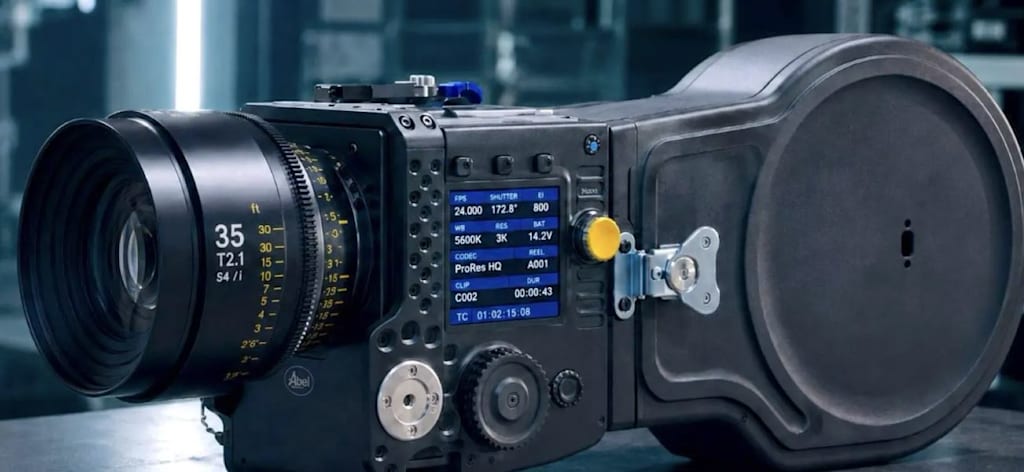
The Cinelux SIXTEEN shoots real 16mm film and digital at the same time. For filmmakers who love analog but live in a digital world, that changes everything.

Film is back. Anyone paying attention to cinema over the past few years already knows this. Directors are shooting on 16mm and 35mm again. Music videos are being cut on film. Independent filmmakers are choosing grain and latitude over the clean digital look that dominated the 2010s. The aesthetic case for film has been won convincingly, repeatedly, by some of the most acclaimed cinematographers working today.
The practical case, however, has always been harder to make.
Shooting film is beautiful. It is also slow, expensive, logistically demanding, and profoundly incompatible with the way modern productions actually operate. Today's film crews expect reliable monitoring. They expect digital proxies for fast editorial turnover. They expect timecode, metadata, immediate reference images, and a pipeline that can move material quickly from set to post. Traditional film cameras were never designed around any of those expectations because they could not have been. They predate them by decades.
A new camera called the Cinelux SIXTEEN is trying to close that gap. And the way it does so is genuinely clever.
Two Exposures, One Shutter Revolution
The core idea is elegant in its simplicity. During a single shutter revolution, the SIXTEEN creates two exposures simultaneously. One goes through the gate onto a frame of Super 16 film a real negative, light hitting photochemical emulsion, the whole analog process intact. The other goes onto a digital cinema sensor via the mirror path.
The film negative remains the source of truth. Nothing about the analog capture is compromised or approximated. But running alongside it, at the same moment, is a complete digital image pipeline: digital feed, proxy footage, monitoring output, timecode, and a live image that the entire crew can use immediately.
This is not a video tap bolted to the side of a film camera, which is roughly the level of digital integration most traditional film cameras offer. A video tap can help with framing. It cannot become a serious production tool. Cinelux is aiming for something more ambitious a digital output that is accurate enough to serve as an exposure reference, an editorial asset, and a real-time confidence monitor for everyone on set.
To make that work, the company has developed what it calls live film emulation: an attempt to make the digital feed behave as closely as possible to the developed film scan, including how shadows fall, how highlights clip, how the dynamic range responds, and how colour behaves on the particular film stock being used. If that emulation is accurate, it changes something important. Cinematographers judging exposure on set would be working from a reference that actually reflects what the negative is recording, rather than a generic video image that looks nothing like the finished scan.
The Specs on the Prototype
The current prototype specifications are worth noting because they are more serious than what most people would expect from a hybrid film concept camera.
The SIXTEEN shoots Super 16 with an open gate film size of 13.35mm by 7.42mm. The digital imager matches that same area. Digital capture runs at 3K resolution up to 48 frames per second, and 2K up to 90 frames per second. Film runs up to 90 frames per second on the prototype, with the projected production model raising both film and digital to 120 frames per second and beyond.
On the connectivity and workflow side: four SDI outputs, USB-C, WiFi, Bluetooth, Ethernet, timecode sync, internal microphone, touchscreen camera control with physical buttons, and a full shutter angle range from 0 to 360 degrees. Recording codecs include Cinelux RAW, CinemaDNG, ProRes 444 HQ, and H.265.
The projected production version adds timecode genlock sync, sound sync, 400 and 1000 foot magazine options, preset special effects, ramping, time shift, shutter blur, and real-time film stock emulation.
These are, to be direct about it, serious claims. Whether the production camera can deliver on them is the question that only real-world use will answer. But the ambition is real, and the specifications suggest a company that has thought carefully about what modern productions actually need rather than simply attaching digital features as an afterthought.
Why the Mirror Path Is the Smart Part
Understanding why this approach is technically interesting requires a brief detour into how film cameras work.
Traditional film cameras use a rotating mirror shutter system. As the mirror rotates, it alternately exposes the film to the lens allowing light through to the gate and redirects light away from the gate to an optical viewfinder. This is the fundamental mechanical architecture that has governed film camera design for most of the medium's history.
Cinelux appears to be using that mirror path as the basis of a hybrid capture architecture. When the mirror redirects light away from the film gate, that light path leads to the digital sensor rather than simply to a viewfinder. The film gets its exposure at the gate. The digital sensor gets its exposure from the mirror path. Neither compromises the other.
This is genuinely clever engineering because it works with the existing logic of film camera mechanics rather than against it. The mirror is already redirecting light. Making that redirected light useful for digital capture, rather than discarding it into a viewfinder, is an elegant solution to what is fundamentally an optical problem.
The Competition: ARRI 416
The camera that defines the benchmark for modern Super 16 production is the ARRI 416. It is compact, mechanically refined, widely trusted, and closely associated with the best 16mm cinematography of the past two decades. When directors and cinematographers choose Super 16, the 416 is typically the first camera they reach for or the one they measure everything else against.
Cinelux has positioned the SIXTEEN to come in below the price of a used ARRI 416, which is a meaningful statement. The 416 has decades of proven reliability, an established rental infrastructure, and a known image-making ecosystem built around it. The SIXTEEN has a strong concept, modern workflow integration, and the possibility of significantly lower access cost.
The honest comparison, for now, is that the ARRI 416 is a proven cinema instrument and the SIXTEEN is a prototype. Every serious film camera lives or dies by the things that only real-world use reveals: mechanical reliability, gate registration stability, noise levels during recording, serviceability and repair access, magazine performance across a full shoot day, sync accuracy, and real-world ergonomics. The hybrid digital side adds an entire second layer of questions: latency in the digital feed, sensor image quality, how close the live film emulation can actually get to a developed scan, heat management, and long-term stability.
None of those questions are answered yet. That is the honest caveat that any fair assessment of the SIXTEEN needs to include.
Who This Camera Is Actually For
The practical value of the SIXTEEN concept is clearest for specific kinds of productions: smaller independent films, commercials, music videos, and creator-driven projects where the desire to shoot film is real and genuine, but where the production infrastructure to support traditional film workflows is limited.
For these projects, the biggest barrier to film is not the cost of the stock or the lab fees though those are real. It is the operational uncertainty. The fact that you cannot monitor your image properly. The fact that your director cannot see what the cinematographer is seeing. The fact that your editor cannot start cutting until the scans come back from the lab. The fact that every department has to operate on trust and experience rather than immediate visual feedback.
The SIXTEEN does not make film cheaper. But it makes film more manageable. And for a significant category of filmmakers who currently admire film from a distance while shooting digital, manageability may be the deciding factor.
What Needs to Happen
The concept is strong. The engineering approach is mature and thoughtful. The market need is real.
What has to happen now is delivery. A film camera cannot survive on concept alone, no matter how elegant the concept is. Registration has to be stable. Movement has to be reliable. The digital pipeline has to actually perform the way the specifications suggest. The live film emulation has to be accurate enough to be useful rather than merely decorative. The production camera has to be something that a rental house can service, that a camera department can trust across a full shooting day, and that holds up under the conditions of real production rather than controlled testing.
If Cinelux can deliver all of that, at a price genuinely below used ARRI 416 territory, the SIXTEEN becomes something significant a camera that opens Super 16 to filmmakers who have wanted to shoot film but could not justify the operational complexity.
Film deserves that. Cinematography deserves that. And after years of watching digital tools produce increasingly competent imitations of film's surface characteristics, it would be genuinely satisfying to see a camera that starts with real film and builds everything else around it.
The negative is still the source of truth. That is exactly the right place to start.
About the Creator
Mark Lim
Hi I am mark an automotive student and a car, tech and food enthusiast ! Im gonna try and post daily & hope you enjoy what I write and do share my page with people you know. I would gladly appreciate it! Cheers
Enjoyed the story? Support the Creator.
Subscribe for free to receive all their stories in your feed.
Comments
There are no comments for this story
Be the first to respond and start the conversation.