
A Movie of Many Twists and Turns
Is Christopher Nolan's Odyssey Deserving of all of this Anger?

To tell a story at all is to adapt it. In real life, eyewitness testimony continues to be less and less reliable, as people in the same space witnessing the same event can have wildly different memories of what happened and how. Even in our more concrete expectations of modern entertainment, when actors and actresses can memorize scripts, there are still variances in presentation, tone, and emotion. You can see Hamlet three different times, and you will see three different versions of the “to be or not to be” soliloquy. Nobody blasts Kenneth Branagh for making his vision of Hamlet in 1996, or Disney for doing the same with The Lion King in 1994, or Robert Eggers for his grisly callback to the original inspiration with The Northman in 2022.
What about when it is the most famous story of all time, the story that is synonymous with the genre of “adventure story?” Is there room for deviations and changes in The Odyssey? Or are adapters expected to just give modern audiences the story as it is?
My initial reaction is to say the latter. As an avid reader, I vividly imagine how the tales play out in my head, and I’m always thrilled to see those tales brought to life on screen faithfully. I think if any story deserves a faithful film adaptation, it is The Odyssey. Having just recently completed a re-read of it (through Robert Fagles’ translation after first reading Lattimore’s in university), I understand that Homer’s adventure epic is not just a classic because it is very old - it is a classic because it is a true literary masterpiece.
However, I do not think my initial reaction is the most fair. I am a passionate fan of Tolkien’s works, and my favorite movie is The Return of the King (closely followed by Fellowship). If I were to hold the trilogy to the same standard we ask of The Odyssey, then I - if I want to be logically consistent - should almost hate those movies, as they have quite a long laundry list of changes and deviations. I enjoy The Lord of the Rings books and movies, and I enjoyed Christopher Nolan’s The Odyssey. I also enjoy the different translations of The Iliad and The Odyssey that I have looked through, whether it is Lattimore's scholarly (while admittedly dry) version, Wilson's modern and easy-to-read version, or, my personal favorite as of right now, Robert Fagles' poetic and modern but epic in tone.
But I am not blindly defending this new movie just for its hype. I have real criticisms of the movie: the central theme of “Zeus’ law” is actually pretty lame, and is a shoehorn of modern morality into a tale in which almost every character is what we would consider a “bad person.” The original theme of Greek hospitality for hospitality’s sake is a better motif than Zeus’ law, especially since Nolan kept dropping these heavy-handed allusions to how barbaric the Sea Peoples are and how scary the end of the Bronze Age is. “Be nice to people because they could be a god” is much more weakly connected to the Sea Peoples and guilt of deception motif Nolan used compared to the theme of “we are welcoming, generous, and kind to strangers because that’s what makes us civilized.” Polyphemus is not a monster because he has one eye — he is a monster because he lies to Odysseus and spits in the face of cultural expectations of hospitality.
The portrayal of Odysseus as this war-torn, racked-with-guilt, disgusted-with-war survivor is also silly. When you read any version of The Odyssey, you see that Odysseus is actually painfully arrogant, even to the gods’ faces. It was a bad plot addition to have Menelaus intentionally disfigure Helen in revenge - that would have been egregiously socially unacceptable for the time. I do not like that the ghost of Achilles is absent from the movie, especially since Nolan really leaned on this theme of “I have war regrets.” In Book 11, Achilles’ ghost tells Odysseus: “No winning words about death to me, shining Odysseus! By god, I’d rather slave on earth for another man— some dirt-poor tenant farmer who scrapes to keep alive– than rule down here over all the breathless dead” (Fagles 1996, 265). The greatest Greek warrior of all time, Achilles, is the only character in either The Iliad or The Odyssey to say, “man I wish we really hadn’t done this.” I also think the absence of the “my name is Nobody” sequence between Polyphemus and Odysseus is a sad removal, as that is really where we see the cleverness of both Odysseus and Polyphemus himself.
To share more personal, superficial dislikes of the movie, I do wish the color palette was a little brighter and more vibrant, but I expect muted blues, browns, and greys from Nolan’s movies. I wish Aeolus and his literal bag of wind were in the movie, because it makes the tragedy of Odysseus’ crew’s mutiny even worse. I wish it were more fantastical: while the subtlety of the gods’ involvement was clever and (in my scorching hot take) actually decently done, I do wish filmmakers adapting Greek myths were less afraid of the mythology. Why are the only mainstream movies utilizing the Greek gods the below-average Clash (and Wrath) of the Titans?
But on a more positive note, there were changes that I did not mind. I am okay with the Phaeakians being absent, because they really are only important to the story if you keep the theme of unquestioning hospitality. I don’t even mind the time crunch in some areas: you cannot have Odysseus angry at Calypso and striving to get home to his wife if you have him willingly sleeping with Circe, which he does for a full year in the book. I also do not even mind Calypso being the one who uses lotus flowers. While including the lotus eaters would have been a great opportunity to flex more “diverse” casting (as the lotus eaters are usually plotted somewhere in or near Libya), they just were not very necessary for the moving along of the plot in this film.
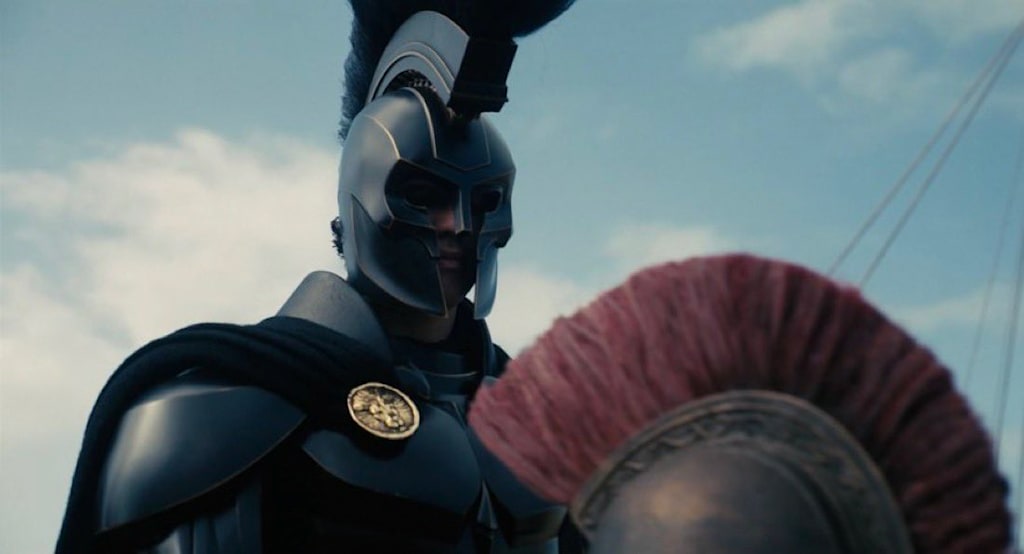
My most controversial take (and one I have made a complete 180 about), is I do not mind the armor in the movie. Reading both The Iliad and The Odyssey this summer made me realize Homer also was either unaware of or was not too interested in period-accurate armor; he was interested in making his characters look and sound cool. In The Iliad, Odysseus wears a tusked, horse-hair plumed helmet, which was accurate to the time. However, in the same book, Achilles wears glowing, sculpted armor with a big plume crest; the glowing is unrealistic regardless, but that style of armor was not around until Classical Greece, around 600 years after the fall of Troy. And in The Odyssey (book), Odysseus has numerous horsehair-crested helmets stored in his armory, even though those would not have existed yet. So, do I think it’s ridiculous that they are all wearing pants in the movie, and is it a little silly that Agamemnon looks a little too sleek and comic-booky? Yes. But is it worth getting worked up over? After reading the books, I have to say – not really.
To say even more positives, I think the acting is fantastic. I think the soundtrack is unbelievable and that Ludwig Göransson might be the best composer in the game right now. I think Nolan gave us the best presentation of what a Cyclops could actually look like, and the scene where Circe turns the men into pigs left me speechless (from being both impressed and horrified).
Emily Wilson translated πολύτροπον as “complicated.” Whether or not you like that choice, Odysseus is a deeply complicated individual: too smart for his own good, dangerously prideful, brutal and merciless, yet often remembered as a benevolent king who treats his loyal people very well. I personally prefer the more poetic and dramatic “man of twists and turns” that Fagles used. Similarly, Christopher Nolan’s The Odyssey is a very complicated movie. It had loud haters from the start because of its casting, color palette, clothing, and set design, but it also had the hard task of a director who craves realism making a movie chock-full of myth and fantasy. I think he managed to do it passably well, even if the movie has many of its own “twists and turns” in deviating from the source material. Is it the “most faithful” adaptation? Definitely not, and I’m sure someone will try their own version of it in twenty or so years (Robert Eggers?). But the question is: to what does an adapter need to be faithful? Which version of The Odyssey is the definitive one? Is the book we have in our hands the same as Homer would have intended it (if he was even real)? It’s hard to say, as our earliest Odyssey manuscripts are centuries after the blind bard is supposed to have lived.
So, Nolan seems to have done what many bards, poets, and translators before him have done: take this classic tale, embellish it in their own ways and put their own spins on it. I of course am not an Ancient Greek historian nor a classicist; I am simply someone who reads a lot, has a passing, academic knowledge of Ancient Greek for the study of the New Testament, currently studies modern Greek purely for fun, and who has been reading and learning about Greek mythology and Greek stories since I was in the 4th grade. If you disagree with my views, that’s fine; they’re all opinions.
This movie is a technical and musical marvel, so for that I give the film itself a 4 out of 5. But as an adaptation of the story, themes, and characters of The Odyssey? A generous 3 out of 5.
About the Creator
Colin Ogilvie
Sing to me of the man, Muse, the man of opinions and thoughts
Enjoyed the story? Support the Creator.
Subscribe for free to receive all their stories in your feed.
Comments
There are no comments for this story
Be the first to respond and start the conversation.