
A Familiar Echo
Whistle Plays All The Horror Hits You've Already Heard
How hard is it to come up with a truly original idea? This is the main problem I have with art in all of it’s different mediums. It is the year 2026, and it seems to me that there is a shortage or lack of imagination, creativity, and originality. I feel like I’m stuck in that episode of South Park where one of the boys suffers from Asperger’s, and all they can see is crap all around them. History repeats itself. Times are hard, and just like it was during the Great Depression, the masses head to the theater to get a little reprieve - just a tiny bit of respite - from their stressful lives. What we have is a problem of choosing quantity over quality.
In this epoch of human history, we have more options available to us than ever before. As a matter of fact, in this age of information, studies show that we have actually developed a condition in which we have so many options available to us, that it has actually made it difficult for us to make decisions. Which really isn’t a surprise. Statistics tell us that a staggering 90 percent of the data available to us were created in the last two years. We’ve generated more information during this era than in the history of the world. But what of the content, and what of the quality of that content? Collectively, we have shown that we prefer cheap fast food as opposed to anything with any real substance. There is perhaps no better way to highlight this than to point to how Stephen King has said that he is essentially the McDonald’s of literature when referring to his own writing. That’s right, the King of Horror himself admits that there is little to no quality to his works, and still we as a people eat his stuff right up. We see this in the way that if you were to take a look at the best horror films of the last half century, more than a half of a dozen of King’s works make that list.
As a lover of cinema, it makes my soul weep that I have grown bored with this art form that means so much to me. Movies these days just seem so banal, mostly because they are so damn predictable. These days, it seems that everything is a remake of something or another, which is tragic in it’s own right when you consider how remakes are never as good as the original. Yet another exemplification of how everything gets recycled is found in the way that there are countless franchises that offer us nothing more than the thirteenth installment of the same slasher thriller which has been around for nearly fifty years. I mean come on, there are thirteen Halloween movies to date, which is a telling tale, when you consider that Halloween Ends was an absolute nightmare of a movie.
We have rehashed these themes, motives, plots, and narratives so much that they almost seem to touch on plagiarism. I think that one major component that factors into why this is has something to do with what it means to be fundamentally a human being. It almost seems to be a part of our very nature, as if it were part of our DNA. The expression that there is nothing new under the sun has been around for more than two thousand years. It would seem that part of the human condition is to have this feeling -this fleeting sensation - that we are by and far unimpressed by the things that we see around us, and that we kind of sort of feel like we’ve seen everything that there is to be seen. If you’ve seen one movie, you’ve seen them all.
Still, I am not convinced that this is the underlying reason that we seem to repeat and replicate the same model - the same concepts - over and over again ad nauseam. No, from what I’ve learned in all my years of study, I truly believe that the root cause for this particular happenstance is found in what academia teaches its students as constituting as a good narrative. The pedagogy needs to change. In the classroom, our professors tell us that, “In order for this to be a good story, it has to follow the narrative of the hero’s journey.” At the same time, we have our brains filled with ideas such as how, “Great artists don’t create; they steal.”The consequence is that our educated artists are left with the impression that great works follow a certain template, and so they all try to emulate it. And to be completely honest, I think that another consequence of this human conditioning is that there are hardly any artists left that are willing to take any real risks with their work. So now, the review. What we find in the case of Corin Hardy’s horror film, Whistle, is that it epitomizes everything that is wrong with the movie industry today. At its best, this movie is likened to a kaleidoscope containing the entire gamut of images taken from all the best movies in the genre. If I were to juxtapose the movie to any human experience, I would say that it bears great likeness to the process of choosing one’s organized religion, in that it picks and chooses what works for it from other models, and discards the rest. Whistle succeeded only in hand choosing everything that had worked from different movies in the past, slapping them all together, and calling it a movie. Lacking in any real sense of verisimilitude, Whistle will go down in history as yet another horror movie, meaning that it is a copy or a duplicate, as opposed to an original.
Art imitates life. Either that or life imitates arts. Whichever side of the argument you are on when it comes to mimesis, the fact remains that art in all of its forms is an expression of what it means to be human. Most importantly, art acts as a documentation of our history. It’s one of the many reasons that Hitler notoriously stole the art of the people that he conquered, in that it was his grandiose hope, that in stealing their art, he could rewrite their history.
In a word, Whistle can best be described as familiar. Watching the movie can be compared to planning a rendezvous with a dear friend, in that there are no surprises, and you know exactly what to expect from it. Right from the beginning the viewer has a pretty good idea of what is going to come next as if they knew the movie like the back of their hand. The movie is like a child’s worn out baseball glove, where the owner knows every last stitch.
There is perhaps no better demonstration of this fact that, like so many horror movies before it, the movie centers around a group of high school students. To give credit where credit is due, Whistle actually made me stop and wonder why exactly this is. Why is it that horror movies are so inclined to incorporate teenagers as their main characters? It is a very common trope in this genre after all. Maybe the answer is so obvious that it is overlooked like the setting of a story. Perhaps it is because there is no other time in the course of our lives more terrifying than our adolescent years. For many, this decade of our lives is very traumatic. Children are mean, and everybody - I don’t care who you are - has someone in their high school years that absolutely made our lives hell in one way or another. Even without rumors, gossip, and childhood bullying, this is a chaotic period of our lives full of turbulent trials and tribulations, which is only intensified that this is a time of our lives marked by vulnerability where we are growing and maturing across every level of the human plane. It is a period where we are susceptible as we come into our own and develop our sense of individuality, and it complicates things all the more than we are subject to the growing pains of puberty and raging hormones. We often forget how traumatizing the high school experience was, until we are invited to our class reunion, where we encounter a bout of PTSD as we think to ourselves, “Why would I want to spend an evening with all the people that tormented me in my childhood, just so they can judge me on how well I’m doing compared to them?” Then again, I could be over-analyzing things, and the answer could be a whole heck of a lot simpler, like that it could be the fact that our teenage years or perhaps the most relatable, the most memorable, or it could very well be because by using teenagers to tell a story, the creators have an excuse to justify the reason that the characters in their stories make really bad decisions. After all, that seems to be another trademark of the horror movies that we watch, in that the main characters always make farfetched decisions that no rational, logical, and conscious human being would make in real life. We are reminded of this every time we go to the theater and shout up at the screen, “No don’t go in the big spooky shed with all the sharp objects in it, the killers in there!” Just as Da Vinci has all the defining characteristics of a genius, so to does this trait apply to Whistle.
That being said, it is not enough to say that this is yet another horror film where the main cast is made up of a bunch of high school kids, because the fact of the matter is that these aren’t your typical run of the mill students. Whistle decided to go along with another kind of stereotypical trope in that the story centers around a group of students who are a handful of the school’s outcasts, misfits, or what you would call the round pegs in the square holes. At least most of them are. For instance, the stories main protagonist is a young girl who could best be described as the hipster that every other hipster aspires to be. The main character is such a hipster, she doesn’t even know she is one. Every school has one. Looking a little bit like a younger Winona Ryder, she’s the type that wears worn and faded army fatigues, that look like they were purchased from the nearest Goodwill or Salvation Army, as if to say, the average person relates to some kind of level of poverty, where this isn’t so much as a choice of individuality, but the only option within the confines of the realities of life. The main character is the type of girl that listens to music that she would describe as niche, which is another way of saying that her fellow students have never heard of the bands she listens to before. Whistle really goes all in on this misfit idea. The main character is a carbon copy tortured artist that makes really dark and macabre drawings. Not only that, but she’s one of those enigmatic individuals where there are countless stories about her tainted past, found in the whispers of the hallway conversations in comments like, “Aren’t you the girl that killed your dad?”
And that is the problem with the movies that we watch today. There is nothing new under the son. There is no longer any real sense of anticipation in the movies that we watch. As in this case, everything has just become sort of ordinary. We have been so conditioned to expect the jump scare, that we are no longer jumping. Even when you have a great filmmaker like M. Night Shyamalan, we have grown to anticipate that, okay, this movie is going to have a twist at the end. And because we have grown to expect it, it has lost it’ initial appeal. It’s more of the same here. As we get to know these characters scene by scene, on an unconscious level, we are thinking to ourselves, Okay, they are going with the whole Breakfast Club playbook, I have a pretty good idea of what to expect.
The only positive redeeming feature to be found in all of this is that it forces us to reexamine what we know. It’s the paradox of the more you know, the less you know. When we’ve seen the same concepts repeated over and over again, and makes us analyze why the collective keeps brining these ideas to the forefront of our attention. After all, it is very unlikely that it is due to the fact that we have reached some kind of anticlimactic precipice where we’ve exhausted all the creative options available to us. We want to know the why of things. Why is it that movies so often feature individuals that don’t fit into the neat little boxes in terms of what we deem, ‘normal.’ It seems almost counterintuitive. As a species, we are a social lot. Not only that, but we are a social lot that pursues being normal so much so, that it is to the extent of putting ourselves out. We are willing to sacrifice bits of ourselves so that we can fit into the group. Psychology proves this in things like group think, we’re people will consciously go against what they actually think, so that their thoughts are a reflection of what the group thinks as a unit. This is so much a factor in our society today, that there is actually a sort of expression in the East that the extraordinary person is the one trying to be ordinary, in a world where everyone is trying to be extraordinary. So, if this is the case, why is it that we relate so much with the person that doesn’t fit into any one particular group. Or is it something else entirely? Is it that we relate with the misfits, or is it that there is so much deeper psychological and societal meaning, in that we cast the outfits in our horror movies, because deep down, we kind of want something bad to happen to the people that we think of as weird. After all, it is a very real reality that when something bad happens, we always want to point our fingers to the people that we always thought were, a little off. Or could, it speak to the fact that these are horror movies, and we are all a little afraid of those people that we just don’t understand?
Whistle is another example of how art has become some sort of mathematical formula for us to follow. Nowadays, when we are watching out horror flicks, it’s like we have become miniature forensic psychiatrists, profiling our patients before us, and the movies that we watch are the patients. We don’t even need a clipboard to mentally check off whether or not a movie has all the traits we’ve come to expect from a horror movie. It’s like before the opening credits even finish rolling, we think to ourselves, I bet anything under the sun that this movie is going to try to appeal to all audiences with it’s characters, and by doing so, actually appealing to know. A soft core sex scene is nothing new. They are in every scary movie, and they’ve been doing it since the seventies, during a time when that sort of thing was actually taboo. Even so, it comes as no shock when halfway through the movie, you discover that the main character is lesbian, as in Whistle. We see these images depicted before us, and we make a kind of mental note that, well they had to appeal to the LGBTQ and liberal community somehow. Except for having a neurodivergent character, Whistle follows this trend of covering all its bases, and trying to please every demographic.
Now for the gritty meat and bones of this review. Every horror movie, good or bad, has that one particular thing that makes it scary. In this way, horror movies have become a way that we can analyze what Carl Jung called the Shadow Self. Through these movies, we not only get a taste of the more unpleasant parts of the human psyche, but we also have a means of inspected what it is that we truly fear as a people. Horror films paint a vivid picture of how we fear the deranged and psychotic serial killer, aliens, the dead coming back to life, clowns for whatever odd reason that may be, and everything else in-between, revealing to us that fear is a very integral part of what it means to be human. Now, the year is half way over, and to date, it seems that 2026 has been the year of supernatural movies. So far, there have been more than 20 films that have debuted this year that have dealt with the supernatural, and Whistle is no exception.
In my humbled opinion, this was the one thing that the movie did right. In exploring what human beings are truly afraid of, the creators of Whistle decided to make a movie dealing with the very broad topic of death. On the most fundamental level, the thing that humans fear more than anything else is death. There are whole religions in various parts of the east that have a deep-seated belief that most human fears stem from the fear of death. It was one of the reasons that the Buddha would have some of his disciples meditate in a cemetery. I am convinced on this point. When a person says that they are afraid of cars, they are not really stating what they are truly afraid of. The person that is afraid of cars is really afraid that he is going to get in a wreck that ends their life. So the person with arachnophobia isn’t so much afraid of a little harmless spider, but rather that that spider is poisonous, and that upon being bitten by it, that they will cease to exist. I can hear the critic asking, “But what of fears that have to do with things like humiliation, like the fear of public speaking? You can’t die from that.” The orient has it’s own thoughts on this matter, in that what the person really is afraid of is kind of death of the ego. In these instances, our fragile egos think that in these instances it would be the death of what people think of us, which is like it’s own kind of death, which is why I am still inclined to share this opinion.
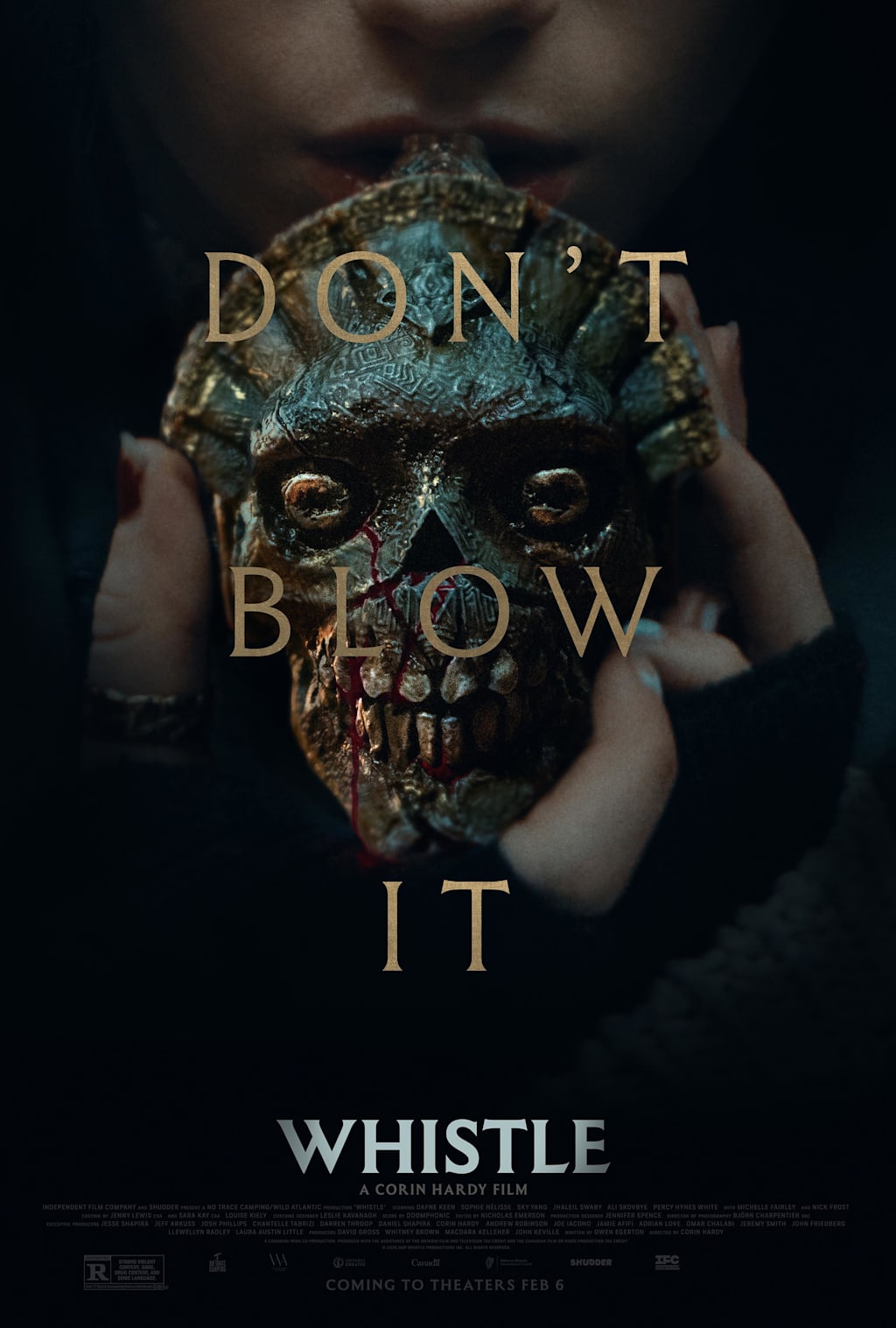
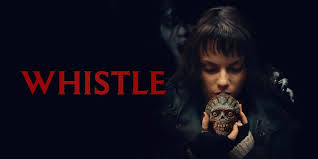
What I’ve noticed in all the movies that I’ve watched this year is that 2026 kind of seems to be the year of supernatural films. The year is only halfway over, and already we’ve seen at least twenty films dealing with the supernatural with movies like Undertone, The Mummy, and Vicious. Whistle is no exception, and it makes you wonder if this tells us that the collective unconscious is becoming more curious and interested in the mystical realm. Either way, in the movie Whistle, death takes on it’s own individual form. More specifically, it is personified in the shape of ancient Aztec whistle, as the title of the movie would suggest. Going along with the theme of this article, this isn’t the first time that a movie has played around with the idea of a cursed object. We’ve seen it it such instances as The Box, Christine, The Hand, Hell-raiser, Annabelle, The Ring, The Evil Dead, Oculus, and many other. As a matter of fact, there was another mentionable movie this year that dealt with a cursed object as if found in the case of Vicious with Dakota Fanning, where a young girl had to feed an object she loves, hates, and something she needs into a cursed box, or else she will die. With Whistle, I really hope that the movie doesn’t reflect the kinds of decisions people make in real life. If that is the case, I myself have little to no hope for humanity. I mean the decisions are just so bad. The whistle that these students find literally has, “Calls to or speaks to summoning your death,” transcribed all around it. I mean who in their right mind would read this and go, “You know what, I’m going to blow into it anyway,” which is exactly what they end up doing. Thus starts the main premise of the movie. Basically, the movie tells a story about how the day of our birth, and the day of our death is fated in the stars. So everything is preordained when you stop to think about it. According to the movie, there is nothing that can change the day that we die, or the way that we die. Except for those that hear the sound of the whistle. If you hear the god awful sound of this artifact, it makes your death gravitate towards you. Suppose you die of old age at seventy, of a car wreck at 40, or of lung cancer at the ripe old age of 95, hearing the sound of the whistle will make you experience that whatever death you were supposed to have in the few days upon hearing it, thus summoning your death.
Spoiler alert: I would have liked the movie a whole lot more if it wasn’t for the fact that the movies conclusion - the way that these students stop their deaths from manifesting - wasn’t, well, so damn predictable. With movies like these, there are usually two different ways of stopping death from coming, and the creators of Whistle decided to go with both. The first option was to do what we’ve seen in every Final Destination movie, which is to cheat death by, basically becoming a murderer, and marking someone else with your death. Of course, no one feels comfortable with this idea, so the alternative method is to do what we’ve seen in movies like The Lazarus Effect, Smile, Edge of Tomorrow, and so many other, which is to cheat death by intentionally committing suicide, only to come back to life. So in the end, it doesn’t even take a horror movie buff to see this ending coming from a mile away.
To conclude, I don’t usually agree with the score that rotten tomatoes gives the movies that it reviews. Typically speaking, they are a little harsh in giving their grades, as if they are the end all, ultimate source on movies. I admit that this may be a little biased when you consider the fact that I generally do not agree with the movies that win the Academy Award for best picture. Even so, in this one particular instance, I feel that rotten tomatoes was actually a little too generous in the rating that they gave the movie. Out of a hundred reviews, Whistle received a Tomatometer score of sixty-four percent. I would have given it less. I would think a score of like 53 percent, or two-and-a-half stars out of five would be more fitting or appropriate, although to be fair, I’m just a simple cinephile, not someone who reviews movies professionally for the MPAA or for sources like Rotten Tomatoes. Overall, I might say that, sure this is a boredom buster movie at best, which you could watch if you had nothing going on, or you simply wanted to increase your knowledge of horror movies, but other than that, this isn’t a movie that I would recommend my friends or family to see, or that I would talk about in passing conversation about the kind of movies I like to watch.
Writing and Research by Aaron M. Weis
About the Creator
Aaron M. Weis
Creator of Continuity Writing: a spiritual, steady‑stream consciousness style shaped by daily journaling, inner expansion, and the belief that awareness is our greatest responsibility.
Enjoyed the story? Support the Creator.
Subscribe for free to receive all their stories in your feed.
Comments