
A Captains Miscalculation
Chapter 3-Anatomy of a Miscalculation

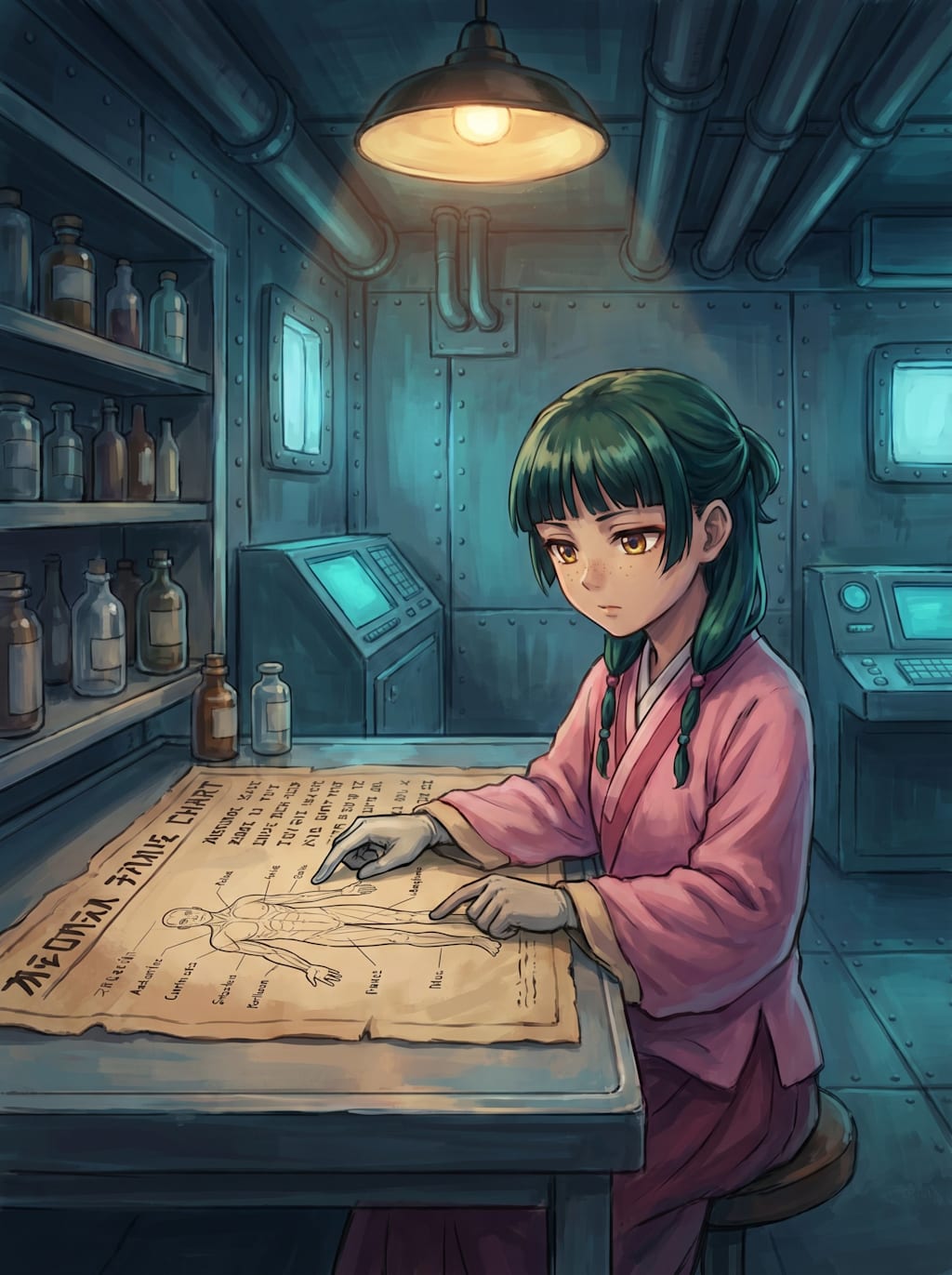
The chart was written in a hand that wasted no ink.
The script was neat and angular, marching down the page in precise lines. Even without understanding every character, Maomao could tell the writer was someone who cared very much about order. The small sketch of a human body beside the text was spare but accurate, organs outlined with just enough detail to be useful and no more.
Law watched her read.
Maomao let her eyes move from top to bottom, mapping the symptoms onto the drawing in her mind. Age: middle. Sex: male. Initial complaints: mild fatigue, headaches, occasional dizziness. Duration: three days. Collapse: sudden, at work. Within hours: fever, patterned bruising along neck and chest, shortness of breath.
She traced the numbered marks near the organs.
“Lungs first,” she murmured. “Then liver. Then heart. Then kidneys.”
Law’s arms were folded, but his attention sharpened.
“That’s the order I saw during autopsy,” he said. “Visible damage increased along that path.”
“And before collapse?” Maomao asked. “Any digestive distress? Diarrhea, vomiting, unusual colors in urine?”
“None reported,” he said. “Stomach and intestines looked normal.”
“So if there is a poison,” she said slowly, “it bypasses or ignores the usual paths. Or it’s something that changes form after entering the body.”
Law inclined his head a fraction.
“Go on,” he said.
Maomao shut her eyes briefly, building a picture.
A man going about his simple work, slowly accumulating something in his body. Nothing dramatic, nothing that would send him to a doctor. Then, one day, a trigger—and everything cascaded.
“Did you test the blood?” she asked.
“Yes,” Law said. “Nothing that matches any common toxins I know. Some abnormalities, but nothing that explains the pattern.”
“Common to your world,” Maomao said, half under her breath.
He frowned. “What?”
“Nothing,” she said again, and handed the chart back. “You’re not wrong. But you are missing something.”
“Enlighten me,” he said dryly.
Her eyes flicked to the covered form on the bed.
“Is this one of them?” she asked.
Law hesitated, then stepped forward and folded the sheet back to the man’s shoulders.
The body was waxy-pale now, the heat of fever long gone. Dark blooms stained the skin along his neck and collarbones, not quite black, not quite purple. Even in death, the marks looked deliberate, like brushstrokes following an invisible pattern.
Maomao leaned in.
She did not flinch at the smell. She had helped her father with corpses before, and the palace had given her more than enough exposure to the scent of death. She placed her fingertips beside one of the bruises and pressed lightly, feeling the texture of the tissue beneath.
“He’s been dead how long?” she asked.
“A day,” Law said. “Give or take.”
She hummed.
“The bruising hasn’t diffused,” she said. “It’s holding shape. Whatever was in his blood has already settled. The fact that it still clings to these paths means—”
“Means?” he prompted.
“Means it isn’t just in the blood,” she said, straightening. “It’s binding to something in the tissue itself. To the walls of the vessels, or to the nerves.”
“That was my impression,” he said. “But that still doesn’t tell us where it came from.”
Maomao tapped her lip, thinking.
“Did all the victims spend time in the same place?” she asked. “Eat from the same pot? Visit the same shrine?”
“We’re still compiling that,” Law said. “Bepo and the others are talking to their families. So far, we know at least three of them frequented the same tea-house near the docks.”
“Not decisive,” Maomao said. “But suggestive.”
She looked back at the bruises, then followed their lines in her mind, imagining them traced on a diagram of meridians and acupoints.
“If I wanted to design something cruel,” she said quietly, “I would use a mild base compound that could be hidden in food or drink. Something that accumulates in the vessels along these pathways, invisible for days. Then, once enough has built up, a second substance to trigger it. And perhaps a third, to push the body’s own defenses into overreaction.”
Law’s gaze flicked to her.
“You’ve thought about this before,” he said.
“Yes,” Maomao said simply.
“Why?”
“Because if I can imagine it,” she said, “someone else can, too.”
For a moment, their eyes met, and in that moment Law knew that this girl with her plain kimono and plain face had seen human cruelty laid out on an apothecary’s table just as he had on an operating one.
He looked away first.
“All right,” he said. “Assume you’re right. How do we test it?”
The Polar Tang’s small laboratory space was not made for two people who liked to spread out.
Maomao claimed a section of counter, laying out what herbs and powders she’d collected from the village so far. Some she’d bought under the pretense of stocking a home remedy kit. Others she’d plucked from roadside or market stall when no one was looking. Their scents mingled with the sharper smell of the ship’s antiseptic.
Law spread his charts on the opposite side of the room, each paper weighted neatly so it wouldn’t slide when the ship shifted. Diagrams of organs, vessels, notes on past autopsies, sketches of bruising patterns, all organized into a grid only he fully understood.
Bepo hovered in the doorway, looking anxious. At a glare from Law, he retreated, closing the door most of the way.
“Describe your fever herb,” Law said, not looking up from his notes.
Maomao picked up the bundle she had used in the village and held it under her nose.
“Used here for ordinary fevers and headaches,” she said. “Mildly cooling, promotes sweating. Also slows the heart slightly at higher doses.”
“Show me,” Law said.
She handed him a sprig. He sniffed it, then frowned.
“Smells like one we have in other parts of the world,” he said. “But not exactly.”
“The soil tastes different,” Maomao said. “The sun, too. I expect most herbs here will be cousins, not twins.”
He gave her a sidelong look.
“You talk like this is all very normal,” he said. “New world, new herbs.”
“If I panic, will that change the composition of the poison?” she asked mildly.
He snorted, conceding the point.
“All right,” he said. “You think this curse is a system. Base, trigger, maybe more. Let’s say the base is in something they ingest regularly. Water, rice, tea. The trigger could be rarer. A special dish. A festival drink. Or medicine.”
“Or incense in a shrine,” Maomao added. “They mentioned gods.”
Law grimaced.
“I hate curses,” he said. “They’re always just laziness hiding ignorance.”
Maomao’s lips twitched.
“We agree on that much, at least,” she said.
They worked.
Maomao prepared tiny infusions of suspect herbs from her collection and from a small box Law provided with samples villagers had brought in. She diluted them, marked each with a careful symbol, and set them in a tray.
Law, in turn, drew a small sample of preserved tissue from one of the cadavers they’d stored—just enough to work with. He explained, in brisk terms, what he’d observed in the bodies’ vessels, how the bruises corresponded to underlying damage.
Maomao listened, absorbing words like “endothelium” and mapping them onto her own internal diagrams of channels and flows. She spoke of meridians and acupoints, and watched his brow furrow as he translated those into nerves and nodes.
They were, she realized, saying the same things in two different languages.
“Here,” Law said at last, pulling on a pair of gloves. “We’ll start simple. Base compounds first, one at a time, to see if any bind preferentially to the tissue.”
He eyed the tray of infusions, then selected three.
“These have shown up more often in the victims’ kitchens,” he said. “According to my crew.”
“And this,” Maomao said, reaching for a fourth, “was burning in the shrine every time someone mentioned prayers.”
He gave her another look, then nodded.
“Fine,” he said. “We’ll include it.”
They added tiny drops of each infusion to separate samples and waited. Maomao watched for subtle changes in color, in texture. Law watched for changes under the lens of a small magnifying device, looking for clumping, binding, anything unusual.
“This one,” he said after a time, tapping the edge of a slide, “is doing something. The vessels look…stickier. Not blocked, but coated with something that doesn’t belong.”
Maomao sniffed the corresponding infusion.
“Rice additive,” she said. “To make the grains softer and whiter. Harmless alone. If you aren’t eating it every day for weeks.”
He grunted.
“The base, then,” he said. “Or part of it.”
They repeated the process with other combinations, gradually sketching out which common elements might lay the groundwork in the body. It was slow, meticulous work. They spoke little, except to share observations, to question each others’ assumptions.
At some point, Bepo appeared again with a tray of food and tea, set it down quietly, and retreated. Neither of them acknowledged it until long afterward, when the tea had gone lukewarm and their stomachs made their displeasure known.
Maomao picked up a rice ball and took a small bite, chewing thoughtfully.
“If the base is safe alone,” she said, “we can’t tell people simply to stop eating. They’d starve before they detoxed.”
“We can disrupt it instead,” Law said. “Introduce something that competes for the same binding sites. Or that flushes it out faster.”
Maomao nodded slowly.
“I know of herbs that increase circulation,” she said. “Others that draw heat away from certain areas. If we combine them correctly, we might coax the base out without triggering it—if we’re careful.”
“Careful,” Law echoed. The word sounded foreign on his tongue.
Maomao finished the rice ball in two neat bites and brushed stray grains from her sleeve.
“It will still be a risk,” she said. “The first patient may worsen before improving. But doing nothing is worse.”
Law’s eyes flicked to her face, searching for fear, for hesitation.
He found none.
“How soon can you prepare such a mixture?” he asked.
“By evening,” she said. “If your crew can fetch what I need.”
He glanced at the list she began to scribble: names of herbs, described by scent and appearance, some common, some rarer. He recognized a few in their own stores. Others they would have to hunt in the nearby hills or markets.
“I’ll send them,” he said. “We can test the mixture on a mild case first.”
“The man I treated at the market,” Maomao said. “If he’s still alive, he’s ideal. We already slowed the progression once. He has a chance.”
Law nodded once.
“Bepo,” he called.
The bear’s head popped around the partially open door.
“Yeah, Captain?”
“Get Penguin and Shachi,” Law said. “You’re going back to the village. Find the man who collapsed at the market earlier—the one the villagers say was treated by this woman. Bring him here, carefully. And take this list.” He slid the parchment across the table. “You know what you can find locally. Prioritize the herbs we don’t already have onboard.”
Bepo took the list with both paws, eyes wide.
“Right away!” he said. He hesitated, glancing between Law and Maomao. “Um. Be careful, okay?”
“We’re not the ones leaving the ship,” Law said.
“I meant with each other,” Bepo muttered under his breath, but he scurried away before either of them could reply.
Maomao watched the door close.
“You have a very anxious bear,” she observed.
“He worries too much,” Law said. Then, after a beat, “He has reasons.”
She did not press. Everyone has reasons. Some were written on their skin; others, she suspected, were carved into the spaces behind their ribs where no scalpel could reach.
***
Evening brought the smell of rain and the return of Bepo’s heavy footsteps.
The man from the market lay now on the infirmary bed, skin slick with sweat, breaths coming in ragged pulls. The patterned bruises along his neck and chest had darkened since Maomao had last seen him. They had also crept farther, faint lines tracing down toward his abdomen.
“He was worse when we got there,” Bepo said, wringing his paws. “The villagers said he stopped talking around midday.”
“But he was still breathing,” Penguin added. “Barely.”
Maomao nodded, her expression grave but calm.
“You did well,” she said. “Please wait outside.”
They hesitated.
“Now,” Law added, voice flat.
The pirates reluctantly filed out, leaving Maomao and Law alone with the patient and their improvised treatment.
The mixture Maomao had prepared sat in a ceramic bowl on the table, steam curling from its surface. It smelled of bitter roots, sharp leaves, and something woodsy and cool. Beside it, smaller bowls held cleaner water and cloths.
“This will increase circulation and draw heat away from the central organs,” she said, half to Law, half to herself. “If the base compound is clinging along the vessels, we might be able to flush some of it back into the blood, then out through the kidneys—if they haven’t failed entirely.”
Law’s jaw tightened.
“And if we’re wrong?” he asked.
“Then we kill him faster than the curse would,” Maomao said. She met his gaze. “You know this.”
He did.
“We’re out of time for caution,” he said. “Do it.”
Maomao slid an arm under the patient’s shoulders, lifting carefully so his head was slightly raised. His eyes fluttered open for a moment, unfocused, then closed again. She touched the rim of a cup to his lips, dripping the decoction into his mouth in small increments, giving him time to swallow reflexively.
“Steady,” she murmured. “Don’t be stubborn now.”
Law watched the movement of the man’s throat, the rise and fall of his chest. He laid a hand lightly over the man’s sternum, fingers splayed, feeling the frantic pounding beneath.
“ROOM.”
The space around the bed hummed, a subtle shift in pressure that Maomao felt more than saw. The hair on her arms lifted. A faint blue shimmer edged the air for a heartbeat, then vanished.
Law’s eyes had gone distant, focused inward—no, not inward, on the thing beneath his palm. His other hand hovered over the patient’s abdomen, following lines only he could perceive.
“Heart rate is high but regular,” he said quietly. “Lungs strained. Liver already showing damage. Kidneys…still functioning. For now.”
Maomao kept feeding the mixture in slow, careful sips until the cup was empty. The patient coughed once, weakly, then settled back into heavy breathing. Sweat beaded on his brow.
“Now we see,” she said.
They waited.
Minutes stretched. The ship creaked softly around them. Outside, someone shouted something indistinct, laughter following. Life went on in the corridors while death and its prevention played out here in this small, bright room.
Maomao watched the man’s face, the color of his lips. Law watched his chest and the invisible patterns beneath.
After a time, the fever’s fierce heat began to ebb.
Maomao wrung out a cloth and laid it across his forehead again, feeling the difference. His skin was still warm, but no longer scorching. His breaths lengthened, just a fraction. The frantic flutter under Law’s fingers slowed.
“It’s working,” Maomao whispered.
“Maybe,” Law said, but his shoulders lost a fraction of their tension.
The bruises along the man’s neck seemed to lighten at the edges. Or was that just the light shifting? Maomao narrowed her eyes, unwilling to trust hope too easily. She traced one of the marks with her gaze, following it down toward the collarbone.
“Do you see that?” she asked.
“Yes,” Law said. “The vessels here…they’re not as constricted as before. The compound is moving.”
“Out?” she asked.
“For now,” he said.
They did not smile. But a quiet, shared satisfaction settled between them, like a third presence in the room.
“I’ll prepare another dose, weaker this time,” Maomao said. “If he tolerates it, we can establish a schedule.”
Law nodded.
“Do it,” he said. “I’ll maintain internal support as long as I can. I can ease the strain on the organs while the mixture does its work. But I can’t keep that up forever.”
She understood. Power always had a price.
She turned to the table to measure out the next portion, movements swift and precise.
Behind her, Law closed his eyes, fingers still resting against the patient’s chest.
“ROOM,” he murmured again, softer.
The hum returned, thrumming through the air.
For the first time since she had woken in this strange land, Maomao felt something almost like optimism. A small, stubborn flame in her chest.
They might actually beat this thing.
***
The flame lasted until dawn.
The man survived the night. His fever remained lower, his breathing less ragged. The bruises stopped advancing, holding their lines instead of creeping further.
Maomao dozed in a chair by the bed, waking at intervals to check his pulse and administer small, carefully timed sips of water and medicine. Law maintained his vigil more silently, stepping in and out of his ability’s range to assess the internal state, then retreating to the table to adjust notes and diagrams.
By the time pale light crept through the infirmary’s small porthole, the patient still lived.
When the man’s eyes finally fluttered open fully, focusing briefly on Maomao’s face before sliding to Law’s, a ripple of surprise ran through the watching pirates clustered anxiously in the doorway.
“He’s alive,” Bepo whispered.
“For now,” Law said.
Maomao permitted herself a small exhale.
“We’ll need to see if the pattern holds,” she said. “If he worsens again, we’ll have to revise—”
She broke off.
The man’s breath hitched. His pupils, which had just begun to respond sluggishly to the light, constricted sharply. The lines of his throat corded.
“Pulse,” Law snapped.
Maomao’s fingers flew to the man’s neck.
It was racing again. Faster than before. Too fast.
The bruises, which had held their territory overnight, darkened suddenly. New tendrils flared out from the existing marks, reaching toward his shoulders and down his chest in jagged paths.
“No,” Maomao said under her breath.
Law’s hand went flat against the man’s sternum.
“ROOM.”
The space shuddered. He gritted his teeth, sweat beading at his temples.
“Lungs are…compressing,” he ground out. “Liver—damn it—there’s a new reaction. Something’s…igniting.”
Maomao’s mind raced.
“The trigger,” she said. “We stirred the base loose. It’s reacting to something else in his system.”
“What?” Law demanded. “We controlled everything he ate, drank—”
The man convulsed, body arching off the bed. His mouth opened in a silent cry.
“Sedative?” Bepo choked from the doorway.
“Too late,” Law snapped. “His heart—”
Maomao didn’t need his words. She felt it under her fingertips: the stuttering, frantic hammering, then a terrifying falter.
She moved on instinct.
“Hold his head,” she snapped.
Bepo stumbled forward, obeying without thinking, bracing the man’s skull between his big paws to keep him from slamming it into the bed.
Maomao’s other hand flew to a pressure point near the man’s wrist, pressing hard. Another at his ankle. Points to redirect, to coax blood away from the overloaded pathways and back toward neglected ones.
“Breathe,” she hissed. “You rude man, we worked all night on you.”
The room felt too small, too hot. Law’s power prickled against her skin. The man’s chest heaved, then stilled for one dreadful heartbeat.
And then—
A ragged gasp tore from his throat. His heart lurched under her fingers, stumbling, then slamming back into a rhythm that was still too fast but living.
Maomao closed her eyes briefly.
“Again,” she said. “We have to push it down again.”
Law’s jaw was clenched so tightly she could see the muscles jumping.
“I can stabilize the heart for a while,” he said. “But the liver is taking damage. If we keep this up—”
“He’ll die slower instead of faster,” she said.
“Which is not the same as living,” he said.
They worked anyway.
They kept him alive through sheer stubbornness and skill and the fragile luck of timing. But by the time the sun had fully cleared the horizon, the man’s skin had taken on a sallow cast that did not bode well. The bruises did not retreat again. They held, dark and angry, a map of their failure.
Eventually, after one more convulsion and one more desperate attempt to drag him back, his heart simply…stopped.
Silence dropped into the room like a stone.
Bepo’s paws slowly loosened from around the man’s head. Penguin stared at the floor. Shachi swore softly under his breath and turned away.
Maomao lifted her hand from the man’s throat and folded it in her lap. Her face was expressionless.
Law’s shoulders lowered, fraction by fraction. He withdrew his power, the faint tingling in the air dissipating.
“Time of death,” he said, voice flat, and noted it on the chart.
No one spoke for a long heartbeat.
Then Maomao inhaled slowly and let it out.
“We were right about the base,” she said. Her tone was not defensive, merely factual. “We were wrong about the trigger.”
Law’s head turned sharply.
“You call that right?” he asked, and there was more bite in his voice than before. “We shook the trap loose and sprung it in his veins.”
“Yes,” she said, meeting his anger without flinching. “And now we know that the trigger is something else he was exposed to. Something we did not account for.”
“And he paid the price,” Law said.
“Yes,” she said again, quieter.
He looked away first, jaw working.
Bepo’s eyes were shiny.
“We did everything we could,” the bear said. “Didn’t we?”
“No,” Law said.
Bepo flinched.
“We didn’t know enough,” Law continued. “We still don’t. Until we do, everything we do is guesswork. Educated guesswork. But guesswork.”
Maomao rose from her chair, knees stiff. She moved to the basin and washed her hands slowly, rubbing at skin that already felt clean.
“The alternative is to do nothing,” she said, not turning around. “Let them die without even trying to understand why.”
He said nothing.
She dried her hands, folded the cloth neatly, and set it aside. Then she returned to the bed, looking down at the still form.
“I dislike being wrong,” she said quietly. “But I dislike ignorance more.”
When she lifted her gaze, it met his again. There was no apology there; she didn’t think he wanted one. There was, instead, a shared, stubborn refusal to accept that this was all they could do.
“We need more data,” she said.
“Yes,” he said.
“We need to know what they did differently on the day of collapse,” she went on. “What they ate, what they drank, where they prayed, what they wore on their skin.”
“I’ll have my crew widen the questions,” he said. “No more just ‘did they go to the tea-house.’ Everything. Ritually, socially, medically.”
“And I’ll need to speak to the families,” she said. “They’ll talk more freely to someone who looks like them, who doesn’t smell of metal and scalpels.”
“And curses,” Penguin muttered under his breath.
Law ignored him.
“Fine,” he said. “We do it your way. But next time we test a treatment, we do it with more than hope and a prayer.”
“I don’t pray,” Maomao said.
“Good,” he said. “Neither do I.”
They stood on either side of the dead man, the gap between them filled with failure and a grim, new understanding.
Their first attempt had bought them knowledge at the price of a life.
They would have to make that price mean something.
Outside, the sea went on breathing against the hull, indifferent.
Inside, Maomao and Trafalgar Law went back to the table to start again.
About the Creator
Sun Pirate Essasys
I write about what One Piece teaches us about politics, trauma, community, and the real world we live in — and I write cross‑anime fanfiction about tired adults, found family, and slow‑burn healing (Sanji × Tohru, Law × Maomao, and more).
Enjoyed the story? Support the Creator.
Subscribe for free to receive all their stories in your feed.
Comments
There are no comments for this story
Be the first to respond and start the conversation.