
5 Anime That Japanese Youth Can't Stop Loving
A Mirror Reflecting the Real Psychology of Modern Japan

Anime is something to kill time with.
Something exciting and fun.
Something to share with friends.
But it's more than that.
Modern anime is no longer just entertainment for children.
I think it's becoming something that "screams on behalf of people growing up — their struggles, their real feelings that society won't say out loud."
A tough job market. The inequalities laid bare by social media. The cursed phrase, "if you work hard, you'll be rewarded."
Unreasonable things that happen. Cases that seem like they could be solved, yet never are.
Days filled with a vague unease about things that don't even directly affect you.
When those raw, delicate emotions overlap with the struggles of anime characters, people find themselves gripped by a story — cheering for a character they feel in their bones.
Right now in Japan, multiple anime are hitting historic turning points all at once. Final arcs, live-action adaptations, films, remakes… It's rare in anime history for this many major events to collide at once.
Through this current moment in Japanese anime, I want to dig into what today's Japanese youth are thinking — and what's driving their obsession.
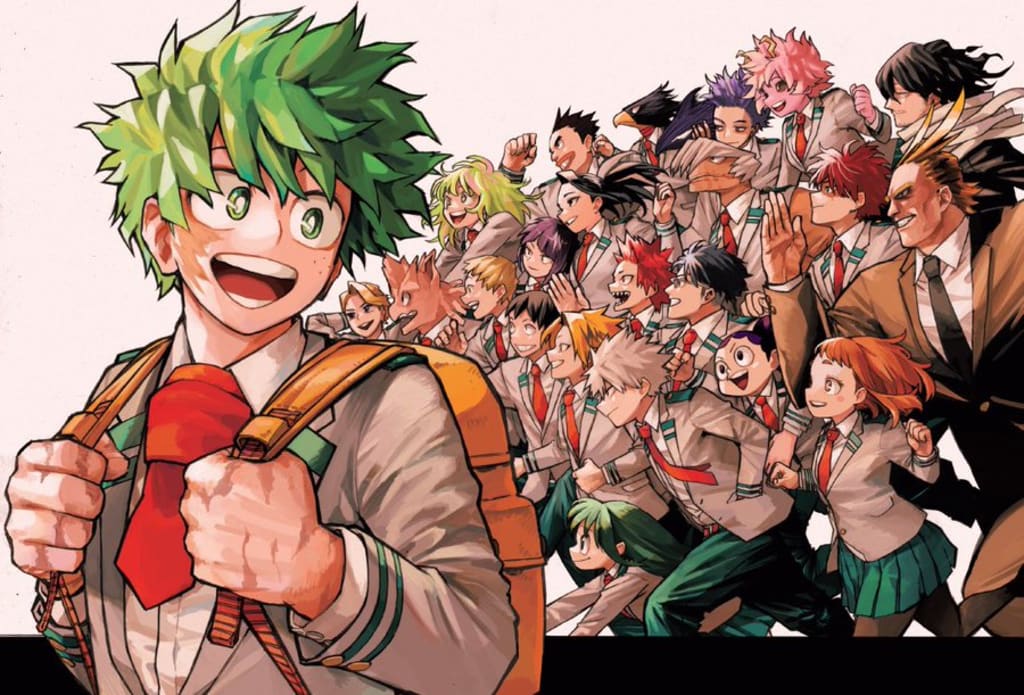
1. My Hero Academia
"The Story of Those Without Talent" Hits Hard in an Unequal Society
My Hero Academia — whose manga has already ended and whose anime recently concluded as well.
In this world, about 80% of the population is born with a power called a "Quirk," and those who master their Quirk become heroes.
The protagonist, Izuku Midoriya, dreamed of becoming a hero — but he was born Quirkless.
From the title and cover art alone, it looks like a straightforward battle manga.
But at its core, it's a story about people who suffer because of inequalities they were born into.
There's no way this doesn't hit home for today's young people.
In Japan, the term "oya-gacha" (parent lottery) has spread rapidly over the past few years.
Gacha refers to those coin-operated toy capsule machines — you never know what you'll get.
So oya-gacha means: "Which parents you're born to is completely up to luck, and that luck determines most of your life" — a bleak slang term that captures a painful reality.
Born into a wealthy family? You get tutors, extracurricular activities, a path to university.
Born without that? No lessons, and the choice between taking on debt for college or skipping it entirely and going straight into the workforce.
And when you open social media in the middle of all that anxiety and suffocation, you're immediately hit with the glamorous daily lives of rich kids.
For Japanese people struggling with that sense of "inequality" — always measuring themselves against others — Deku was an easy character to connect with.
And yet Deku himself never gives up. He keeps pushing toward becoming a hero. He tries to save the world.
For young people on the verge of thinking "without talent, what's the point" — that's a genuine kind of salvation.
What's also worth noticing is that every character beyond the protagonist has their own background.
Many of the villains are depicted as people who were abandoned by society.
They're not simply evil — they're products of the distortions of an unequal world. And they found their way to All For One, a figure of darkness.
Meanwhile, among the heroes, there are those who came from dark home environments — people who, one wrong turn, could have ended up on the other side. But they had an encounter with a hero.
Who you meet. Who you never meet.
It's a direct reflection of modern Japan, where inequality and isolation have become serious social issues.
That, I think, is why all of Japan became obsessed with this anime.
This story began as a manga, was adapted into anime and film, and came to a close — leaving behind a flood of voices that didn't want it to end.
I myself am torn every day between wanting to see them continue as full-fledged heroes in a sequel, and wanting it to end just the way it did, cleanly and beautifully.
2. Oshi no Ko
The Darkness of Idol Culture and Social Media, Right There on Your Phone
The manga concluded in 2024, and a major live-action drama and film adaptation followed — Oshi no Ko.
This isn't a series Japanese youth simply "know about." It's one they felt in their bodies.
Around this time, isekai (reincarnation) manga and anime were everywhere in Japan.
And then this series opens with an idol-obsessed doctor being reincarnated — as a baby.
Most people probably thought: "Oh, the usual reincarnate-and-become-overpowered thing."
But the doctor is reborn as the child of the very idol he was a fan of.
And that idol is killed right in front of him.
Nothing pop. Nothing fantasy. It's just dark.
After witnessing that, he enters the entertainment industry to expose what's hidden underneath. That's episode one. Dense doesn't begin to cover it.
But the real heart of this series is a sharp critique of "an entertainment world built on lies and illusions" — and of "an SNS culture that consumes those illusions innocently, then turns to abuse the moment something doesn't go its way."
Japanese idol culture has its own unique rules.
No dating. Performing amateurish innocence. A simulated closeness with fans. Being pure, inexperienced with men.
Idols are required to sell a "dream."
And the moment that dream cracks even slightly, adoration turns to hatred. It's a terrifying world.
When a beloved YouTuber gets "cancelled," criticism piles on instantly.
A female idol's scandal can follow her for months — with attacks relentless enough to make it impossible to keep working.
And still, Japanese people keep searching for a new "oshi" — a new idol image to love.
The line in the series, "a lie can be the greatest act of love," resonates deeply with Japanese culture, where switching between your public face and your true self is practically a survival skill.
Everyone has some kind of "oshi." Everyone is playing some kind of role.
It's no surprise this series shook young people to their core.
3. ONE PIECE
The Ideal of "Nakama" — Born from a Rejection of Japan's Top-Down Society
ONE PIECE, which has been running since 1997, is now past the Egghead Arc and heading into its final chapters — and every week in Japan feels like a festival.
Over 500 million copies sold worldwide.
This series doesn't just create a social phenomenon. It is one.
But let me ask again: why hasn't ONE PIECE faded, even after all these decades?
One answer lies in the structure of the Straw Hat crew itself.
Luffy doesn't give orders. He doesn't scold. He doesn't manage people.
He just says "I believe in you" and charges ahead toward wherever his crew can shine brightest.
And his crew trusts him not as a boss — but as one of them.
This is exactly what young Japanese people are looking for in a workplace.
Japan has long been a society defined by seniority systems and the idea that older automatically means higher-ranking.
But today's youth feel a strong discomfort with that structure.
"Why am I evaluated by age instead of ability?"
"Why do I have to manage the mood of a boss who's worse at the job than I am?"
That frustration gets projected onto Luffy's style of leadership — and it becomes something they long for.
The Straw Hat crew members also each carry their own wounds from the past.
The pirate who stole Nami's home. The government that hunted Robin for years. The promise Zoro couldn't keep.
They don't blame each other for those wounds. They just choose to keep moving forward together.
People who've been hurt, connected by something horizontal — not a hierarchy.
There's no question that modern young people, who often feel alone, find a sense of belonging in that.
4. Dragon Ball
Pride Passed Down Across Generations, Across Borders
Dragon Ball ran for only 11 years — and yet, more than 30 years after it ended, remakes and new projects keep coming without pause.
For today's children, Dragon Ball is "a story that existed before they were born" — and still, they go to the park and turn Super Saiyan. If they find seven balls, they're calling Shenron.
Parents who watched Dragon Ball as kids show the remakes to their own children.
New installments come out, and the next generation goes wild.
This cycle of inheritance, crossing generations, keeps spinning — year after year, unchanged.
In Japan, there's a deep cultural sense that identity is something you inherit.
Companies, household rules, land and property, the local festival.
There's meaning and pride in the act of carrying something forward.
Dragon Ball embodies that feeling as entertainment.
I've also heard that people all over the world name this series as the reason they fell in love with anime in the first place.
The fact that the very series that served as that "entry point" is still alive and still expanding — that says something extraordinary about the staying power of Japanese content.
And for Japanese people, nothing is more genuinely moving than knowing that someone, somewhere across the ocean, loves something you love too.
5. Blue Lock
The Obsession with "Egoism" Reveals What Japanese Youth Really Feel
The most radical series in Japanese anime right now is Blue Lock.
A massive live-action film adaptation is coming this summer, and the excitement has hit its absolute peak.
The premise is simple.
A man who wants to make Japan the best soccer team in the world gathers promising high schoolers and puts them through extreme competition.
But the core of this series isn't the setup — it's the ideology.
There's a message repeated throughout:
"If you want to become the world's greatest striker — become an egoist."
Don't play for the team. Stop holding back for your teammates. If it means scoring your goal, steal the ball from your own side. Be honest about what you want.
This hit Japanese people like a truck.
In Japan's schools and workplaces, the value of "stand out and you'll be resented" runs deep.
Excessive self-expression is seen as selfish. Stepping outside the group means you "can't read the room."
From a young age, people are taught to prioritize manners and other people's feelings above all else.
Most Japanese people won't dance in the middle of the street. It would get in other people's way.
Most Japanese people, when they think of something they want to do, first scan the room. Will this be a nuisance? Will I bother someone?
And then they tend to side-eye anyone who doesn't go through that same mental process.
Japan is a country where the desire to "express more of yourself" and "be recognized" gets suppressed — and people get so used to that suppression that they stop noticing it.
But Blue Lock is a world where you throw all of that away.
It's something that tells you: "Your desires are worth asserting."
And still, this series isn't simply advocating for individualism.
As the story progresses, the egoists collide against each other's egos — and out of that collision, something remarkable emerges: genuine teamwork.
Push "self" to its limit, and on the other side, a new kind of connection is born.
In a way, it's a proposal for a whole new relationship between the individual and the group.
Anime Is, Right Now, the "Language" of Youth
I only know the Japan I can see from here — so I can't say for certain what makes a series travel across oceans and be loved.
But I can say this without hesitation: every single series I've introduced here will move you. Emotions, thoroughly wrecked.
If you drop your favorite anime in the comments, I promise I'll put together a piece on how Japanese people have reacted to it.
I'd be genuinely happy if even one new series finds its way into your life.

About the Creator
Enjoyed the story? Support the Creator.
Subscribe for free to receive all their stories in your feed.
Comments
There are no comments for this story
Be the first to respond and start the conversation.