
29 vs. 29: What 50 Years of Smoking and Sunscreen Did to Hollywood
A side‑by‑side look at Dennis Stewart, Tom Holland, and the lines we don't see until we look in the mirror.
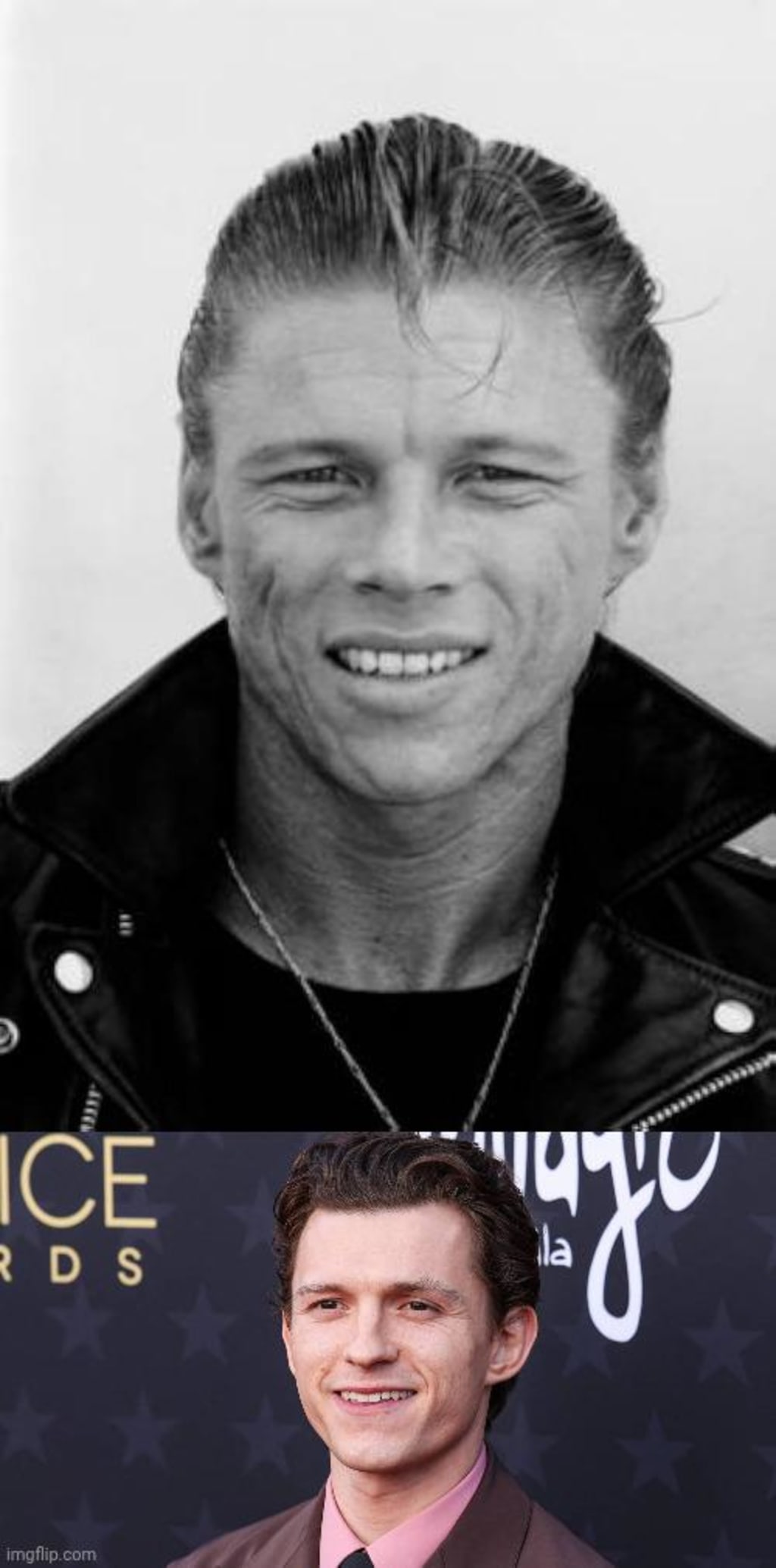
Two faces on a screen.
The one on the left comes from the set of Grease in 1978. Dennis Stewart, twenty‑nine years old, plays a gang member called "Crater Face." Half his jawline is swallowed by shadow; from cheekbone to mouth, the skin is pitted, like an old plank sanded too many times, or a construction site after rain before the holes get filled. The one on the right is Tom Holland, also twenty‑nine, just off a Spider‑Man shot, with smooth skin, a tight jaw, and not a single forehead crease in sight.
Someone put the two images side by side and took a screenshot. The first comment read: "What in the actual fuck were people doing to themselves in the 70s?" A finger paused over Stewart's face for two seconds. Then the screenshot was shared eight thousand times.
Seven Butts in an Ashtray
A behind‑the‑scenes photo from the Grease production log shows a metal ashtray next to a folding chair in the rest area. Seven cigarette butts are wedged inside: three with lipstick stains, four crushed out of shape. After each group scene, Dennis Stewart walked back to that chair, lit one, took his drags, then called the makeup artist over. Before she could powder him, she had to wait for him to finish that mouthful of smoke; otherwise the powder would stick to his damp upper lip and show up on the close‑up as a white ring.
He went through most of a pack every day on that set. Not because he was a heavier smoker than anyone else; everyone was. The assistant director's cigarette never went out. The gaffer adjusted lights with one dangling from the corner of his mouth. Even the Pink Ladies passed a pack around during breaks. In 1978, 42 percent of American adults smoked. Nicotine constricted blood vessels. Carbon monoxide pushed oxygen out of the bloodstream. Collagen was slowly dismantled by thousands of chemicals. Stewart did not know any of that back then. He only knew that after wrap he coughed twice and poured himself a glass of whiskey.
Holland does not smoke. He said in an interview that as a kid, watching his father smoke, he thought "that thing makes it hard to breathe." Later, playing Spider‑Man, he did a dozen wire‑flips a day. His lung capacity is nearly a liter more than a smoker's. His dermatologist runs a photoaging check twice a year. The reports have never once shown "elastic fiber fragmentation."
No Umbrella Under the California Sun
In the summer of 1978, Grease shot an exterior scene that ran an entire afternoon. The director made everyone stand on a vacant lot outside Los Angeles, waiting for the clouds to break. No parasol. No SPF. Not even a hat. Stewart's neck tanned in two distinct shades: the part under his collar still flesh‑colored, the exposed part reddening by the hour, turning brown‑black the next day. He rubbed the back of his neck with his palm and thought nothing of it.
The word "sunscreen" had not entered everyday vocabulary back then. Sunscreen was a thick white paste that only beachgoers applied, and they applied it to avoid getting burned, not to avoid getting old. People thought a tan was a good thing, healthy and sexy, like you had just come back from a holiday. Actors even deliberately darkened their faces to look tougher on screen.
Stewart's generation absorbed enough UV radiation in their teens to last a lifetime, and UV light forgets nothing. It cuts tiny fissures into the dermis, and when those fissures heal, they form folds that all show up together by age thirty. Holland was seventeen when he shot his first film. His agent already had a sunscreen spray packed for him, with a two‑hour reapplication rule. He found it annoying at first. Then he saw a skin‑biopsy slide of a fifty‑year‑old actor on the same set and never forgot it.
Those Pits Stayed
The hollows on Stewart's face were not from the sun. At seventeen, he developed severe cystic acne: hard, swollen lumps crowding both cheeks, aching when they touched the pillow. The dermatologist at the time prescribed benzoyl peroxide, a high‑concentration oxidizer that turned the skin white and flaky, like peeling paint off a wall. Every night he spread that paste over his cheeks. When it dried, the edges curled up white, and every morning he washed it off with hot water and put on another layer. The inflammation subsided. But the places where the dermis had been stretched open never filled back in.
Those pits stayed for thirty years. On the Grease set, the makeup artist layered on two extra coats of foundation, but once the lights hit, the shadows along the crater rims still showed. The director did not suggest any corrective work, because one line of dialogue had another character yelling at him: "Get lost, Crater Face." That line was written for him.
If Holland gets one pimple, his dermatologist has a plan within twenty‑four hours: low‑concentration retinoic acid spot treatment, an oral anti‑inflammatory, flat in three days. He is twenty‑nine now, without a single acne scar on his face. Not because his genes are better. Because at seventeen, he had access to everything Stewart never did.
A Photo That Never Made the Film
Later, someone dug up a discarded still. Stewart is sitting on the folding chair, head down over the script, one hand covering half his face, exactly the side with the deepest scarring. The gesture looks habitual. He probably never even noticed. Whenever someone came near, he would turn his face slightly, letting the shadow mask that side.
In that photo, he is wearing a grimy white tank top, his shoulders sunburned red, his fingers pinching the edge of the script where the pages have gone soft with sweat. He is twenty‑nine, the same age as Holland. If you ignore the marks on his face, his eyes do not have many wrinkles, just a little tired, like he has just finished a scene that required him to shout.
After I Turn Off the Screen
I closed the comparison image. The phone screen went dark, reflecting my own face back at me, thirty‑one, with a faint line at the corner of my eye from last summer, a day I skipped sunscreen. I stood up, walked to the bathroom, picked up the bottle labeled SPF 50, squeezed out a strip, and smoothed it slowly over my skin.
Outside the window, no cigarette smoke, no studio lights. The convenience store downstairs still sells that old brand of cigarettes, but they keep it on the bottom shelf, under the grey‑lettered warning: "Smoking is harmful to your health."
Nobody knows where Dennis Stewart went after that. He made only a few more films after Grease. Nine years later, he appeared briefly in a low‑budget picture. The pits were still there, but he had grown thinner.
I screwed the cap back on the sunscreen and put it back on the shelf. The face in the mirror was not all that young. But it did not look sixty‑two, either.
That is enough.
About the Creator
Jin
Writer of reamstories
https://reamstories.com/jin
Enjoyed the story? Support the Creator.
Subscribe for free to receive all their stories in your feed. You could also become a paid subscriber, letting them know you appreciate their work.
Comments
There are no comments for this story
Be the first to respond and start the conversation.