
168 Million Nights: What Short Dramas Understand About Tired People That Long-Form TV Doesn't
Hongguo now has more daily users than iQiyi, Tencent Video, Youku, and Mango TV combined. The reason isn't better storytelling. It's the twelve minutes before sleep.
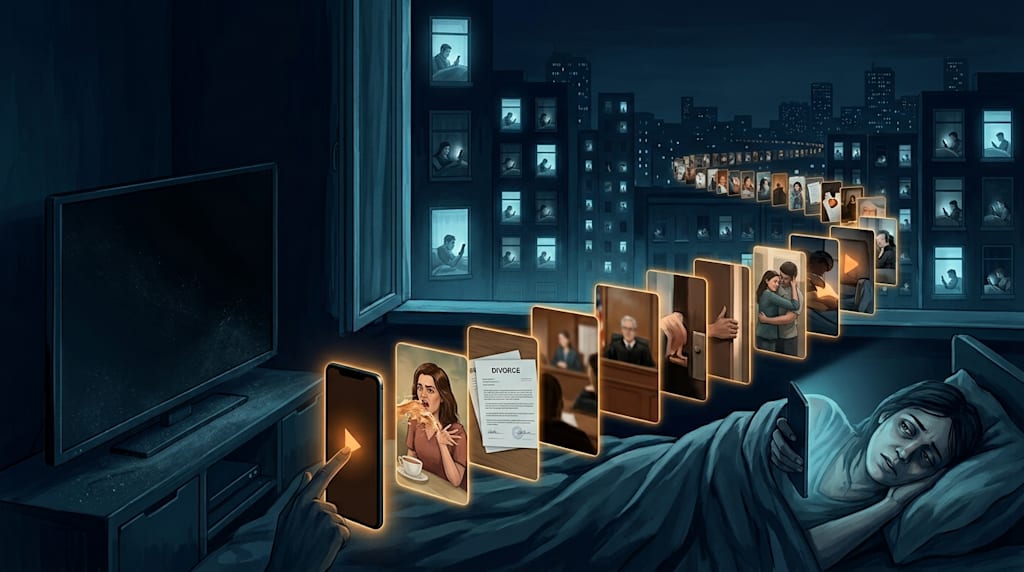
168 million nights
At 10:30 p.m., a man finishes cleaning the kitchen. He wipes the stove, wrings out the dishcloth, and drapes it over the faucet. He lies down on the bed and picks up his phone.
First, he opens a long-video platform. The homepage recommends a new drama. The cover is polished. The description says “a major production of the year.” He taps in. The first two episodes are all setup. Characters appear one after another. By the third name, he has forgotten the first. He exits. He opens another drama. Beyond VIP, there are extra episodes, advance screenings, three yuan per episode. He does the math, puts the phone on his chest, and stares at the ceiling for a few seconds.
Then he turns over and opens Hongguo.
Thirty seconds in, a woman has tea thrown in her face by her mother-in-law in public. At one minute, her husband is scrolling through his phone, saying nothing. At ninety seconds, she wipes the tea leaves off her face and smiles. At two minutes, her phone rings. It is a lawyer.
His thumb hovers over “Next Episode,” as practiced as pressing an elevator button.
This is the smallest unit of Hongguo Short Drama’s 168 million daily active users: one night. Countless nights like this added together become a number.
A report from Nomura Securities shows that as of July 2026, the standalone Hongguo app reached 168 million daily active users, a year-over-year increase of 107%. Over the same period, iQiyi, Tencent Video, Youku, and Mango TV had a combined total of about 155 million. Tencent Video had about 50 million, iQiyi about 45 million, and Youku and Mango TV about 30 million each.
This comparison only counts mobile standalone apps. It does not include web or TV. When users open Hongguo to check in, collect coins, or watch ads, that also counts toward daily active users. So it cannot be directly used to conclude that “Hongguo’s business value has already surpassed the four combined.” Daily active users are attention, not revenue. The money of iQiyi, Tencent Video, Youku, and Mango TV mainly comes from membership subscriptions. Hongguo’s mainly comes from advertising. They do not belong on the same ledger.
But 168 million still says one thing: users have already voted with their thumbs.
The wall that free tore down
The business model of iQiyi, Tencent Video, Youku, and Mango TV was built on a paywall. Users pay. The platform provides content. That model ran for ten years. Membership numbers were once the industry’s most important metric.
But the paywall was also a filter. It filtered in people with a strong willingness to pay, and filtered out people with a strong willingness to watch but a weak willingness to pay. Older users, lower-tier market users, students, recent graduates. They wanted to watch. They did not want to pay first for something that might not be good.
Hongguo removed the wall. Free to watch, ad-supported. Users pay attention. The platform sells that attention to advertisers.
This was not a model Hongguo invented. But it made the model work. The market share of free short drama climbed from about 11% in early 2024 to more than 50% by the end of the year. People who had been shut out by the paywall were, for the first time, seen at scale.
A woman in her fifties, after lunch in the factory cafeteria, takes out her phone and watches two episodes. She does not know what VIP is, and she does not care. She only knows that when she taps, it plays, and when one episode ends, the next starts automatically. She watches “The CEO’s Wife Is Thrown Out” and “The Rural Daughter-in-Law Rises.” These stories are far from her life, but the humiliation in them is close.
Douyin’s pipe, Tomato’s shelf
Hongguo did not grow out of nothing.
More than half of its new users come from Douyin. A person sees a clip on Douyin: a woman kneels on the floor wiping it, a man throws divorce papers in her face. The clip ends there. In the comments, someone asks, “And then?” Someone replies, “Search the title on Hongguo.” He taps the link, jumps to Hongguo, and watches eighty episodes in one go.
Tomato Novel is further upstream. It provides a large number of market-tested web novel IPs: CEO romance, rebirth, revenge, counterattack. These stories have already been filtered by readers’ click-through rates in text form. Hongguo films them, much lower risk than original production.
The algorithm is in the middle. Hongguo and Douyin share the same underlying recommendation logic. If a user watches “mother-in-law conflict,” the homepage recommends “mother-in-law conflict.” If they watch “workplace counterattack,” the next one is “workplace counterattack.” It does not ask, “What do you want to watch?” It looks at “What did you just watch?” Every one you swipe away tells it what to recommend next.
A long-video platform bets on one big drama: stars, sets, marketing, scheduling. Cost in the hundreds of millions, cycle of a year, and if it flops, it is a huge sunk cost. Hongguo is like putting hundreds of flavors on a shelf at once: this one is not good, swipe away; that one performs well, invest more; a certain character type works, and within a week a batch of variants appears.
Product efficiency beat long content. Short-form video was how it arrived. A product system collided with a traditional broadcast mentality.
The thirtieth second
Long dramas ask the audience to enter a world.
You have to remember relationships, understand the era, wait for foreshadowing to pay off. The first two episodes are setup. The third enters the main plot. The fifth has a small climax. The tenth reveals the core conflict. This is “ceremonial viewing.” It requires preparation, focus, patience.
Short dramas do not ask for that.
At thirty seconds, a character is humiliated. At sixty seconds, the conflict escalates. At ninety seconds, identity is reversed. It gives you the pleasure first, then asks: next episode?
An office worker may indeed have forty minutes at night. But he may not have the mental energy to follow three character lines, remember six names, and wait for foreshadowing to pay off. He just finished overtime. He stood on the subway for forty minutes. He still has to reply to work messages at home. What he has left is only enough to watch someone get slapped, and two minutes later slap back.
Short drama offers entertainment that can be consumed even in a low-energy state. Flat characters are fine. On-the-nose dialogue is fine. As long as I do not have to work hard to quickly know who has been wronged, who is the villain, and when the face-slapping will happen.
Betrayal in marriage. Favoritism in family. Humiliation at work. The rich’s disdain for ordinary people. Middle-aged fantasies of starting over. The villain immediately suffers. The good person immediately rises. Lost dignity is restored two minutes later.
Professor Zhao Hui of Communication University of China points out that long-video users watch with an “appreciation attribute,” while Hongguo short drama is essentially a content aggregation platform with strong social and e-commerce attributes. What users consume is immediate emotional value.
Viewers moved from appreciation to consumption. Deep immersion gave way to dense stimulation. Being filtered gave way to being satisfied.
Five tigers share the prey
Traditional film and television’s rival was never just short drama.
Five categories compete for the same attention: short video, micro-drama, livestreaming, games, and concerts. Short video takes fragments of time. Micro-dramas take bedtime and commutes. Livestreaming offers companionship and instant interaction. Games offer participation and immersion. Concerts offer offline ritual and social currency.
Long-video platforms also have their own problems: watered-down openings, slow starts, complicated membership rules, unstable supply of good content. The platform raises the viewing threshold while asking exhausted people to prove they love art.
When a user on a long-video platform has to deal with membership, ads, extra episodes, advance screenings, and device limits, Hongguo only needs him to tap “Next Episode.”
When attention is scarce, lowering the threshold for pleasure is a competitive advantage.
K-shaped divergence
168 million daily active users does not mean long dramas will disappear.
More likely is K-shaped divergence: short drama goes up, becoming “default entertainment”; long drama goes down, becoming “event-based consumption.”
Short drama is like fast food. It does not chase Michelin stars, but it is everywhere and quickly satisfying. It occupies fragments of time and becomes the default option people open without thinking.
Long drama is like a meal you have to schedule. Viewers turn off their phones on the weekend, make a cup of tea, and watch a good drama immersively. It carries deep narrative, character arcs, and social issue exploration that short drama cannot replace.
Excellent long dramas will still become national conversation topics. It is just that they increasingly look like an “event” that requires setting aside dedicated time.
And most ordinary nights will be taken by short drama first.
The thumb that presses the elevator button
Hongguo’s 168 million, in the end, is just countless nights like this added together.
A person has only twelve minutes before bed. Whoever can introduce a character at the thirtieth second, create conflict at the sixtieth second, and leave a hook at the ninetieth second is more likely to take those twelve minutes.
Efficiency won. Attention won. Product thinking won.
Excellent long dramas will still become national conversation topics and still make people willing to set aside whole blocks of time. But before that, on most tired, ordinary, brain-off nights, people will open the app that requires the least effort.
The light from the phone screen reflects on the ceiling. His thumb hovers over “Next Episode,” as practiced as pressing an elevator button.
Hongguo did not take 168 million people. It took 168 million nights.
About the Creator
Jin
Writer of reamstories
https://reamstories.com/jin
Enjoyed the story? Support the Creator.
Subscribe for free to receive all their stories in your feed. You could also become a paid subscriber, letting them know you appreciate their work.
Comments
There are no comments for this story
Be the first to respond and start the conversation.