
10 Types of Office Desks and Their Uses
Explore the different types of office desks and their uses, including writing desks, standing desks, L-shaped desks, and more to help you choose the right setup for productivity and comfort.

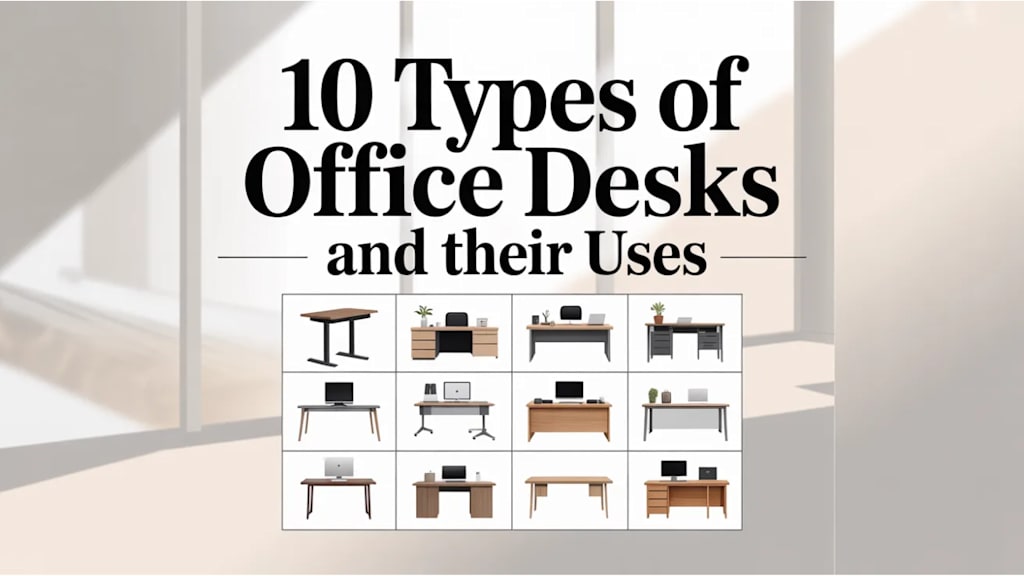
An office desk might look like a simple piece of furniture, but it quietly shapes how you work every single day.
It affects your posture, your comfort, your focus, and even how productive you feel over long hours. The wrong desk can make work feel tiring and cramped, while the right one can make your space feel organized, open, and easier to use.
Most people choose a desk based on appearance or price. But in reality, different types of office desks are designed for very different needs. Some are built for long computer work, others for storage, collaboration, or flexible setups.
In this guide, we will explore the main types of office desks and how each one is used in real work environments. This will help you understand not just what they are called, but when and why they actually make sense.
Why the Type of Desk Matters More Than People Think
A desk is not just a surface to place your laptop on.
It influences how your body sits, how you organize your tools, and how efficiently you move through your tasks. A poorly chosen desk can lead to clutter, poor posture, and wasted space.
On the other hand, the right desk supports your workflow. It keeps things within reach, reduces unnecessary movement, and helps you stay focused for longer periods.
That is why understanding desk types is important before choosing one.
1. Standard Writing Desk
The writing desk is one of the simplest and most traditional types of office desks.
It usually has a flat surface with minimal storage. The design is clean and open, making it suitable for writing, reading, or light computer work.
This type of desk is often used in home offices or small spaces where simplicity is preferred over storage-heavy designs.
It works best for people who do not need multiple monitors or heavy equipment. Writers, students, and light office users often find this desk comfortable because it keeps distractions to a minimum.
However, the lack of storage can be a limitation if you need to keep documents or accessories nearby.
2. Computer Desk
Computer desks are specifically designed for working with digital devices.
They often include features like keyboard trays, cable management systems, and space for monitors or CPUs. Some even have built-in shelves for accessories.
The main goal of a computer desk is to create an organized setup for screen-based work.
This type of desk is widely used in both home offices and corporate environments because most modern jobs involve computers.
While they are practical, some designs can feel restrictive if they are too focused on fixed setups. That is why choosing the right size and layout is important.
3. Executive Desk
Executive desks are larger, more formal desks often found in managerial or leadership offices.
They usually have a solid, bold design with multiple drawers and a wide surface area. The purpose is not just functionality but also presence.
These desks are meant to create a sense of authority and professionalism in an office space.
They are ideal for people who handle paperwork, meetings, and administrative tasks at the same time.
The downside is that they require more space and are not suitable for small rooms or minimal setups.
4. Standing Desk
A standing desk is designed to allow work while standing instead of sitting.
Some models are fixed, while others are adjustable so you can switch between sitting and standing positions throughout the day.
The main idea behind a standing desk is flexibility. It helps reduce long periods of sitting and encourages movement during work.
Many people use standing desks to improve comfort and reduce stiffness caused by long hours of sitting.
However, it is not meant to replace sitting completely. The best use comes from alternating between sitting and standing.
5. L-Shaped Desk
An L-shaped desk is designed in a corner format, giving you two connected work surfaces.
This layout is ideal for multitasking or managing different types of work at the same time. For example, one side can be used for a computer setup while the other is used for writing or paperwork.
It is especially useful in home offices where space optimization matters.
The biggest advantage of this desk is organization. You can separate tasks physically, which often helps improve focus.
However, it requires more floor space compared to standard desks.
6. U-Shaped Desk
A U-shaped desk offers even more workspace by surrounding you on three sides.
It is commonly used in executive offices or professional environments where multiple tasks are handled at once.
This type of desk allows everything to be within arm’s reach, which improves workflow efficiency.
It is ideal for people who work with multiple devices, documents, or ongoing projects simultaneously.
The only limitation is that it requires a large dedicated space and can feel overwhelming in small rooms.
7. Floating Desk
A floating desk is mounted directly to the wall and does not have traditional legs.
It is designed for compact spaces where floor area is limited.
This type of desk is often used in apartments, small home offices, or minimalist setups.
It provides just enough surface for a laptop or basic work essentials.
While it saves space, it is not suitable for heavy equipment or long working hours.
8. Adjustable Height Desk
An adjustable height desk allows you to change the height of the surface to suit your comfort.
Unlike fixed desks, this type supports both sitting and standing positions.
It is often used in modern workspaces that focus on flexibility and ergonomics.
Many people prefer this type of desk because it allows movement throughout the day without changing furniture.
It pairs well with an ergonomic chair when used in sitting mode.
The main advantage is adaptability, but these desks are usually more expensive than standard options.
9. Secretary Desk
A secretary desk is a compact desk with a fold-down writing surface and built-in storage compartments.
It has a classic design and is often used in smaller rooms or traditional-style interiors.
This desk is great for organizing stationery, documents, and small office items in one place.
It is more suitable for light office work or writing tasks rather than heavy computer use.
Its charm lies in its compact and organized structure.
10. Reception Desk
A reception desk is designed for front-office or welcoming areas in businesses.
It is usually larger and structured to accommodate both staff and visitors.
The design focuses on accessibility and first impressions. It often includes storage for documents and space for computers used for check-ins or customer service.
This type of desk plays a functional and visual role in professional environments.
It is not typically used for deep work but rather for communication and coordination tasks.
How to Choose the Right Office Desk
Choosing the right desk depends on how you work and how much space you have.
If you mostly use a computer, a computer desk or adjustable height desk might be ideal. If you handle multiple tasks at once, an L-shaped or U-shaped desk may suit you better.
For small spaces, floating or writing desks are more practical. For formal environments, executive desks offer both function and presence.
The key is to match the desk to your daily workflow instead of choosing based on looks alone.
Final thoughts
Office desks are not just furniture pieces. They shape how you work, how you organize your space, and how comfortable your daily routine feels.
Each type of desk serves a different purpose, from simple writing surfaces to large executive setups and flexible standing systems.
Understanding these differences helps you avoid choosing a desk that looks good but does not actually support your work style.
In the end, the best desk is not the most expensive one or the most popular one. It is the one that fits your space, your tasks, and your way of working naturally.
About the Creator
Saif
Exploring different parts of life.
Enjoyed the story? Support the Creator.
Subscribe for free to receive all their stories in your feed.
Comments
There are no comments for this story
Be the first to respond and start the conversation.