
U4gm Why You Should Skip Every Side Quest in MLB The Show 26 Diamond Quest Today
Skip Every Side Quest in MLB The Show 26 Diamond Quest Today.

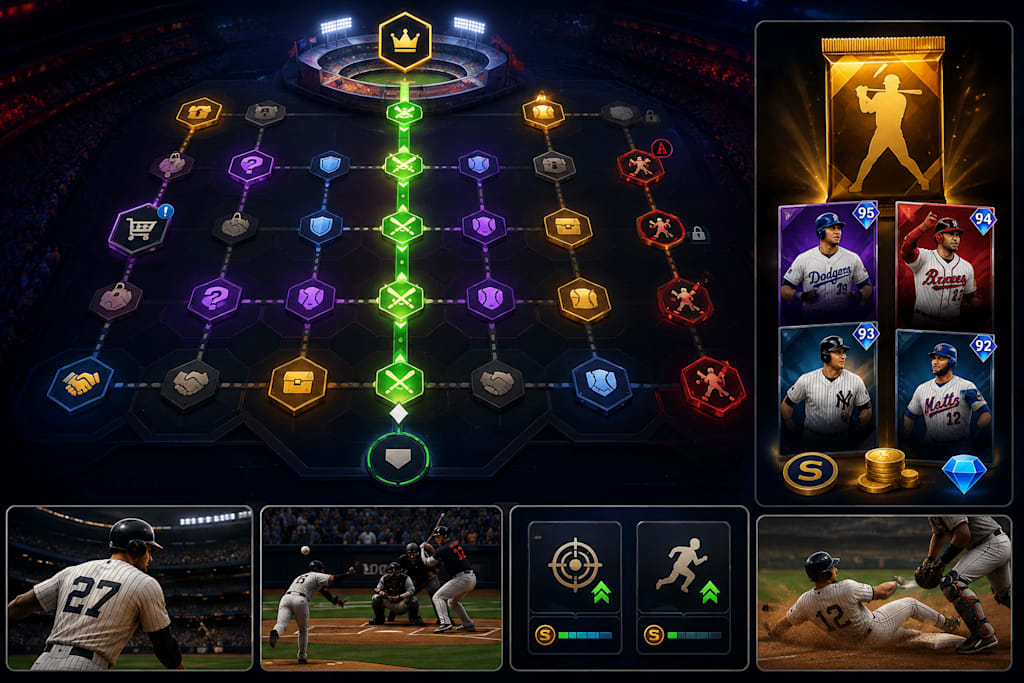
Thursday in MLB The Show 26 is no longer just a content refresh point. It functions more like a volatile trading session in a live economy. With the May 28 weekly reset introducing amplified Peanut Token multipliers across the Diamond Quest board, player behavior has shifted from casual progression to aggressive resource extraction.
Across r/MLBTheShow, a growing number of high-efficiency players are abandoning traditional full-clear strategies entirely. The logic is simple: every additional tile you clear that is not directly contributing to final reward unlocks is lost Stub potential. In a system where rewards are time-gated and market-sensitive, inefficiency is effectively a tax.
I started looking at it less like a game mode and more like a short-term asset cycle. And once you do that, the optimal path becomes obvious.
The Full-Clear Trap: Why Completionism Is Costing You Stubs
On the surface, Diamond Quest is designed to reward exploration. Side chests, optional nodes, and bonus encounters appear to increase total value per run. In practice, they function as volatility sinks.
Every detour into a side tile introduces three hidden costs: increased innings played, higher CPU difficulty scaling, and delayed access to reward triggers. While you are grinding out a marginal silver pack on a peripheral node, the market value of Live Series cards and featured pulls is actively shifting in real time.
The key insight is that value in MLB The Show is not static. It decays with time and player saturation.
This is why high-efficiency players are moving toward what can only be described as a Zero-Waste Midline Route.
Instead of clearing the board, you ignore it.
You enter, you move vertically through only mandatory progression nodes, and you exit through the final Stadium Boss chain as quickly as the system allows. The goal is not exploration. The goal is reward compression.
The Efficiency Model: Treating Runs Like Economic Cycles
Once you abandon full clears, Diamond Quest stops being a content map and starts behaving like a short-duration yield loop.
A typical optimized run today looks like this:
Enter board immediately after reset
Ignore all side chests and optional reward branches
Chain only required Spectacular Play gates
Reach final boss in minimum possible match count
In practice, this reduces total session time to under half an hour for experienced players.
That time compression is where the real advantage emerges. Because rewards are distributed in fixed cycles, faster completion effectively increases your hourly Stub acquisition rate without changing drop probability.
In economic terms, you are increasing throughput, not yield.
Micro-Budget Allocation: Spending Peanut Tokens Like Liquid Capital
A common mistake during fast clears is overinvesting in long-term board perks. But when your strategy is built around rapid completion, long-duration buffs lose their value window before they can fully pay out.
Instead, Peanut Tokens should be treated as liquid tactical capital.
The most efficient allocations fall into two categories:
Immediate Contact Stabilizers
Boosting PCI coverage against the expected Boss pitcher archetype ensures you reduce at-bats per game. Fewer innings equals faster cycle completion.
Tempo Acceleration Tools
Base-running speed and aggression modifiers directly reduce time spent in each match. A stolen base that turns a single into a scoring opportunity is not just a play—it is a time compression event.
The goal is not optimization for performance. It is optimization for duration.
Anything that does not reduce time-to-finish is a liability.
Market Timing: Why Early Rewards Matter More Than Rare Pulls
The most overlooked layer of Diamond Quest is its relationship to the broader Stub market. Early in the Thursday reset window, reward saturation is low. That means any Rare Pack pulls or high-value Live Series cards enter a temporarily under-supplied market.
This creates a short-lived arbitrage window.
Players who complete their runs quickly are effectively liquidating assets into a low-supply environment. As the weekend approaches, casual players flood the system with additional supply, driving prices downward through volume dilution.
This is where timing becomes more important than luck.
Holding cards is often a losing strategy during high-volume cycles. The optimal play is immediate liquidation. You are not collecting assets—you are cycling inventory through a temporary price peak.
The Real Game Is Time Arbitrage
Once you understand Diamond Quest through this lens, the entire mode changes character. It stops being a progression path and becomes a time-arbitrage loop. The players who win are not necessarily the ones who play the best—they are the ones who exit the fastest with usable assets.
And in that framework, every side quest, every optional chest, and every unnecessary inning is not just inefficient. It is a missed economic opportunity.
About the Creator
Billo Nali
Step into the thrilling world of u4gm, your go-to destination for the latest game updates, expert strategies, and exclusive tips.
Enjoyed the story? Support the Creator.
Subscribe for free to receive all their stories in your feed.
Comments