
The Red Line That Never Was: Why Snezhnaya’s Technology Isn’t the Real Threat
Celestia doesn’t punish progress. It writes a sentence, then lets fate finish the job.
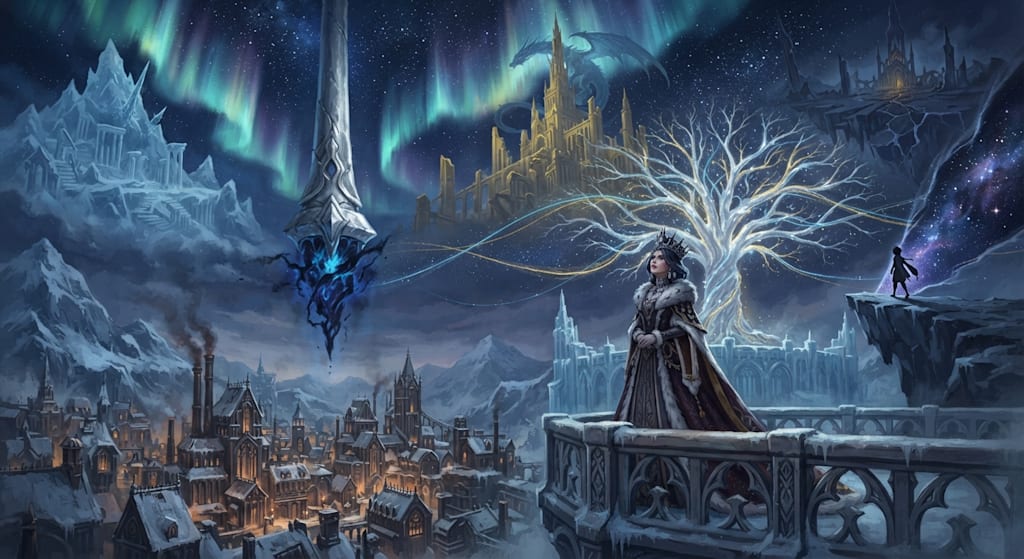
I. The Misread Red Line
Has Snezhnaya’s civilian technology touched the red line of the Heavenly Principles? The question keeps returning in community debates, but it carries an unexamined premise: that a red line exists, calibrated by technological level, and that crossing it brings punishment.
That premise does not hold.
As of Version 7.1, Snezhnaya’s civilian technology has regressed compared with the era of the White Tsar. Boilers, trains, and urban infrastructure are not more advanced. If the Heavenly Principles drew a red line at some point on a technological scale, Snezhnaya should be safer than it was under the White Tsar. The Tsaritsa’s narrative says the opposite. Snezhnaya’s technology faces the threat of Divine Nail sanctions at any moment. Why would a nation whose technology is regressing fear that technology will bring destruction?
The answer lies elsewhere. The Heavenly Principles’ red line was never on a scale of technological level. To understand what the Heavenly Principles punish, look at what Divine Nails do.
II. Divine Nails: Repairers, Not Punishers
The most common misunderstanding in the community treats Divine Nails as punitive tools dropped when a civilization crosses a line. Game text does not support that reading.
Divine Nails repair damage to the world caused by the Abyss. Records from The Chasm state that after the war in the Year of Fallen Embers, Phanes dropped crystal nails to purge Abyssal forces. Seven Divine Nails fell on Teyvat. The vast majority were tied directly to Abyssal contamination. In the Year of Fallen Embers, the ley lines were severely damaged, and Celestia frequently dropped Divine Nails to repair them. Nails from other periods were also essentially exclusive to Abyssal contamination.
The mechanism resembles an environment rewrite protocol. When the Skyfrost Nail fell on Sal Vindagnyr, it did not physically destroy the city-state. It rewrote the region’s fundamental rules from habitable land to eternal night and deep sea. That kind of revocation order does not punish a civilization. It permanently deletes a region from the world’s list of viable existence. The region has been contaminated or deemed no longer fit to exist.
The cases that were not directly punished by Divine Nails matter more.
Arcadia built a death coffin on the ley lines and caused its silver-white ancient tree to wither. The Heavenly Principles did not drop a Divine Nail. Sal Vindagnyr drew on ley line energy and caused abnormal climate change. The nail there fell to repair the world fracture brought by Nibelung. It had no direct punitive relationship to Sal Vindagnyr’s use of ley lines. Hyperborea’s angels modified ley lines to hold fairy souls and altered the world’s rules for the sake of the afterlife. The Heavenly Principles did not directly intervene.
Khaenri’ah’s Abyssal technology and its extraction of Azoth substances from ley lines pushed against Celestia’s bottom line. The Heavenly Principles did not directly drop a Divine Nail as punishment. Khaenri’ah fell because Abyssal energy spiraled out of control and triggered the dark calamity that swept Teyvat. Only then did the Heavenly Principles join the Seven Archons to suppress it. That was a passive response, not an active sanction. Some analyses suggest that after the war with Khaenri’ah, the Heavenly Principles were effectively paralyzed. Otherwise, Khaenri’ah’s remnants would not have required the Seven Archons. A Divine Nail would have sufficed.
Arranged together, these cases show a pattern. Celestia does not punish a civilization for developing a particular technology. A Divine Nail strikes the damage itself, not the technology that caused the damage. When a civilization’s technological development triggers Abyssal contamination or ley line damage, a Divine Nail falls. Its function is repair, not punishment.
III. The True Crimes of the Destroyed
If Divine Nails are not tools for punishing technology, why were those civilizations destroyed?
Sal Vindagnyr’s destruction has competing interpretations. A common claim says the snow mountain kingdom privately drew on ley line power, so Celestia dropped a nail. A closer reading shows the problem was not ley line energy itself. The problem was the nature of the action. Mortal wisdom saw through part of the world’s truth, then tried to use that wisdom to become a new rule-maker. After the priests and people discovered the sky was false and the world’s rules were not immutable, their ambition became plain: “With this light, act in Heaven’s stead.” That is not simple technological research. It is a direct usurpation of Celestia’s authority over creation. The Skyfrost Nail suppressed a political act, not a technology. The timing supports this. Sal Vindagnyr’s destruction marks the end of the Year of Fallen Embers and the start of the Archon War. The nail was tied to a major node in the reconstruction of world order, not to a milestone in technological development.
Hyperborea is more complex and more instructive. This angel-administered civilization ran experiments that were technically over the line. Angels modified ley lines to contain fairy souls. The former Archangel stole the authority of the Ruler of Life and entrusted it to the wind spirit clan. The golden kingdom tried to forge a Primordial Human from the flesh and blood of the original ice dragon. They tried to create their own god. Yet the true cause of Hyperborea’s destruction was not those experiments. According to the legends of the Children of the Frostmoon, the golden kingdom offended the angels by questioning eternity through wisdom. The Third Descender possessed a youth, pleaded before the envoy sent to punish the golden kingdom, and the golden kingdom was destroyed by a Nail of Judgment. Its out-of-control god-making experiment turned all of Snezhnaya into the holy land of primordial ice. That caused enormous destruction, but it reads more like the execution of a sentence than the basis of the sentence.
The critical record is this: “Hyperborea’s fate was already sealed before the Saint arrived. The sentence of destruction had already been written, and even the eldest daughter of the angels could not change it.” The sentence existed before the crime. The Saint’s intervention and the angels’ efforts postponed the execution by thirty years.
Khaenri’ah follows the same logic. Its Abyssal technology pushed the bottom line, but the Heavenly Principles did not directly punish it. Khaenri’ah fell because Abyssal energy spiraled out of control and triggered the dark calamity. Only then did the Heavenly Principles join the Seven Archons to suppress it. That was a passive response. Khaenri’ah was a nation doomed from the beginning. Its destruction was often an accident and a self-fulfilling prophecy.
These cases show the pattern. Celestia does not punish a civilization for developing a particular technology. It watches whether a civilization challenges order itself, or whether its actions trigger uncontrollable Abyssal contamination. The first is the crime of usurpation. The second triggers the repair mechanism. Civilizations that had their sentence written, such as Hyperborea, often had their fate anchored before their experiments began.
IV. The Grammar of Curse
If Divine Nails are Celestia’s scalpel, prophecy and curse are its most fundamental means of rule.
This fate system feels like euthanasia. It keeps a living civilization going as long as possible. Because it is fate, the longer it goes, the more inevitably it is swallowed by the Abyss. The metaphor captures Celestia’s governing logic. It is not direct violent control. It anchors fate and lets a civilization walk toward a preset end through its own struggles.
This mode of governance resembles the oracles of ancient Greek myth. Oedipus learned the oracle that he would kill his father and marry his mother. He tried desperately to escape. Because of that escape, he walked step by step toward the oracle’s fulfillment. Celestia’s prophecies share this self-fulfilling structure. It does not stop your self-salvation or your struggle. All of it is almost futile. The more you try to break free from fate, the more you pave the road for fate’s fulfillment.
Fontaine’s prophecy is the best-known case. Egeria’s original sin led to the prophecy that Fontaine would be submerged by seawater. Celestia did not actively execute the prophecy. The prophecy was written into the World Tree and became part of the current of fate. All that remained was to wait for it to fulfill itself. Only with the appearance of the Descender did this seemingly unchangeable ending show a possibility of loosening.
Hyperborea’s fate was the same. The Saint’s arrival postponed destruction by thirty years. Prophecy is not absolutely unchangeable. The price of change is extremely high. It often delays rather than reverses.
The curse itself is harmless. The destined destruction inevitably arrives. This is the most exquisite and cruel aspect of Celestia’s governing logic. It does not oppose you directly. It anchors your future in a certain direction, then watches you run madly toward that direction yourself. Celestia does not punish because of prophecy itself. It does not need to. Prophecy is the punishment.
V. Snezhnaya: Willful Defiance, or the Curse Taking Effect?
Back to Snezhnaya. The Tsaritsa believes Snezhnaya can be destroyed in a civilization’s struggle, but it cannot be negated by a single thought of the Heavenly Principles like Khaenri’ah or Hyperborea. She began planning to overthrow the Heavenly Principles. She created mistletoe and energy specialized against Celestia. Her motive is active resistance, a refusal of the fate of being negated by a single thought.
The question remains. Is Snezhnaya’s resistance an effort to break free from fate, or part of fate’s fulfillment?
On the technological level, Snezhnaya’s civilian technology is regressing. The problem lies in its militarized application of Abyssal forces. Snezhnaya’s technological development is touching the edge of forbidden knowledge. The Ruler of Death has stalled its research progress. One player pointed out sharply: “Where exactly did your technology touch the red line? Isn’t it that whole anti-Celestia plan involving the Abyss? It’s not been one or two days. You’ve been plotting for hundreds of years. In these hundreds of years, if you had focused on economic construction, vigorously developed civilian technology, and not touched forbidden knowledge, I refuse to believe you would have touched the red line.”
The curse facing Snezhnaya’s technological development has a concrete manifestation. According to the story, Snezhnayan researchers suffer a death curse when they approach a technological breakthrough. That suggests Celestia’s management system is actively intervening in Snezhnaya’s technological process. From Ronova’s behavior, Celestia’s system is very rigid. As long as one is a little cunning, it is easy to exploit loopholes in the system. What Snezhnaya faces may not be the Heavenly Principles’ intentional punishment. It may be an automatically running fate system. That system triggers an intervention mechanism when it detects the signal of humans evolving without authorization.
What is unsettling is not the curse itself. Snezhnaya is reenacting Hyperborea’s script. Snezhnaya’s Divine Nail originally suppressed the ice dragon’s remains. Those remains are the legacy of Hyperborea’s out-of-control god-making experiment. Today, the Tsaritsa’s rebellion is built precisely on the use of Hyperborea’s leftover technology. The Saint’s alien technology ultimately failed, but it was indeed used to block the Abyss. Is Snezhnaya repeating the same mistake? Is it using resistance against the Heavenly Principles as its name, committing usurpation in fact, and ultimately triggering the same destruction as Hyperborea?
The Tsaritsa’s willful defiance is described by Pierro: “The current civilization of Teyvat has no true dignity, because there is a master above its head, and that master does not treat you as an equal life.” This motive has strong moral justification. Hyperborea’s Saint also tried to change fate. The angels also tried to protect mortals. Their efforts ultimately postponed destruction by thirty years. In the grammar of curse, resistance may be part of fate.
VI. The Only Variable
Celestia’s governing logic works like a Dao-like management. It is impersonal. It works through fate anchoring and prophecy writing. It ends with the self-destruction of civilizations. It does not need constant intervention because it believes in the power of fate. The fulfillers of ancient Greek oracles always ran madly down the road to destruction. Civilizations whose fates are anchored by Celestia often walk toward a predetermined end in the very process of saving themselves.
Snezhnaya’s civilian technology has not touched the red line. This is almost certain. Whether Snezhnaya’s fate is already on the same track as Hyperborea and Khaenri’ah is another question that demands more vigilance. The Tsaritsa’s resistance may stem from a sincere moral appeal. Hyperborea’s Saint was also sincere. Khaenri’ah’s founders were also sincere. Sincerity alone is not enough to change the inertia of fate.
Prophecy is not absolutely unchangeable. Fontaine changed its destruction ending because of the Descender’s intervention. Hyperborea postponed its destruction by thirty years because of the Saint’s efforts. The Descender is the only variable in this fate system that cannot be preset. They come from outside the world and are not bound by Fortuna’s threads of fate. The Saint’s efforts could only postpone destruction by thirty years because the Saint was still an existence within the world, still within the grammar of fate. The Descender comes from outside the world.
The fate of Snezhnaya, and the fate of all Teyvat, may ultimately not lie in the Tsaritsa’s Gnosis. It may lie in the Traveler who came from beyond the sea of stars. The precedent of Fontaine has already proven that a Descender’s intervention can change a written ending. After Fontaine’s ending was changed, did Teyvat’s overall fate also change? Or was destruction merely shifted from one node to another? The game has not yet given an answer.
Hyperborea’s sentence was postponed by thirty years. Fontaine’s prophecy was rewritten by the Descender. Snezhnaya’s ending has not yet been written. Or rather, it has not yet been fulfilled.
About the Creator
Jin
Writer of reamstories
https://reamstories.com/jin
Enjoyed the story? Support the Creator.
Subscribe for free to receive all their stories in your feed. You could also become a paid subscriber, letting them know you appreciate their work.
Comments
There are no comments for this story
Be the first to respond and start the conversation.