

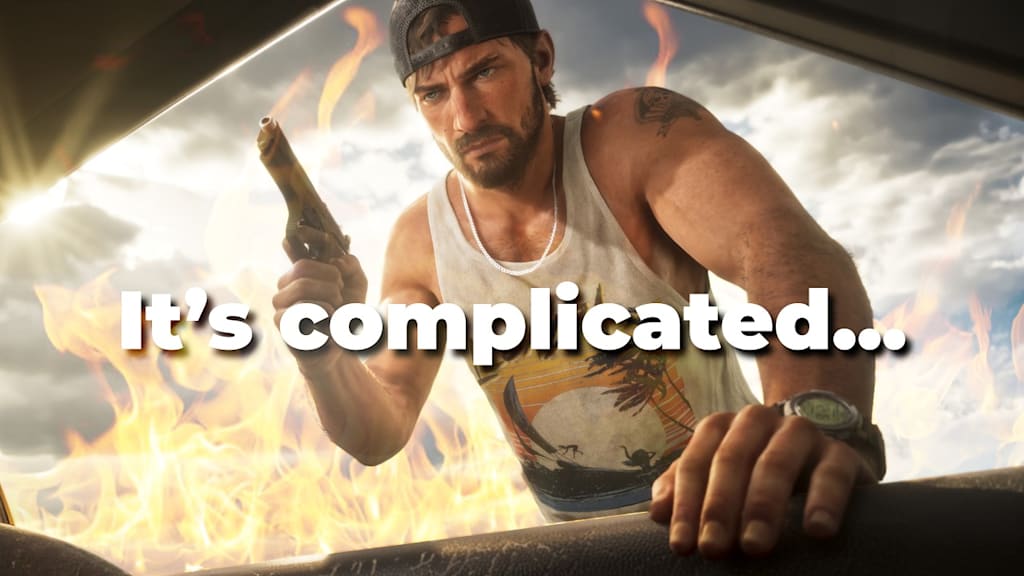
Grand Theft Auto VI can be a remarkable game and still disappoint people. Those two things are not mutually exclusive, and a lot of the conversation around it would be better if we could acknowledge that.
The review split is certainly dramatic. In the early post-launch snapshot I examined, GTA 6 had a 99 Metacritic critic score, while its user score sat at 5.6. The user breakdown was 49% positive, 7% mixed, and 44% negative. That is an enormous gap between critical acclaim and public sentiment on one particular site.
Some of that negativity is exactly what you would expect: culture-war arguments, conspiracy theories about reviewers, and people repeating complaints about things they have not personally experienced. But some of it is thoughtful, specific criticism of the actual game.
I have put more than two dozen hours into the PlayStation version, and I regularly find myself wondering how Rockstar pulled this off. Technologically, it is astonishing. That does not make its pacing perfect, its characters universally appealing, or its design decisions immune to criticism.
The central issue is that GTA 6 feels much closer to Red Dead Redemption II than GTA V. For me, that is largely a good thing. For someone expecting another giant arcade crime playground, it can be a pretty serious disappointment.
What the Negative Comments Actually Say
Rather than assume everyone criticizing the game was arguing in bad faith, I collected comments from several places, including X and Instagram, put them into a spreadsheet, and categorized them. Because of course I did.
I narrowed the collection to roughly 100 posts, looking at what people were criticizing, whether they disclosed any playtime, and whether their complaints concerned gameplay or ideological grievances. I removed usernames to avoid directing harassment at anyone, along with spoilers and racial slurs. There was, unfortunately, plenty of material in that last category.
This was an informal collection, not a scientific survey of everyone playing GTA 6. Still, the breakdown was useful:
Roughly 32% fell into the ideological or bad-faith category. These included accusations that the game was “woke,” complaints about women writing it, and claims that reviewers had all been paid off.
More than half specifically criticized gameplay or design. Recurring concerns included slow pacing, repetitive missions, driving physics, limited early sandbox freedom, and the appeal of the protagonists.
A smaller group raised technical problems. These included bugs, frame drops, and other performance complaints.
That matters. If someone says the opening missions are repetitive, that argument does not become invalid because another person on the same platform is screaming something awful. Those are different people making different arguments.
The Zelda review-bombing story needs some perspective
One particularly bizarre part of the discourse was a Dexerto report about Ocarina of Time fans allegedly coordinating negative user ratings after GTA 6 displaced their game at the top of Metacritic.
The original 1998 Ocarina of Time had long occupied that position with a 99. The allegation was that some fans were upset about losing that distinction, with potential Game of the Year competition against the newer remake adding fuel to the argument.
Coordinated review bombing is bad. The idea of people organizing a campaign over whose favorite game gets to sit at the top of a website is also, honestly, a little funny.
But that story does not explain every negative rating. It certainly would not be intellectually honest to attribute tens of thousands of votes to angry Zelda fans. I specifically looked for comments making that connection and found very little. That does not disprove the reported forum activity, but it limits what I can reasonably conclude from my own sample.
I also noticed comments criticizing GTA 6 while recommending Zelda, Ananta, Genshin Impact, or another game instead. Some had the flavor of automated promotion. Maybe they were bots. Maybe they were simply enthusiastic fans. The pattern was interesting, but it was not proof.
The Biggest Divide: More Red Dead II Than GTA V
Grand Theft Auto has spent years establishing itself as the ultimate playground for ridiculous criminal behavior. Steal a car, start a chase, cause an absurd amount of destruction, and see how long you can survive. That freedom is a huge part of its identity.
GTA 6 deliberately pushes toward something more grounded. You can feel that philosophy across its systems:
Weapon loadouts are more constrained. It moves away from the old inventory-wheel fantasy of producing a rocket launcher from your back pocket.
Driving aims for a less arcade-like feel. Not everyone likes the result, with some complaints describing the handling as floaty or unconvincing.
Gunplay emphasizes a more grounded experience. It is a different approach from GTA V’s comparatively arcade-oriented combat.
The six-star wanted system is less forgiving. The old routine of causing military-level chaos, briefly hiding, and returning to normal life is not the same proposition here.
In GTA V, you could steal a tank, disappear into a bush for a short while, and emerge into a world that seemed remarkably willing to move on. GTA 6 is much less interested in letting consequences evaporate that easily.
I like that direction. I enjoy a grittier crime story with a slower rhythm and more weight behind its systems.
But most people do not spend months following developer interviews and dissecting magazine previews. They buy a sequel because they liked the previous game. If their reference point is GTA V or GTA Online, it is entirely understandable that they might load this up and think, “This is not the thing I expected.”
A deliberate creative choice can still be the wrong choice for a particular player. Explaining what Rockstar intended does not automatically resolve that player’s disappointment.
The Opening Hours Really Are Slow
The pacing criticism is probably the easiest one for me to understand.
For roughly the first 10 hours, a lot of your work is small-scale and repetitive: collect a drop, clear out a location, make a delivery, and return to a designated spot. There is a lot of establishing your place at the bottom before the game lets you climb.
The intention makes sense. Rockstar wants your criminal career to begin with mundane, low-level work so that the eventual escalation feels significant. Starting with everything already turned up to maximum would produce a very different story.
But Rockstar also chose how long that setup would last. If someone spends an evening or two doing tasks they do not find interesting, “It is supposed to start slowly” is not much of a rebuttal.
Among the people in my sample who disclosed their playtime, the average was about six hours. That is not enough to assess the entire game, especially its later character development. It is absolutely enough to say whether those six hours were enjoyable.
Could the game establish its ambitions sooner?
There are ways to preserve a gradual rise without withholding nearly all of the excitement at the beginning.
A flashback could provide an early burst of something more ambitious. Alternatively, the story could offer a brief glimpse of the life your characters are pursuing before returning them to their current circumstances.
GTA 6 already does something like that around seven or eight hours in. Without spoiling the specifics, you spend time with people enjoying the kind of life you want, and it gives you a taste of the possibilities ahead.
I think a moment like that could have arrived earlier. It would not require abandoning the slow build. It would simply give players a clearer emotional and mechanical promise of what they are building toward.
I have also spoken with someone who finished the game, and their description of the final stretch sounded completely unhinged in the best possible way. Other accounts of the later sections, particularly beyond the 30- and 40-hour marks, have been similarly enthusiastic.
That is encouraging. It does not erase the question of whether the journey takes too long to get there.
Red Dead Redemption II shows both sides of this argument
Major spoilers for the ending of Red Dead Redemption II follow in this subsection.
After Arthur Morgan dies and you take control of John Marston, Red Dead II slows down dramatically. You leave behind the outlaw life and spend time doing ordinary farm work.
Compared with what preceded it, that section can feel monotonous. I think that is precisely the point.
The game lets you experience why John might struggle with a quiet life. After dozens of hours of robberies, escapes, and violence, routine work feels restrictive. You understand the pull of the life he is supposed to leave behind because, as the player, you feel some of that pull yourself.
That is a genuinely interesting use of game design. Instead of merely telling you that a character feels restless, the game creates conditions in which you can feel restless too.
But somebody can understand that intention and still say, “Okay, mission accomplished. I am bored.”
I think the epilogue’s eventual payoff is excellent, and I would encourage people to finish it. I also understand the person who was invested primarily in Arthur and lost interest after his story ended.
The same distinction applies to GTA 6. Creating a longing for a more exciting life may serve the story. It also means some players will genuinely wish they were doing something more exciting. You cannot deliberately produce that feeling and then act shocked when people describe it.
GTA Online Has Changed What People Expect From the Sandbox
For tens of millions of people, their most recent relationship with Grand Theft Auto is not the GTA V campaign. It is GTA Online.
That is a very different baseline.
GTA Online lets you participate in races on platforms suspended above the city. It lets you buy a nuclear submarine. Public lobbies can become spectacularly chaotic, and realism is clearly not the governing principle behind every activity.
For people whose recent exposure came through that environment, including the surge of interest around roleplay servers in 2021 and 2022, Grand Theft Auto means a huge space full of possibilities.
Then they begin GTA 6, drive an unimpressive car, and discover that the exotic car they actually want has a security system they cannot bypass yet. That capability comes later through progression.
I understand why the game does that. I also understand why somebody thinks, “The game is called Grand Theft Auto. Why can’t I steal that car?”
The disagreement is not simply about whether the sandbox exists. It is about how quickly the game lets you use it and how much friction it places between you and the fantasy.
GTA 6’s opening is a structured, comparatively realistic climb. GTA Online has conditioned many players to expect immediate access to absurd possibilities. Neither preference is inherently wrong, but the mismatch is significant.
Jason, Lucia, and the Absence of a Trevor
Another recurring complaint concerns character charisma, particularly Jason’s role in the opening hours.
He is dry. His delivery can be restrained and monotone. There are narrative reasons for that presentation, but it does mean the early game asks you to spend considerable time with someone who is not immediately bursting with personality.
Personally, I prefer that to characters who respond to everything with a sarcastic quip. I will take Jason over the kind of relentlessly jokey writing represented by the Saints Row reboot’s waffle guy.
Jason feels believable to me. I know people with that general demeanor. He does not need to deliver a punchline every 15 seconds to seem human.
But think about what GTA V offered.
Trevor was a walking catastrophe. Even alongside Michael and Franklin, he occupied a completely different level of insanity. He became a recognizable cultural figure partly because he was so extreme and so unlike an ordinary person.
Neither Jason nor Lucia serves that function in GTA 6. Their more grounded presentation appears intentional, and I can see why. Sustaining a Trevor-like personality across a long, relatively grounded crime story would create a difficult tonal balancing act.
There are still eccentric side characters, including a particularly memorable person searching the swamps for a cryptid. But the central cast operates in a different register.
That does not mean Jason’s characterization automatically works for everybody. It means that some complaints about him reflect a real preference for a different kind of protagonist, not necessarily a failure to understand what the game is doing.
At the same time, early impressions have limits. Judging a character’s entire depth after four or six hours of a much longer story is different from saying their introduction failed to grab you.
Why Critics and Players Can Reach Different Conclusions
A lot of the supposed contradiction between critic scores and player complaints becomes less mysterious when you consider expectations.
My read is that critics enthusiastic about Red Dead Redemption II are particularly well positioned to appreciate GTA 6. This is a game that develops many of the same priorities: deliberate pacing, grounded systems, and a story willing to take its time.
Review assignments can reinforce that fit. Outlets often choose someone with relevant experience rather than handing a major release to a writer who dislikes its genre or design approach. That is generally sensible. You want informed criticism.
But it can also help explain why a group of experienced reviewers responds differently from players whose main point of comparison is GTA Online.
This is an interpretation of the divide, not evidence that every outlet used the same assignment process or that every positive review came from the same preferences.
The larger point is straightforward: someone who loves Red Dead II’s rhythm may see GTA 6 as an impressive evolution. Someone who found Red Dead II too slow may encounter many of the same frustrations again, this time inside a series they expected to feel different.
Neither reaction requires a conspiracy.
The Store Ratings Tell a Different Story From Metacritic
It is also worth asking how representative the loudest negativity actually is.
In the storefront snapshot I checked, the PlayStation Store’s standard edition had approximately 221,000 ratings and a score of 4.82 out of 5. On Xbox, the score was around 4.8 from roughly 23,000 reviews, with 93% awarding five stars.
Those storefront ratings are tied to purchases, which gives them a different evidentiary value from an open user-rating page. Buying a game does not make someone’s opinion automatically correct, but it provides more grounding than an anonymous rating with no demonstrated ownership.
The discrepancy suggests that the online controversy is not a straightforward picture of widespread buyer dissatisfaction.
Some comments in my collection explicitly acknowledged that the author had not played the game and was relying on a streamer’s experience. Others repeated inaccurate descriptions of the opening, such as the idea that you spend six hours being ordered around by a girlfriend who remains on a couch.
That is not what happens.
People can decide a game does not appeal to them based on someone else’s experience. But repeating secondhand claims as firsthand criticism muddies the discussion, especially when those claims are wrong.
Open rating systems and social platforms are also vulnerable to coordinated activity and automated posting. That is a reason for caution, not a license to declare every negative comment fake.
Technical Complaints Are Separate From Taste
Not every issue fits neatly into the debate over realism and arcade freedom. Bugs, frame drops, and performance limitations deserve their own consideration.
A person can love the story’s deliberate rhythm and still dislike how it performs. Equally, someone can have a technically smooth experience and dislike the mission design.
I have experimented with using a PC GPU and the Vora app for frame generation to reach 60 frames per second or higher. For my setup, that has been an appealing way to play. It is still a workaround, not a reason to dismiss anyone’s complaints about the underlying experience.
A Great Game Does Not Have to Be Everyone’s Ideal GTA
One comment in my collection captured the good-faith disappointment particularly well: the writer liked GTA 6 as a game but did not think it delivered what they wanted from Grand Theft Auto. They were fine with Lucia and with systems such as loadouts. They simply wanted less life simulation and more immediate fun.
That is a coherent position.
I would encourage that person to continue, because the story and characters have more room to develop than the opening suggests. Reports from people who reached the later sections make me especially interested in seeing the full escalation for myself.
But “keep playing” is an invitation, not a rebuttal. If it takes dozens of hours to reach the material someone finds most compelling, the time required to get there remains a valid criticism.
My own position is that GTA 6 is remarkable. I like the grounded tone. I like a story that builds slowly. I am consistently impressed by its ambition.
The broader commercial picture also hardly suggests a game in trouble. The reported first-day revenue exceeded $3.5 billion, and a future online component could expand its reach further. None of that proves every design decision works, just as a noisy user-score controversy does not prove the game has failed.
You do not have to choose between calling GTA 6 a masterpiece and admitting that its opening can drag. You can admire Jason’s believable restraint and understand why somebody finds him bland. You can prefer the more consequential sandbox and recognize that another player misses the ridiculous freedom of GTA Online.
There is ugly, bad-faith criticism in this conversation. There is also genuine disappointment rooted in clear design preferences. Treating those as the same thing makes it harder to understand either.
The most useful explanation for much of the GTA 6 drama is not that everyone suddenly hates an acclaimed game. It is that Rockstar made something closer to Red Dead Redemption II with cars, while a portion of its audience wanted GTA V turned up even further. That gap is real, and it is worth discussing honestly.
About the Creator
Enjoyed the story? Support the Creator.
Subscribe for free to receive all their stories in your feed.
Comments
There are no comments for this story
Be the first to respond and start the conversation.