
The Game Industry Still Has a Door Open in 2026. It Just Isn’t the Same Door.
AI has rewritten the entry-level job, Beijing has changed the language around games, and the studios with money are still hiring. Here is what that means if you want in.
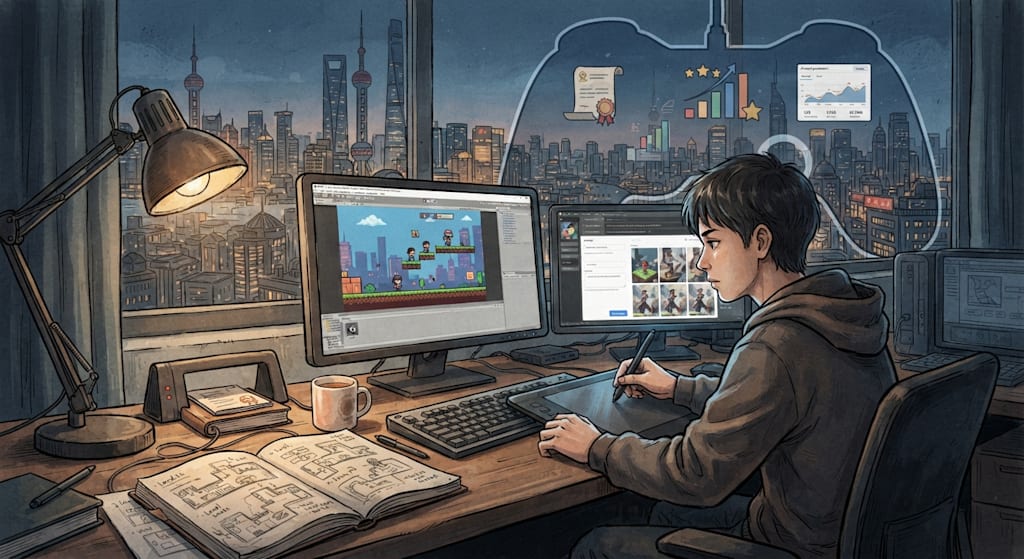
If you want to work in games because you already make things, the industry is still a reasonable bet. If you want it because games are hot, stop. The case for entering in 2026 depends on location, skill, and your ability to use AI on day one. Most studios cluster in Beijing, Shanghai, Guangzhou, Shenzhen, and Hangzhou, with a smaller pocket in Chengdu. That geography matters. It sets rent, commute, and how many interviews you can take in a week.
Two changes matter more than the rest. AI has pushed every internet job, including game jobs, toward tool-assisted work. And games have moved into a different policy category. The first change hits juniors directly. The second changes how long the industry can plan.
Start with AI. If you are graduating now, you have an advantage that older staff often lack: time. You can spend a month building with AI tools before your first interview. A design student should not fight the tools. Use your taste, generate options, edit them, and ship a small case. A playable prototype with a few hundred users and a little ad revenue says more than a PDF of mood boards. A coding student should go further. Learn to work inside Vibe Coding workflows, test what the tools do well, and keep a project log. Studios do not need you to defend old methods. They need you to finish work faster.
The junior job itself has changed. The old entry-level tasks, filling forms, making decks, collecting references, were training wheels. AI now does much of that. The new junior task is to direct AI, check its output, and fix the parts it gets wrong. That is why job titles with “AI” in them keep appearing. Game industry AI roles grew 127% year over year in 2026. The catch is experience. 73.34% of game jobs ask for three years or more, and roles for people with under one year are shrinking. So the entry ticket is not a degree alone. It is proof that you can use the tools inside a working pipeline.
Policy changed too. Version approvals increased in 2026. The shift started earlier, with Black Myth: Wukong showing that a Chinese single-player game could carry cultural weight. Then the 15th Five-Year Plan for Publishing put games into a national publishing plan for the first time. The wording moved games from a controlled content area to a publishing industry with cultural attributes. The plan also called for more version-number supply. That does not mean no rules. It means the industry can plan further ahead, and studios can justify longer projects.
The money is not imaginary. Domestic game market revenue from January to June 2026 reached 188.45 billion yuan, up 12.17% year over year. Tencent is expanding its AI team. ARC Lab is planned to grow from 100 people to 400 or 500. Tencent’s total headcount rose by 1,079 from Q1 to the end of Q2. NetEase kept expanding campus hiring, with 2,000 spring internship slots in 2026, up 70% year over year. Those numbers do not guarantee you a job. They do show that the largest employers are still adding people in specific areas.
AI games are the messy part. On Steam, AI games made up 30.8% of new releases in the first half of 2026. Sales for those AI-native games still trail handcrafted new releases. That gap is the opening. The winners will not be the people who generate the most assets. They will be the people who use AI to test ideas cheaply, then spend human time on the parts players feel: controls, pacing, level flow, the first ten minutes.
Platforms are lowering the cost of a first project. TapTap Maker produced more than 6,000 mini-games in the first half of 2026. Cumulative players passed 10 million. In July, daily active users were 162,600, with about 3,300 active creators. Developers can earn from in-game ads. That is a small business model, not a jackpot. It is enough to teach the full loop: idea, build, publish, read data, patch, publish again. If you are a student, that loop is your portfolio.
So the practical advice is narrow. If you are a designer, build one small game with AI tools and your own art direction. If you code, ship a prototype and document how you used AI to cut build time. If you are neither, learn enough of both to run a tiny project. Move to a city with studios if you can. Apply to AI-adjacent roles even if the title is new. Expect the first job to be less glamorous than the title suggests. And decide with your eyes open. The door is open. It is just narrower, and it asks for evidence.
About the Creator
Jin
Writer of reamstories
https://reamstories.com/jin
Enjoyed the story? Support the Creator.
Subscribe for free to receive all their stories in your feed. You could also become a paid subscriber, letting them know you appreciate their work.
Comments
There are no comments for this story
Be the first to respond and start the conversation.