
The Case for Being a Beginner Again: Why Gamers Should Try Genres They Usually Ignore
Every gamer has a comfort zone

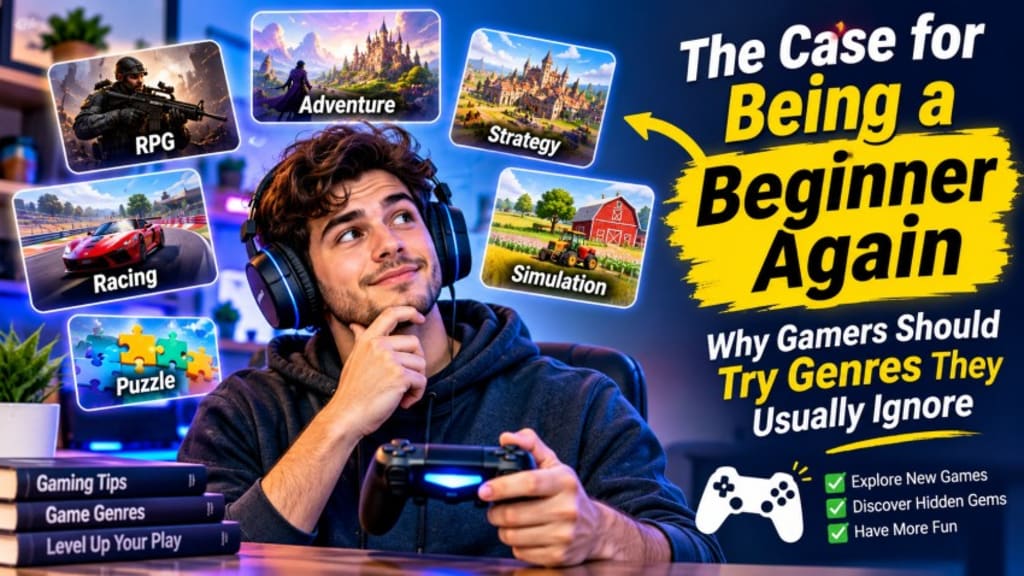
Maybe yours is competitive shooters. Maybe it's massive RPGs, racing simulators, survival games, or anything that involves building a civilization from scratch.
You know what you like. You know which mechanics make sense to you. You probably have strong opinions about certain franchises, and you've learned to recognize a disappointing game within the first hour.
Experience is useful.
But it can also make gaming surprisingly predictable.
At some point, we stop asking whether a game might be interesting and start asking whether it belongs to a genre we already enjoy.
That's a shame, because one of the most exciting experiences in gaming is discovering something you didn't expect to like.
When Taste Becomes a Habit
There's nothing wrong with having favorite genres.
If strategy games provide exactly the experience you want, there's no reason to abandon them. If you love story-driven adventures, another carefully written RPG can be a great investment of time.
The problem begins when preference turns into automatic rejection.
A puzzle game looks too simple. A life simulator seems boring. A rhythm game appears frustrating. A casual browser title doesn't look serious enough to deserve attention.
Sometimes those assumptions are accurate.
Other times, they're just habits.
We often judge unfamiliar games through the expectations developed by playing familiar ones.
Someone accustomed to competitive multiplayer might expect every game to test their reflexes. A devoted RPG player may look for character development in experiences that were never intended to provide it.
The better question is simpler: What is this particular game trying to do?
The Strange Pleasure of Not Knowing What You're Doing
Experienced gamers are used to understanding systems.
We recognize quest markers, skill trees, inventory menus, crafting mechanics, and progression loops almost instantly.
That familiarity makes modern games easier to navigate.
It also reduces the feeling of discovery.
When you try an unfamiliar genre, ordinary interactions can become interesting again.
You don't immediately know which choices matter. You may need to experiment. You might misunderstand the rules, make mistakes, or find yourself surprisingly entertained by something you previously dismissed.
For a little while, you're a beginner.
That experience can be refreshing.
Not because being confused is inherently enjoyable, but because learning something unfamiliar reminds us of that gaming still has room to surprise us.
A Genre Doesn't Need to Become Your New Favorite
Trying something different doesn't mean committing to it.
A racing fan can experiment with a farming simulator without becoming a farming-game enthusiast. A strategy player might enjoy a rhythm game for an evening and never return to it.
The experience can still be worthwhile.
Think of gaming as a collection of different creative approaches rather than a competition to discover the single best genre.
Some games emphasize narrative. Others focus on problem-solving, exploration, timing, creativity, or randomized entertainment.
Even unfamiliar casino-inspired formats may interest adults who want to understand another part of the casual gaming landscape.
For example, someone exploring a coins game casino platform would encounter virtual-coin entertainment built around recognizable casino-style game formats rather than conventional cash wagering.
That experience is fundamentally different from a strategy RPG or competitive shooter. Slot-style outcomes are randomized, and familiarity with a game's appearance does not make future results predictable.
The point of trying an unfamiliar format isn't to become an expert.
It's to discover whether the experience offers something enjoyable on its own terms.
Stop Comparing Every Game to Your Favorite
One of the easiest ways to spoil a new experience is to measure it against something it was never trying to imitate.
A short narrative game isn't necessarily worse than an open-world adventure because it has fewer hours of content.
A casual puzzle isn't automatically shallow because it lacks character progression.
A creative sandbox doesn't need a traditional ending to be worthwhile.
Different games make different promises.
The challenge for players is recognizing those promises before deciding whether they've been fulfilled.
Consider a hypothetical weekend.
You have three hours available and could spend them playing a familiar multiplayer game, exploring an independent adventure, or trying several smaller titles.
There isn't one correct choice.
But if you always choose the familiar option, you may never discover how much you enjoy something different.
Let the Game Teach You What Matters
Some of the most memorable games demonstrate their ideas through the experience itself.
They don't begin with an elaborate explanation of why their mechanics are interesting.
They let players discover those qualities gradually.
A particularly good example is LIMBO, the atmospheric puzzle-platformer from Playdead.
In LIMBO: A Masterclass in Subtle Storytelling, a Vocal Media contributor explores how the game's restrained presentation, environmental design, and minimal storytelling create an unexpectedly powerful experience.
Its basic controls are simple.
The emotional effect is not.
For someone who usually judges games by dialogue, elaborate progression systems, or cinematic cutscenes, LIMBO demonstrates how an entirely different design approach can create a memorable world.
That's the reward of trying something unfamiliar.
A game may reveal strengths that would never appear on your usual list of requirements.
Three Ways to Expand Your Gaming Horizons
You don't need to completely change your gaming habits to discover new experiences.
A few small adjustments can make exploration easier.
Try one unfamiliar genre each month
Choose something outside your usual preferences.
It could be a puzzle-platformer, visual novel, rhythm game, digital card game, simulation, or casual browser experience.
The objective isn't to finish everything.
It's to explore.
Judge the experience by its intended purpose
Ask what the game is trying to deliver.
Does it emphasize relaxation, challenge, atmosphere, creativity, or discovery?
Avoid expecting every title to provide the same kind of entertainment as your favorite franchise.
Give yourself permission to stop
Experimentation should remain enjoyable.
If an unfamiliar game doesn't appeal to you, there's no obligation to continue. You can appreciate what it attempted without deciding that it belongs in your regular rotation.
Curiosity works better without pressure.
What Unfamiliar Games Can Teach Experienced Players
Trying new genres can change how you think about games you already enjoy.
A puzzle title might make you notice level design more carefully.
A narrative adventure could highlight how much storytelling depends on pacing.
A strategy game may encourage you to think differently about resource management, while a relaxing sandbox could reveal the value of creative freedom.
The lesson isn't that every game contains profound insights.
Many are simply entertaining, and that's enough.
But variety helps players recognize how differently designers approach the same basic challenge: creating an engaging interactive experience.
It also makes conversations about gaming more interesting.
Understanding a genre doesn't require loving it. Sometimes it only requires spending enough time with it to recognize what other people appreciate.
Gaming Is More Fun When Curiosity Wins
There's a certain comfort in returning to games we know.
Familiar controls, recognizable mechanics, and favorite franchises can provide exactly the experience we're looking for.
Those preferences deserve a place in our gaming routines.
But they shouldn't define the boundaries of everything we're willing to try.
The next unexpectedly enjoyable game might be a tiny independent title, an unusual puzzle, a quiet simulation, or a genre you've spent years ignoring.
You don't need to master it.
You don't need to finish it.
And you certainly don't need to pretend it's your new favorite.
Sometimes, discovering that you enjoy something completely different is enough to remind you why gaming became exciting in the first place.
About the Creator
Mohammad Akhtar
Mohammad Akhtar is an SEO and SEM Expert with over 10 years of experience in digital marketing and search engine optimization. A 2013 graduate of The Islamia University of Bahawalpur, he has worked with various IT companies.
Enjoyed the story? Support the Creator.
Subscribe for free to receive all their stories in your feed. You could also become a paid subscriber, letting them know you appreciate their work.
Comments
There are no comments for this story
Be the first to respond and start the conversation.