
The AI Trust Tax Is Quietly Punishing Indie Developers Who Play It Straight
Steam refunds and demos may stop another Atari crash, but a blunt AI label still makes careful developers pay for someone else’s slop.
In 1983, the shelf gave you a cardboard box and an advertisement. That was the whole due-diligence packet. You could not read a review, download a demo, watch a stream, or ask for a refund two hours later. The cartridge was shrink-wrapped, the marketing was loud, and the money changed hands before anyone knew what was inside.
That is the part of the Atari story people skip. The crash did not happen because too many bad cartridges existed. Bad cartridges are a permanent feature of any content market. The crash happened because bad cartridges could not be identified before purchase. E.T. is the symbol, not the cause. The cause was information asymmetry with no exit.
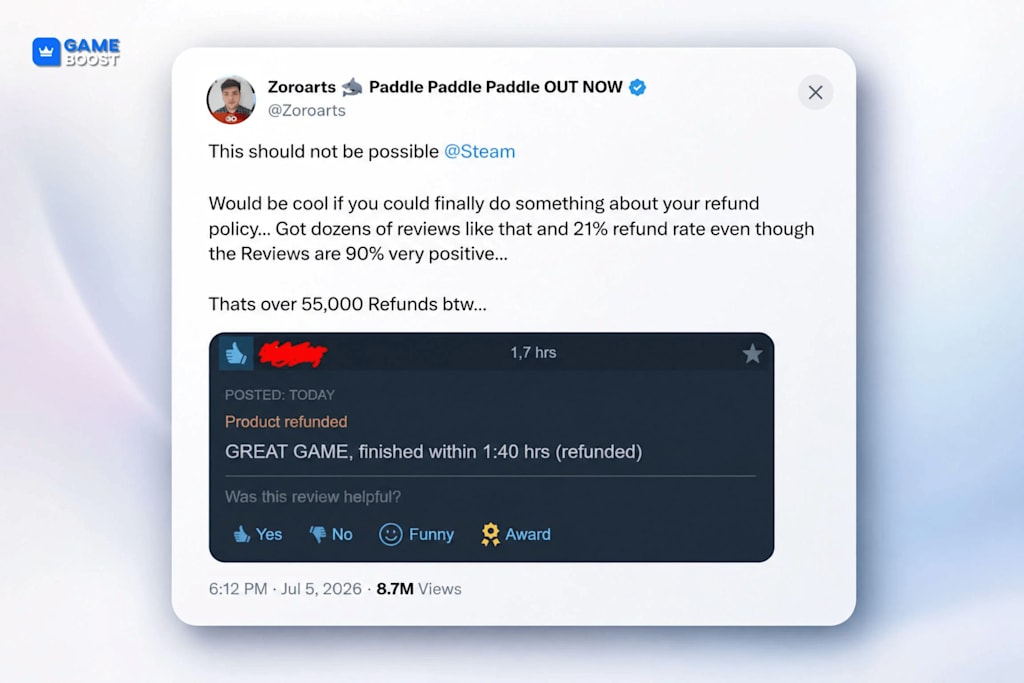
When people point at AI slop and say “this is 1983 again,” I look for the exits. On Steam, they are there. The store page carries an AI disclosure field. Next Fest gives away demos. The refund window runs two hours. Reviews, community threads, streamers, and third-party databases sit between the player and the buy button. SteamDB lets users filter by “AI Content Disclosed,” and the filter gets used. None of these mechanisms is perfect. Together they give the player more than one way to retreat before the money is gone.
That matters for player rights. Steam’s refund policy is not a moral system, but it is a working exit. A demo is not a review score, but it is a playable sample. A disclosure field is not an audit, but it is a signal. The 1983 shelf had none of these. The 2026 store page has several. The Atari crash is the wrong warning for a market with refund buttons and demos.
Players are not anti-AI. They are pro-signal.
Last year’s Steam Next Fest had 2,960 demos. Of those, 504, about 17%, carried an AI-generated content disclosure. That number sounds like a flood until you look at the other number. Among the 50 most-played demos, only three had an AI disclosure.
That gap is the story. Players did not organize a boycott against every game with an AI field. They played what looked playable. AI slop did not vanish. It got pushed into corners where nobody clicked. The market did not need a tribunal. It needed attention, and attention is finite.
This is why “see an AI label, swipe left” is not stupidity. A player with 2,960 demos and a dinner break does not run a due-diligence committee. She uses a shortcut. A label is a shortcut. A demo is a shortcut. A refund window is a shortcut. When a shortcut becomes common, it works often enough to save time.
The problem is the label is too blunt for the job.
“AI-generated content disclosed” can mean a localization draft run through a machine translator and then edited by a human. It can mean placeholder icons that were later redrawn. It can mean a concept sketch used to brief an artist. It can also mean a pipeline that spits out portraits by the hundred and ships them untouched.
Those are not the same thing. A player looking at one field cannot tell which one is in front of her. So she treats the field as a warning and moves on. The careful developer who used AI for a first-pass localization gets hit. The careless developer who hides the pipeline gets through. That is adverse selection wearing a compliance badge.
The infrastructure is already reacting. After Steam made disclosure mandatory, third-party tools added filters, and users started sorting by them. SteamDB’s “AI Content Disclosed” filter is not a niche toy. It is a market response. Once a label becomes a filter, it shapes behavior. In my own Steam research, I found several store pages that removed the AI disclosure after Next Fest. Removing a label is not the same as removing the use. It is a change in disclosure strategy. If the platform has no finer fields, no appeal process, and no audit, the label can drift from transparency tool to PR tool.
Call it a trust tax: the extra cost of proving you are not slop before anyone plays your game.
Large studios can pay that tax with brand equity, trailers, and PR. They also have room to admit what they are doing. AI has been running inside big-company workflows for a while. The question was never whether it was used. The question was whether anyone would say so. This year, companies that had sworn off AI, Capcom among them, started describing it as a necessary part of development. That is not a scandal. AI is a tool. The abuse is the problem.
Small teams pay the tax differently. A solo developer writes “AI used for localization drafts; final text edited by a human” and watches wishlist conversions dip. Another team prints “100% human-made” on the capsule because the blunt label leaves no room for nuance. It works. It also makes me wince. The market rewards a slogan because it has not been given a sensor fine enough to reward the truth.
That is the risk in the AI storm. Not an industry collapse. A trust cost allocated by leverage. The big studio absorbs the tax with PR. The small team absorbs it with visibility. The careful developer who used AI for a thumbnail draft now has to convince strangers the game is not generated mush. The careless developer who hides the pipeline keeps the benefit of the doubt.
The fix is not to abolish the AI label. A crude label beats no label. But a crude label is not the end state.
Platforms should turn the disclosure into structured fields. Where was AI used: art, text, code, localization, audio, level design. Is the output a final asset. How much human editing followed. Is there a human review step. Was the tool used for placeholders or shipped content. Add an appeal path and spot audits so “remove the disclosure after the festival” is not a free cleaning service. The label should be comparable, explainable, and checkable. It should not be a moral tribunal.
Developers should write specifics, not slogans. “AI was used for localization drafts; all final text was edited by a human. AI was used for placeholder icons; final icons were redrawn. AI was used for early concept sketches; final art was made by the team.” That sentence does more work than “no AI” in caps. It gives the player something to test against the demo.
The demo is still the strongest trust device in the store. A twenty-minute build lets a player feel the controls, the pacing, the bugs, the care. A developer log that shows the messy middle, the cut feature, the redrawn asset, the fixed collision bug, does more than a manifesto. Trust is not a claim. Trust is a record.
Nintendo rebuilt market trust after 1983 with a round seal on the cartridge. One stamp, one manufacturer, one promise. That worked because the console maker controlled the shelf.
No one controls today’s shelf in the same way. The seal is now a stack: a specific disclosure field, a playable demo, a refund window that works, a review page that is not all noise, a devlog that shows the work, a community thread where the developer answers questions. The developer presses the seal. The platform makes the wax. The player holds the letter up to the light.
AI slop will keep coming. It will not cause a second Atari crash as long as the exits stay open. The danger is narrower and more annoying: a coarse label that punishes the careful, rewards the hidden, and teaches players to swipe left on the wrong people. Fix the sensor, and the market can still tell the difference between a tool and a flood.
About the Creator
Jin
Writer of reamstories
https://reamstories.com/jin
Enjoyed the story? Support the Creator.
Subscribe for free to receive all their stories in your feed. You could also become a paid subscriber, letting them know you appreciate their work.
Comments
There are no comments for this story
Be the first to respond and start the conversation.