
The $200 Game That Lost $84.60
A late-night ledger from the bottom of the indie market: 21 days of waiting, a 30% platform cut, seven wishlists, and a bowl of noodles that went cold while the pipeline kept running.
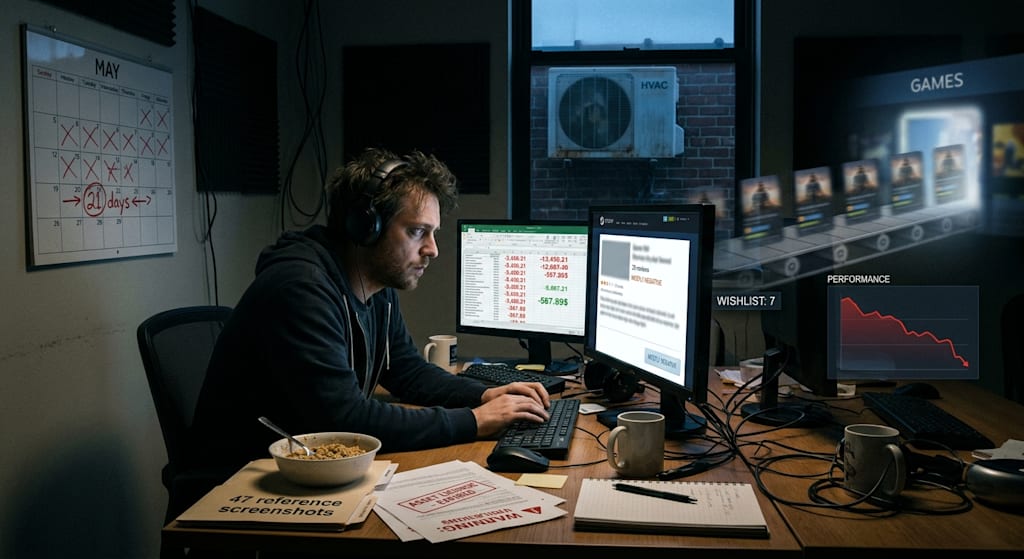
At 2:40 a.m., in a rented office in Nanshan, Shenzhen, the air-conditioner compressor was humming outside the window. He clicked the “Submit for Review” button on his ninth store page. The page spun for three seconds, then a green line appeared: Review approved. Earliest release date: 21 days from now. He took a screenshot and dropped it into a folder called “Reference.” The folder already held 47 screenshots, all store pages from the top twenty games on the wishlist charts. He closed Steamworks, opened the AI code-generation page, and typed: organize shelves, click, score, three-level loop. The screen light fell across his face. He picked up a bowl of noodles. The noodles had already gone soggy.
He had repeated this routine nine times over the past three months.
One day to build, twenty-one days to wait
Simple gameplay is no longer worth much. Chameleon jumping, library organizing, shelf stacking, spot-the-difference, decompression clicking. For these games, AI can write the core loop and produce a playable prototype in a day. Swap the art and music for human-made licensed asset packs, state in the submission that the game contains no AI-generated content, and the process works. From the “make it” side, the barrier has fallen to the floor.
But between “make it” and “get it listed” sits a store page. Capsule art, screenshots, tags, system requirements, adult-content questionnaire, AI disclosure, asset-license explanation, support email, refund policy. For a simple game, this work can be heavier than writing the code. Finishing the gameplay in one day does not mean finishing a passable store page in one day. For his ninth game, the code took six hours, the store page took four days of revisions, the capsule art cost $50 outsourced, and the screenshots were reshot three times because the first version was rejected by review on the grounds that “the main gameplay screenshots are unclear.”
The 21-day cooldown is a hard constraint, and it applies to everyone equally. The original developer also has those 21 days, and the original developer usually started accumulating wishlists earlier. Shipping first does not mean players will buy. Going live two weeks before the original does not mean you can intercept its wishlists. A wishlist is a player’s expectation of a specific expression, not a queue for a gameplay genre. A fast copy with no brand, no community, and no review history is likely to meet bad reviews and refunds first, not sales.
The two-hundred-dollar ledger
In the first month after his ninth game went live, gross revenue was $214. He did the math. Steam took 30%, or $64.20, leaving $149.80. Eleven refunds at an average of $4.99 each took out $54.90, leaving $94.90. Taxes and withholding at 10% left $85.40. The asset pack cost $20 and the outsourced capsule art cost $50, leaving $15.40. The $100 listing fee is prepaid per App and is only recoupable after $1,000 in adjusted gross revenue. His game did not reach $1,000, so the $100 was not returned. Net loss: $84.60.
He pulled the numbers for all nine games into a spreadsheet. Total revenue was $1,876. After platform cut, refunds, taxes, assets, and outsourcing, he was down $311. He had fronted $900 in listing fees, and not a cent had come back. His goal of ten games a month meant fronting $1,000 in listing fees, and every game that failed to reach $1,000 would not get its fee back. The idea that “$200 means profit” only holds if you treat listing fees, assets, outsourcing, refunds, and taxes as zero. That is not a business model. It is an accounting illusion.
Asset packs are not a get-out-of-jail-free card
He once bought a music asset pack. The license said “may be used in interactive media,” but a line underneath added: prohibited in products where “audio is the main selling point.” His game did not have audio as its main selling point, but he was not sure how review would judge it. He also bought an art pack whose license required attribution. He forgot to add a credits page in the game. On the third day after launch, he received an email from the asset seller demanding he take the game down and fix it. He fixed it, resubmitted, and waited another 21 days.
Valve’s AI disclosure policy requires disclosure of AI-generated content in games. The exact scope depends on the latest terms and review inquiries. You cannot assume code is definitely exempt. Even if code does not trigger disclosure, asset packs still raise license questions: commercial use, adaptation, redistribution, whether sale on Steam is allowed. Each must be checked item by item. Music and sound effects are especially likely to run into Content ID or complaints from asset sellers. Using human-made asset packs to avoid AI review is logically workable, but it cannot become false disclosure. The risks of platform anti-abuse enforcement, copyright complaints, and account risk control are far higher than the disclosure cost you save. He knew a developer whose store-page description did not match the actual content. Players mass-reported him, his account was restricted from releasing for two weeks, and two games were taken down.
Wishlists are an outcome, not demand
His logic for copying the wishlist charts was simple. The charts are outcome data, which means the genre has demand. He copied games near the top of the chart, and as long as he shipped before the original, he could capture the genre boom. His seventh game copied a library-organizing game. The original had 40,000 wishlists. He shipped first. In the first month he sold 31 copies, for $154 gross. The original sold 20,000 copies in its first week. He went to the original’s community. A player wrote in a thread: “I bought a similar one before, refunded it within two hours. I’ll wait for this one.”
Being first buys a time gap, not a moat. A time gap is worth almost nothing when you have no exposure. The more practical problem is legal and commercial. Gameplay itself is usually not protected by copyright, but specific levels, UI, characters, copy, music, art expression, trademarks, and trade dress may all be protected. For the library game he copied, he had changed the level layout and UI color scheme, but he used the three words “library,” “organize,” and “cozy” in the tags and description. The original’s publisher sent a cease-and-desist letter demanding he change the tags. He changed them, but the game’s exposure was already gone.
The algorithm does not look at quantity; it looks at conversion
The Steam algorithm looks at conversion, reviews, refund rate, wishlist growth rate, and community activity. A low-quality copy might get a little organic traffic from tags and keywords, but with poor conversion, high refunds, and low reviews, it will quickly be pushed down by the algorithm. In the first week after his fifth game went live, it had 800 store-page visits, a 0.8% conversion rate, a 22% refund rate, and three reviews, two of them negative. In the second week, visits fell to 90.
A large number of repetitive, low-quality apps can also trigger platform anti-abuse measures and manual review. His eighth game was stuck in manual review for six days and was asked to provide asset-license proof and a consistency statement between in-game footage and store-page screenshots. He supplied the materials, passed, but the release date was pushed back a week. The quantity pipeline has a ceiling. Store pages, capsule art, screenshots, tags, localization, builds, refunds, customer support, negative-review management. Every one of them is friction. Ten games a month is feasible on paper. In operations it quickly turns into a customer-support and compliance quagmire. On the third day after his ninth game went live, he received seven support emails: three refund requests, two bug reports, one asking “Is there Chinese?”, and one cursing him out: “You copied this so badly.”
The bottom collapses; the mid-to-high end gets more expensive
AI makes “making it” cheaper and makes “being seen” and “being trusted” more expensive. Indie games will polarize further. At the bottom, a mass of fast copies, quantity arbitrage, and low-quality, low-price products, with brutal competition and razor-thin profit. At the mid-to-high end, greater dependence on human polish: art, visuals, feel, story, engineering complexity, content volume, community operations, and publishing resources. Creativity itself is not a moat, because creativity is the easiest thing to copy. Expression, execution, community, publishing, and trust are. Players buy the organizing game this team made. They buy this character, this feel, this atmosphere.
In the second week after his ninth game went live, its wishlist count was 7. He opened the charts. There were three more games in the same genre. He turned the heat down. The noodles had gone soggy. He did not eat them. He went on to make his eleventh. The AI code-generation page was still open on the screen, the cursor blinking after “organize shelves, click, score.” He deleted “score” and typed “combo.” Then he clicked Generate.
Outside the window, dawn was coming. The air-conditioner compressor was still humming.
About the Creator
Jin
Writer of reamstories
https://reamstories.com/jin
Enjoyed the story? Support the Creator.
Subscribe for free to receive all their stories in your feed. You could also become a paid subscriber, letting them know you appreciate their work.
Comments
There are no comments for this story
Be the first to respond and start the conversation.