
Subnautica's Slipshod Sequel
And the regression of gaming
My first gaming entry on this blog is not for lack of ideas, because Unknown World Entertainment's Subnautica (2018), and its slipshod sequel, represent an ever repeating issue not just in the video game industry but in popular media as a whole, and it's something I wish to address.
Contrary to many, I love the ocean, even more than space. While I wouldn't enjoy being stranded in a boundless and bottomless body of water, nor was evading leviathans in the tenebrous depths of Subnautica a pleasant experience, these do not compare to the rest of the myriad of wonders that it offered.
Subnautica had always fascinated me as an experience, being one of the few, if not the only, subaquatic survival videogame that also takes place on an alien planet. I remember following its evolutionary stages of early release in 2016 and 2017, captivated by its original construction system, alien lifeforms, whacky AI, surprisingly humanistic story, and its ability to capture the feeling of hopeless isolation (this was before we knew that an escape off the planet would be possible by the end of the game). A sequel seemed inevitable albeit unnecessary, and while Below Zero served as a lacklustre continuation of the game, I was open to the idea of another submarine odyssey that could rival the original. Subnautica 2 is not what I, and many others, had in mind, however.
Horrid Aesthetics
Besides tedious exposition (which we'll get to in a minute), your character is almost immediately blasted with a cacophony of gaudy colours upon surfacing in the safe shallows. The scintillating reefs are illuminated by rays of sunshine, interstellar albedo, and each others' bioluminescence, clashing in a loud, continuous blend from biome to biome. They are further populated by what might have been beautiful sea creatures that otherwise blind you with stripes of their own lurid colours. Whenever your brain, already overwhelmed by the burdens of survival, tries to relax it is bombarded; when hunting for fish, when evading fish, when gathering materials, and when exploring your surroundings.
Compare this to the original, where every biome had a distinct and confident identity. The shallows had warm sands with strips of purple and red biodiversity, the kelp forest waters turned murky green and were dotted with radiating yellow seed clusters, the contemplative grand reef was a deep, dark blue coupled with the spectral cyan of its Anchor Pods, the Lost River percolated with poisonous green sulphur streams flowing through glowing blue fauna and pale acid mushrooms. These are only a few examples, with a couple of further examples for each, but they demonstrate a salient artistic choice made by the original developers: balance.
Each environment is simple in Subnautica 1, but they are highly memorable and easy on the eyes. They don't need to say much when communicating just enough. And for a survival game that expects hours of commitment from its players, players who look with their eyes, it is an essential element of the game to appear pleasant.
Tedious Survival Mechanics
Replayability seems to be a factor many game studios are either ignoring or forgetting today. When the beginning of your game bombards the player with exposition or tutorials it makes future run-throughs needlessly tedious, especially if the information cannot be skipped.
In Subnautica 2, the character's stomach is, at first, incapable of digesting fauna from the planet they crash on due to its alien proteins. A mysterious plant known as an Angel Comb solves this issue by allowing any creatures that pass through its membrane to adapt to local conditions. Quite convenient. And ultimately unnecessary.
If I, as the player, am required to seek out an Angel Comb at the start of every new game, the locations of which I will have memorised after my first playthrough, the experience quickly becomes mundane, even if it serves the story. But the tedium does not end here.
The player is inundated with exposition during the first minute by NoA, an endearing orbicular robot you'll come to know very well; he loves to listen to himself talk. Your character coughs up their lungs, unable to adapt to the planet's atmosphere, while NoA emphasises his essential role in keeping you alive. Darkly comedic, though I suspect the developers don't realise this.
NoA postulates on the reason for your spaceship's crash and exposits on the identities of your former friends and colleagues, in-between your collection of voice-logs that previous survivors conveniently left behind in the ruins of their underwater shelters, dumping lore on the object of their mission and their slow descent into madness, along with a giant tree.
You know, I found myself reminiscing about the atmospheric storytelling of the original game, and the hours of exploration between each PDA lore dump as opposed to mere minutes. Part of Subnautica's appeal was the exploration and spaces between. Not much is left to the imagination if most of the story is revealed within the first few hours of gameplay, nor when the rest can be easily pieced together.
Limited Construction
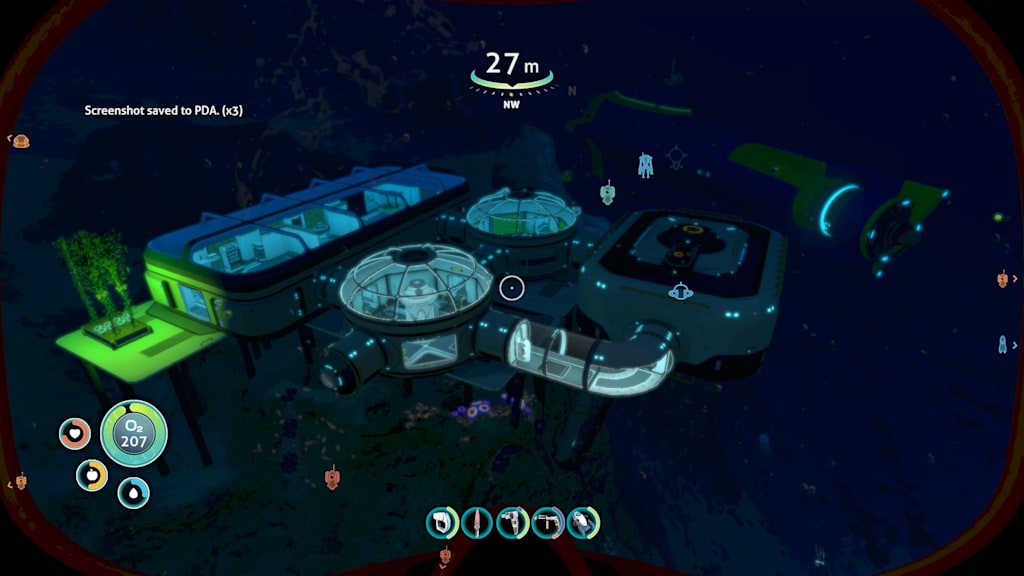
While it seems that some freedom is granted in how you expand your underwater base in the sequel, the shelter itself is uninspiring; a sterile, angular cell as opposed to the futuristic, rounded rooms, both small and large, of the original, rippling with lights through turbid waters like some docile leviathan.
And let's not forget the freedom of placement in the original. Unless your storage, machinery, or furniture clipped through the walls of your base or the pipes of your Cyclops, it could be placed anywhere on a vacant surface. Space out your décor for aesthetic appeal, or cram them together for utilitarian purposes, the game didn't care. But for whatever reason, the sequel does.
Now it may seem petty to nit-pick an issue like limited placement availability in one's base, but I believe that downgrades are important to address when they appear in your franchise's sequel, meant to be the refined and improved successor to what started it all.
Closing Thoughts
All of these issues make a person stop and consider whether a sequel was even necessary to the classic submarine survival game many have come to love. Its success and originality always doomed it towards a franchise, as both fans and the studio saw the potential. And in another era, we may have received a worthy follow-up.
Modern gaming has given us titles like Concord with its garish character designs, or the remakes of Demon's Souls and Silent Hill 2 where the improved graphics lost the oppressive atmosphere of the original releases. Whether to justify a game's existence or through radical short-sightedness when it comes to aesthetics, the modern entertainment landscape is regressing in its creation abilities.
Every year now seems to be saturated with either unoriginal cash grabs or lacklustre sequels and remakes. Like the film and, to an extent, the television industry, gaming has become an intensely competitive market. Every decade has seen the niche hobby turn into a preferred way to pass the time, a lifestyle, or even a career. And risk petrifies studios.
Whether its through shortcuts or a flashy attempt to stand out in the crowd, Subnautica 2 has demonstrated that it is a title its creators, who have already gone through a tumultuous development process due to internal politics, fail to understand what makes the original work. Why play a loud, haphazard early release of a superfluous game, when Subnautica 1 provides the same experience and better?
About the Creator
Enjoyed the story? Support the Creator.
Subscribe for free to receive all their stories in your feed.
Comments