
Rsvsr Diablo II: Resurrected Economy — How Real Wealth Is Built Through Trading, Not Farming
Diablo II: Resurrected Economy — How Real Wealth Is Built Through Trading, Not Farming.

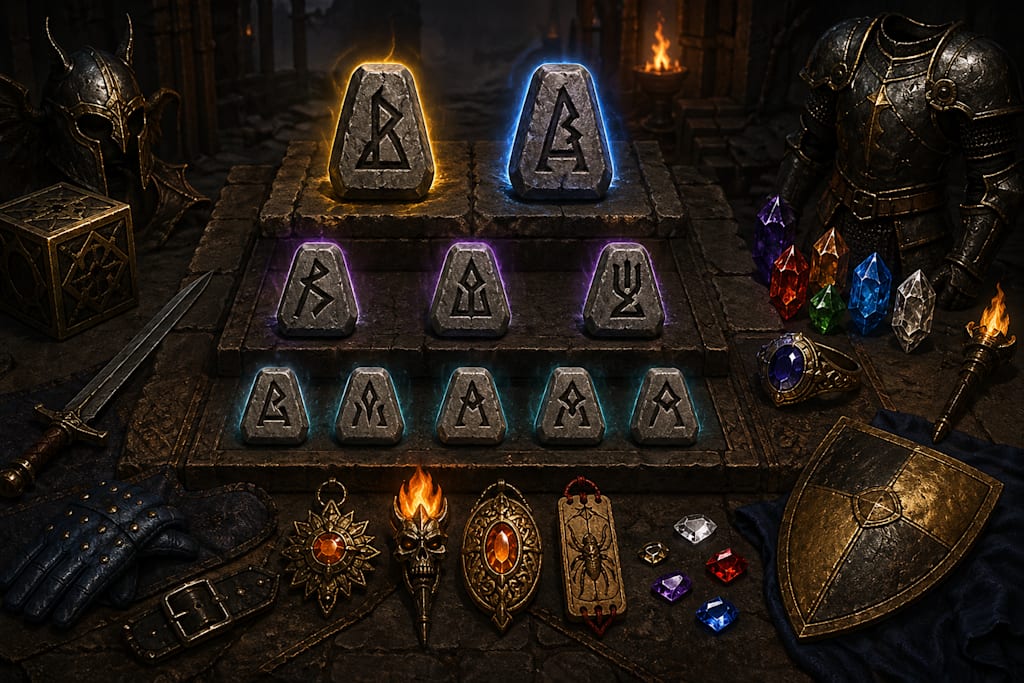
In Diablo II: Resurrected, most players assume wealth comes from luck—landing a high rune drop, finding a rare unique, or rolling a perfect item. On the surface, it feels like a pure RNG game where success depends on how fortunate your drops are.
But the reality is very different.
The players who consistently become rich are not just lucky farmers. They are traders who understand how value moves through the economy. In D2R, wealth is not created by what drops—it is created by how efficiently you convert what drops.
Once you understand this, the entire game changes.
Wealth Is a Flow, Not a Drop
New players often think in terms of single lucky moments: “I need a Jah rune” or “I need a perfect item drop.” But experienced players think in systems, not moments.
The Diablo II economy is better understood as a flow:
low-value items → mid runes → high runes → endgame gear
Nothing stays static. Value is constantly being upgraded, converted, and repositioned through trading.
This is why some players with average luck end up extremely wealthy, while others with great drops remain poor—they never convert their wealth efficiently. They hold instead of circulate.
Liquidity Is the Real Currency
Not all valuable items are equal in practice. The key difference is liquidity—how easily something can be traded.
High liquidity: Ist rune, popular uniques, crafting bases
Medium liquidity: Vex, Gul, Ohm runes
Low liquidity: niche uniques, off-meta gear, situational items
The most successful traders prioritize liquidity above everything else. Why? Because liquid assets can be upgraded or exchanged instantly without waiting for the “perfect buyer.”
In many ways, Ist rune functions as the unofficial currency of Diablo II. It’s stable, widely accepted, and often used as the baseline for pricing everything else.
Trading Up Beats Farming Down
Efficient players don’t wait for perfect drops. They build wealth step by step through constant upgrading.
A typical progression might look like this:
Sell early drops and useful items for Ist runes
Combine or trade Ist upward into Vex, Ohm, or similar value tiers
Convert mid runes into high-value runes like Lo, Sur, Ber, or Jah
Eventually exchange high runes for endgame runewords or gear components
This is the core loop of wealth creation in Diablo II.
The mindset shift is critical:
You don’t need to find a Jah rune. You need to build toward one.
Prices Are Driven by Psychology, Not Just Rarity
Unlike fixed-price games, Diablo II’s economy is shaped heavily by player behavior. Prices move based on demand, hype, and perception more than raw drop rates.
For example:
At the start of a ladder season, crafting materials and mid runes spike in value
When a build becomes popular, its required gear suddenly becomes expensive
When supply floods the market, even rare items temporarily lose value
This makes timing just as important as what you are selling. Smart traders don’t just sell rare items—they sell into demand peaks.
The Meta Controls the Economy
The strongest force in the economy is always the current meta.
If a build dominates farming efficiency or PvP performance, everything tied to it increases in value:
Key weapons and armor pieces rise sharply
Runewords enabling movement or damage scaling become more expensive
Supporting gear like charms, resist items, and skill modifiers also spike
In short, the economy follows the players. It is shaped by what people want to play, not by what is statistically rare.
Why Most Players Stay Poor
The difference between wealthy and poor players usually isn’t luck—it’s behavior.
Common mistakes include:
Hoarding items because they “might be useful later”
Refusing to trade mid-tier value items
Waiting endlessly for perfect deals
Ignoring rune conversion paths entirely
Meanwhile, successful traders are constantly cycling value. Nothing sits idle for long. Everything is part of a moving chain of upgrades.
The Diablo II: Resurrected economy is not a loot system. It is a conversion system.
Wealth doesn’t come from finding rare items—it comes from transforming small value into larger value through intelligent, continuous trading.
About the Creator
Dangyc Ding
Welcome to the ultimate paradise of u4gm! Here you can find the most exciting game content, the latest strategies and cheats, and a passionate player community. Whether you are a novice or an expert, you can find your own game product.
Enjoyed the story? Support the Creator.
Subscribe for free to receive all their stories in your feed.
Comments