
IPS vs VA vs TN: Best Budget Monitors in India (2026)
Stop buying blurry screens. We break down IPS vs VA vs TN tech to find your perfect monitor under ₹15,000 in 2026 with real Indian market data.

I remember my first "gaming" monitor back in the day. It was a TN panel that looked like someone had smeared grey Vaseline over the screen. Colors were washed out. If I tilted my head an inch, the image inverted.
Fast forward to 2026, and the market is hella different. You can get a stunning display without selling a kidney. But the old question remains: IPS vs VA vs TN? Which one should you actually spend your hard-earned Rupees on right now?
Navigating the Panel Jungle Without Getting Fleeced
Shopping for a screen in India feels like a minefield. Brands throw alphabet soup at you: GTG, MPRT, DCI-P3, and HDR400. Most of it is just marketing noise to hide cheap components. You need to look past the box art.
Why Your Old Screen Looks Like Hot Garbage
If you are rocking a 5-year-old office display, the backlight is probably dying. Older panels used thick CCFL tubes or crappy edge-lit LEDs. Modern budget screens in 2026 use better backlighting, which helps every panel type look a bit more decent.
The Quick Specs Cheat Sheet for 2026
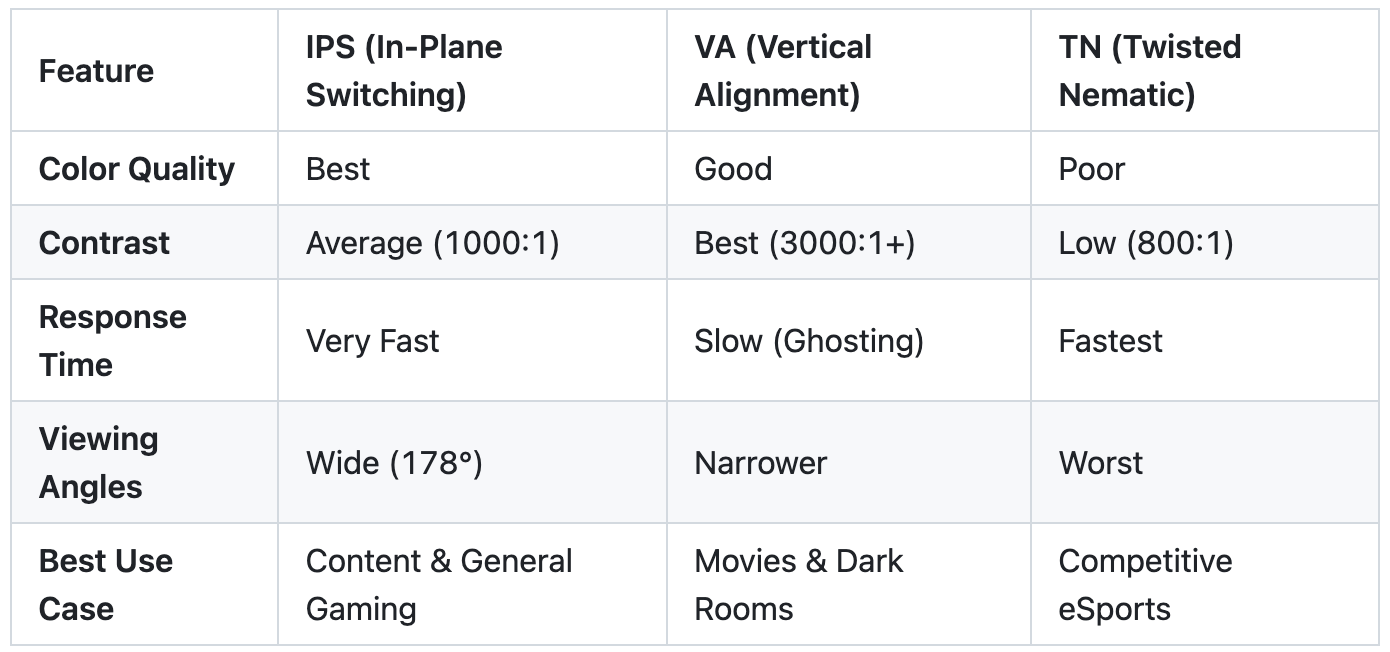
Budget monitors have peaked. You can now find 180Hz refresh rates as a standard. Resolution is still stuck at 1080p for the most part under ₹15,000. Here is a quick look at how the three main techs stack up against each other.
TN Panels Are the Fast But Ugly Stepchild
TN technology is old. Like, really old. But it is not dead yet. If you are a sweat who only plays Valorant or CS:GO, you might still consider one. They are cheaper to manufacture and offer the lowest input lag.
Speed Over Everything for Aspiring Pros
The main draw here is the motion clarity. TN pixels flip states faster than a politician during election season. You get almost zero motion blur. For a budget monitor under 15000 in India, you can find TN panels pushing 240Hz easily.
You might be wondering if that speed is worth the trade-off. Stick with me. If you are not trying to go pro, the answer is probably no. The visual cost is just too high for most folks.
The Death of Color Accuracy in Cheap Builds
Not gonna lie, TN panels look depressing. The blacks are actually dark grey. Red looks like washed-out pink. If you do any photo editing or even just watch Netflix, you will hate it. It is all hat and no cattle.
"TN panels are essentially on life support. Unless you’re a professional eSports player who needs every single millisecond of advantage, there’s no reason to buy one in 2026." — Tim Schiesser, Lead Display Analyst, Hardware Unboxed.
VA Panels Provide the Deepest Blacks for Movie Buffs
VA panels are the middle child. They try to do everything but often stumble. They are famous for high contrast. If you play games with dark atmospheres, like Resident Evil, VA looks pure dead brilliant compared to IPS.
Contrast Ratios That Put IPS to Shame
While IPS usually sits at 1000:1 contrast, VA hits 3000:1 or 4000:1. This means the black parts of the screen actually look black. It makes for a much more immersive experience when the lights are turned off in your room.
But wait. There is a catch. There is always a catch with budget gear. While the colors are decent, the "VA Smearing" is a real vibe killer. It can make fast games look like a blurry mess.
The Ghosting Headache in Fast Motion
Here is the thing. VA pixels are slow to transition from black to grey. When a dark object moves across a light background, it leaves a trail. It looks like the object is melting. Some people do not notice it; others find it tidy annoying.
Actually, scratch that. Most people notice it once they see a fast IPS panel next to it. If you are sensitive to blur, stay away from cheap VA screens. They are best for office work or slow-paced RPGs.
IPS vs VA vs TN: Why IPS Usually Wins the Budget War
In 2026, IPS has become the default choice for a reason. Manufacturers finally figured out how to make them fast and cheap. It is the most balanced tech for 90% of people reading this right now.
Vibrant Colors for Content Creators
The color reproduction on even a budget IPS is lush. You get 99% sRGB coverage on almost every model. This means what you see on the screen actually matches reality. It is a massive jump from the dull TN days.
I reckon that once you go IPS, you can never go back to TN. The pop and sizzle of the image are just too good to give up. Even for basic web browsing, it feels more premium.
Viewing Angles That Don't Shift When You Lean
Viewing angles are the secret sauce. On an IPS, you can look at the screen from the side, and the colors stay the same. This is braw if you like to slouch in your chair or share the screen with a mate.
"The death of the TN panel was predicted a decade ago, but the sheer affordability of IPS in the 2024-2026 era finally sealed the deal for the mass market." — Adam Vjestica (@its_adamv), TechRadar.
Future Trends in Indian Monitor Tech for 2026
The Indian market is growing like crazy. Statista projects the monitor segment in India will reach $1.2 billion by late 2026. This massive volume means we are getting tech that was "high-end" just two years ago at budget prices.
The Rise of Budget 240Hz Displays
Right now, 144Hz is the baseline. By the end of 2026, expect 240Hz IPS panels to dominate the sub-15k segment. This will effectively kill off any remaining reason to buy a TN panel for speed.
What this means for you is simple. Do not overpay for 144Hz right now. If you can wait a few months, the faster stuff is fixin' to drop in price. The competition between Acer, LG, and Gigabyte is fierce.
Mini-LED Trickle Down to Mid-Range Gear
We are also seeing the very first "Budget" Mini-LED panels hitting the market. These use hundreds of tiny LEDs for better dimming. They aren't quite under ₹15,000 yet, but they are getting close. It is a lowkey revolution for contrast.
I might be wrong on this, but I suspect VA panels will eventually be replaced by these Mini-LED IPS hybrids. They offer the speed of IPS with the contrast of VA. It is the best of both worlds, really.
Hard Truths About Your Next Purchase
Look, no monitor is perfect. Every single one has a flaw. IPS has "glow" where the corners look bright in the dark. VA has smearing. TN has... well, everything. You just have to pick your poison.
For most of y'all, the IPS vs VA vs TN debate ends with IPS. It is the safest bet. It does everything well enough that you won't regret the purchase three months down the line.
Don't get blinded by the spec sheet on Amazon. A "1ms" response time claim is almost always a lie on budget monitors. They use a setting called "Overdrive" that creates ugly artifacts. Stick to the "Standard" or "Fast" modes.
Plot twist: the best monitor is the one that fits your desk and doesn't hurt your eyes. If you spend 8 hours a day coding, a VA might actually be better for eye strain. If you play Valorant till 3 AM, get the IPS.
At the end of the day, we are spoiled for choice. India has gone from having two decent options to having twenty. Just make sure you check the warranty. Dealing with dead pixels is a canny nightmare if the brand has bad service.
So what does that mean for you? Go for an IPS if you want a great all-rounder. Choose VA if you only watch movies and play slow games. Avoid TN unless you are literally playing for a trophy and a paycheck.
Frequently Asked Questions
Q: Is IPS better than VA for gaming in 2026?
A: Yes, for most gamers. IPS offers better motion clarity and faster response times. VA is only better if you prioritize deep blacks and play in a pitch-dark room where IPS glow might be distracting.
Q: Why are TN monitors still being sold in India?
A: They are incredibly cheap to produce. Brands use them to hit ultra-low price points for bulk office orders or for extreme budget eSports builds where every Rupee counts toward refresh rate over image quality.
Q: Does IPS glow ruin the movie-watching experience?
A: It depends on the unit. Some have it worse than others. While it is visible in dark scenes, it is usually less distracting than the motion blur or "smearing" found on budget VA panels.
Q: Can I use a budget monitor for professional color grading?
A: Not really. While budget IPS panels have good colors, they lack the bit-depth and calibration accuracy needed for pro work. They are fine for YouTube or social media content, though.
About the Creator
Aveloria Thessar
Aveloria Thessar, Head Content Editor at BestGuides, brings 8+ years of hands-on experience in PC building and benchmarking. She reviews GPUs, CPUs, and laptops with data-driven insights.
Enjoyed the story? Support the Creator.
Subscribe for free to receive all their stories in your feed.
Comments
There are no comments for this story
Be the first to respond and start the conversation.