
GTA 6’s 27‑Minute Gameplay Trailer Proves “Bigger” Isn’t the Point — It’s “Alive”
Forget the 11x map size. After frame‑by‑frame analysis of the PS5 footage, the real game‑changers are the fuel gauge, the raindrop physics, a new police AI that forces you to use your rearview mirror, and one tiny “hold hands” button that rewrites Rockstar’s entire narrative playbook.
I. Put frame rates aside; look at the rain and the lights first.
At 4 minutes 12 seconds into the trailer, Jason turns a muscle car left through rain. Pause and zoom in. The raindrops on the windshield do not fall uniformly. Where the left wiper blade passes, water trails into curved streaks. On the uncovered corner of the right side, droplets are swept sideways by airflow, collide with the side‑window edge, and burst into smaller beads.
This is not a lighting or texture trick. Rockstar wrote separate simplified fluid‑dynamics layers for glass surfaces at different angles. If this is common in actual gameplay, the PS5’s compute‑allocation strategy is more interesting than the graphics themselves.
At the 9‑minute aerial shot, the neon signs in the distant commercial district do not share a uniform brightness. They flicker in alternating rhythms, not synced blinks but irregular breathing patterns that mimic aging ballasts in real circuits. Los Santos’ night scenery was beautiful, but every light turned on and off together, like a postcard run through a one‑click filter. In Vice City, some signs flash fast, some slow, some stutter as if they have a loose connection. That is the real meaning of “density.”
II. Steal, refuel, check the rearview – the action chain has lengthened.
In GTA V, to get a sports car you ran into the middle of the road, yanked the driver out, hit the gas – three seconds and you were gone. Your brain did not need to engage.
The trailer and hands‑on impressions show that the same goal in GTA VI becomes a forced sequence.
First, assess the risk. That bright yellow sports car on the curb is tempting, but if you yank the driver out in daylight, NPCs now scream and immediately pull out their phones. Police no longer spawn out of thin air; they generate a dynamic file based on license plate, your outfit, and your passenger. In the chase around the 15‑minute mark, police vehicles stay glued to the protagonists’ route – not through scripted spawning, but because the stolen sedan has a built‑in GPS tracker. Testers confirm you must first shake the pursuers, then drive to a specific chop‑shop stall to remove the tracking module; otherwise the system keeps updating your location.
Second, watch the fuel gauge. The trailer does not show the dashboard closely, but bloggers who participated in the recorded demo confirm that gas stations and charging stations are interactive, and vehicles have real fuel consumption. If your tank runs dry mid‑escape, the car loses power and coasts to a stop – you have to abandon it. That breaks the old logic of “steal any car and drive around the entire map three times.” The driver now needs to maintain a basic vehicle‑awareness habit.
Third, keep your eyes on the rearview mirror. Police no longer appear as fan‑shaped vision icons on the minimap. In chase shots, the upper‑left radar is conspicuously clean. You can only judge pursuit distance through the flashing red‑and‑blue lights in the mirror and the siren sounds growing closer outside the window. This forces your gaze away from abstract symbols in the corner of the screen and back onto the scene’s own audio‑visual information.
III. The number 11x does not matter; what matters is which doors you can push open.
Official data: the overall map is twice the size of GTA V’s, but Vice City’s urban core alone is already twice the size of Los Santos. Including the surrounding swamps, islands, and inland farmlands, the total scale reaches 11 times that of Los Santos and its outskirts.
Here is a practical translation. In GTA V, driving from downtown Los Santos to Sandy Shores lake takes about four minutes. In GTA VI, driving from the southern beach of Vice City to the northern airport might take six minutes, and the trip from the suburbs to the mangrove swamps approaches fifteen minutes.
The real question appears in the nightclub scene and the skydiving shot around the 6‑minute mark. From above, roofs are fully detailed – air‑conditioning units, water tanks, exhaust ducts are all modeled. If interiors are filled to the same standard, the map’s effective volume will be far more impressive than the area figures suggest. However, the gameplay clips do not show any action of entering ordinary residences. Currently, all enterable buildings are marked with special icons (convenience stores, clothing shops, restaurants). Whether Rockstar has built interiors for thousands of structures, or only ground‑floor storefronts and mission‑related floors, must wait for the final release. Until then, “11x” is just a unit of area.
IV. The evolution of a single button.
At the 22‑minute mark, Jason and Lucía walk side by side on the street. Briefly, an interaction prompt appears in the lower‑right corner: press a specific button to “take her hand.”
In GTA V, you could interact with strippers and go to bars with friends, but those interactions triggered preset animations followed by a fade‑to‑black. The “hold hands” prompt means the physics‑collision and motion‑blending systems now allow two characters to maintain physical arm‑to‑arm connection while freely walking, and can be interrupted at any moment by gunfire or sudden events.
More importantly, there is the combat interaction later. In the gunfight near the end of the trailer, the two are not side by side behind the same cover; they are at opposite ends of the warehouse. As Lucía fires, Jason does not wait for a command – he automatically chooses a flanking route. This is not scripted. According to testers, the AI companion dynamically adjusts position based on your attack rhythm. If you hold back, she pushes forward; if you rush out, she provides cover.
There is no visible affection meter, no explicit romance mission line. You can send her texts via your phone, invite her to dinner, invite her to the gym – or ignore all of that. Relationship changes are not tallied by numerical values but judged through dialogue differences in specific scenes. Lucía’s switch between curly and straight hairstyles, shown in the trailer, is not just a clothing‑store feature; it is an external marker of the character’s state.
V. Let me state two doubts plainly.
First, driving feel. Hands‑on feedback says vehicle physics sit between the heaviness of GTA IV and the agility of GTA V. That sounds like a compromise. But GTA IV’s “boat‑like” handling turned away many casual players, while GTA V’s “overly sticky grip” was criticised by hardcore players as too arcade‑like. Trying to please both sides often pleases neither. If the fuel system triggers too often, it becomes a pure traversal chore – imagine having to detour to a gas station before every mission. Whether that realism is worth the pacing sacrifice is questionable.
Second, the male protagonist, Jason. His lines in the trailer are sparse, his voice steady and lacking distinctiveness. Compare to Trevor’s in‑your‑face madness in GTA V, or the oppressive gloom of Arthur Morgan’s first line – “It's cold out there” – in Red Dead Redemption 2. Jason currently reads as a functional sidekick. Lucía’s straight‑haired look and body language have already sparked fan creations on social media, while discussions about Jason remain scarce. Rockstar is clearly holding back most of his story, but they are hiding it so deeply that one cannot help but wonder whether the character’s depth really exists.
VI. An alternative and an old save file.
If you still do not buy my assessment, go back to the 18‑minute mark. Lucía jumps out of a plane, and the camera follows her through the clouds. During the seconds of descent, the ground – vehicles, trees, buildings – magnifies rapidly without any visible texture‑pop cuts. This seamless streaming technology is more impressive than any ray‑tracing bullet point.
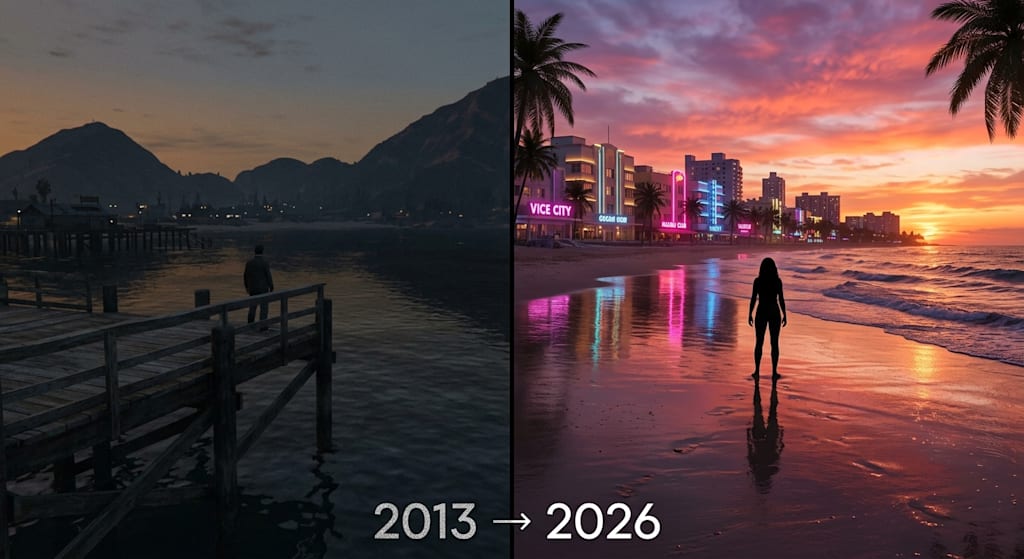
After watching the trailer, at 4 a.m., I did not post on social media. I turned on my PS4 and loaded a dusty old GTA V save. My character stood on the pier at Paleto Bay, in the game’s twilight, with an unremarkable ocean. I powered down and lay back in bed.
Thirteen years ago, I first entered Los Santos and drove my first mission vehicle straight into a swimming pool. Thirteen years later, every grain of sand on Vice City’s beach is being ray‑traced into a shadow, NPCs sidestep because I glance at them, and stealing a car requires removing three trackers. A lot has changed. But I will not say “this is the future” – that is a hollow sentence.
All I know is that when Lucía lands, stands up straight, takes off her goggles, and looks at the city skyline, she says something – I did not catch the subtitle. But the colour of that sky looked a little like the twilight in that 2013 save file.
Vice City. When that day comes, I will buy the disc, pop it in, and start burning fuel from the very first gas station.
About the Creator
Jin
Writer of reamstories
https://reamstories.com/jin
Enjoyed the story? Support the Creator.
Subscribe for free to receive all their stories in your feed. You could also become a paid subscriber, letting them know you appreciate their work.
Comments
There are no comments for this story
Be the first to respond and start the conversation.