
Forget Understanding: Why Black Myth: Wukong's Real Cultural Export Is Getting Your Ass Kicked by a Monkey God
They don't know karma from karma. They don't need to. When a foreign player screams "Wu Kong" in pinyin for the first time after thirty deaths to Tiger Vanguard, the bridge built of misunderstanding is already sturdier than any lecture on the Heart Sutra.
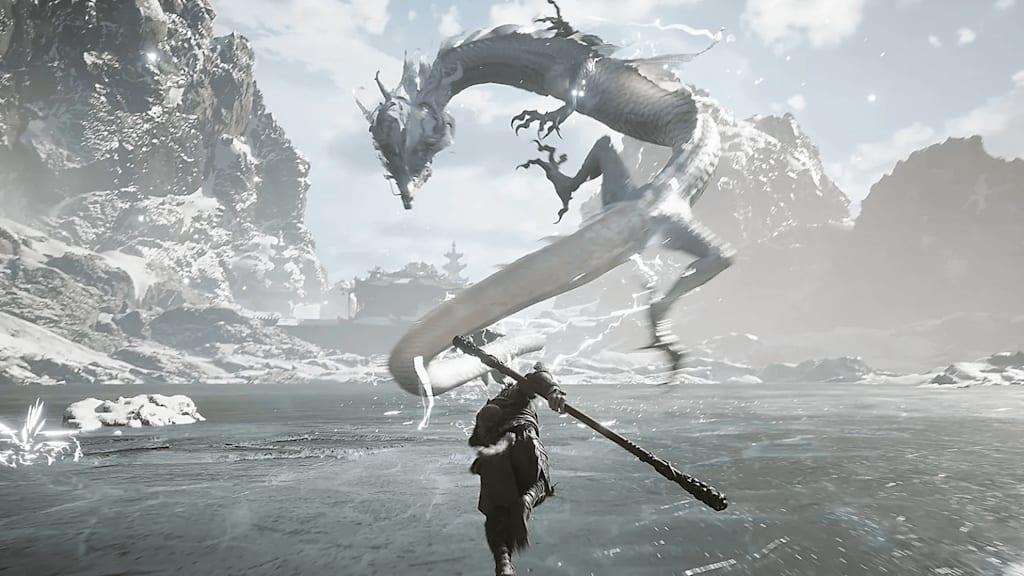
In the first weekend after Black Myth: Wukong dropped, one question kept spinning around Chinese social media: those foreign players who got their controllers smashed against the desk by Tiger Vanguard, do they actually get karma, reincarnation, and the whole Buddhist‑Taoist metaphysical tangle?
And if they don't, does this even count as cultural export? Or are we just jerking ourselves off in a bubble of hype?
To answer that, we have to go back to another game franchise: the one that made Western players flip off the entire Greek pantheon—God of War.
I. What God of War Taught Us
In 2005, Santa Monica Studio dropped Kratos into the Aegean. While players were chopping up the Hydra with the Blades of Chaos, how many of them could recite the full genealogy of Cronus castrating Uranus? In 2022, when Kratos sliced through Freya's vines in the Norse snowfields, how many could explain the precise trigger conditions of Ragnarök?
The honest reaction of 99% of players: after finishing this game, every Greek god is trash, not worth a single hair off Kratos' bald head.
Players don't give a damn about theological metaphors. What they care about is: a bald beefcake ripping himself off chains with dual blades, screaming at Athena, "I owe you nothing." That feeling of breaking loose needs no translation.
Same with Black Myth. Foreign players don't need to tell Yogācāra from Chan Buddhism. When Wukong's forehead bleeds under the tightening band, when Bajie freezes at the sight of an old tunic tangled in spider silk at the Web Cave, when Yellowbrow grins and says "Pure Land" while biting a living person in half, greed, hatred, and delusion don't require Sanskrit footnotes. You see blood, you hear laughter, you feel the nausea of betrayal. That's enough.
The philosophical systems are unfamiliar, but the rhythm of tragedy is universal. When the rhythm hits, the body understands before the brain.
II. The Two Gears of Cultural Export
If "cultural export" means "making foreigners submit an 800‑word book report on the Heart Sutra," then no commercial video game in human history has ever achieved that. A blockbuster game is not a sutra commentary.
Cultural export actually runs on just two gears.
First gear: renaming. Before Black Myth, when foreign players saw "monkey + staff," their first reflex was Kakarot—a Japanese manga Saiyan, not China's Great Sage Equal to Heaven. Not anymore. On Twitch streams, millions watch the Destined One pull out the golden cudgel, and what comes out of their mouths is "Wu Kong", pinyin, original packaging. "Jingu Bang," "tiger‑skin kilt," "Ruyi" have stopped being second‑hand Japanese anime symbols and reclaimed their native Chinese identity. Just that step alone, retaking the visual sovereignty of the image, is already a win.
Second gear: making them go back and read the source material. And this is the real killer. On the Black Myth subreddit, hundreds of new lore posts appear daily. Someone drew a diagram of the "Six Roots" (eyes, ears, nose, tongue, body, mind), mapping each to a boss drop, the text clunky but packed with actual content. On YouTube, gaming channels started doing speed‑run summaries of the original Journey to the West novel, pulling twice their usual view counts. One podcast did a special episode titled "Who is the real Buddha?" The comment section blew up into a 400‑reply war.
Players went back to a Ming‑dynasty novel because they couldn't beat a boss.
You made a particularly sharp point earlier: the hippie generation had already worn out "Zen" and "Karma" in Western art decades ago. Lord of Light (1968) put the Buddha in outer space. Zen and the Art of Motorcycle Maintenance (1974) became required reading on American college nightstands. Blade Runner (1982) had replicants eating oden at a street‑corner convenience store. The whole New Wave sci‑fi movement used Eastern mysticism as a shell to write Western anxieties about modernity.
That means Black Myth entered the scene at a very interesting moment: it's not teaching Westerners a brand‑new concept; it's reactivating a vocabulary that's been sitting in their cultural basement for fifty years. "Karma," "reincarnation," "age of decline"—these terms have been floating around Western pop culture for half a century, always misread, always simplified, always used as decoration, but they're already there.
So when Western players see Lingji Bodhisattva's headless torso, when they see Buddhist statues converted into mechanical contraptions, their first reaction isn't "what the hell is this," but "I've seen this feeling before," both sacred and uncanny, both ancient and cyberpunk. That overlap of strangeness and familiarity hits much harder than introducing an entirely new mythology from scratch.
III. Misunderstanding Is the Final Polish of Charisma
One last question: if by the end they still confuse Taoism with Buddhism, does that count as success?
Yes. And possibly the highest grade of success.
Cultural export was never about "precise delivery." The final destination of charisma isn't understanding; it's being unable to let go even after you've misunderstood.
Westerners don't need to grasp yin‑yang and the five phases to lob fireballs in World of Warcraft. The Japanese don't need to master Lovecraft's cosmic horror genealogy to get flattened by Great Ones in Bloodborne. Gamers share a primal instinct: "I don't fully get this, but I feel it's awesome."
What Black Myth does is brutally simple: it pulls you in with "the fighting feels great," keeps you there with "every trial actually costs you something," and pins you down with "my fate is my own to make." When a foreign player gets killed by Tiger Vanguard thirty times and finally wins, his head isn't filled with the words "karmic retribution." But he definitely feels something: Why the hell was this monster so strong? And why the hell did I have to beat it so badly?
That feeling is the physical version of tribulation. No translation needed.
When they put down the controller and take a deep breath, they don't say "I now understand Chinese philosophy." They say: "That's so Chinese, and that's fucking cool."
Enough. The bridge of culture grows by itself. It grows in the enormous shock of not‑quite‑understanding.
About the Creator
Jin
Writer of reamstories
https://reamstories.com/jin
Enjoyed the story? Support the Creator.
Subscribe for free to receive all their stories in your feed. You could also become a paid subscriber, letting them know you appreciate their work.
Comments
There are no comments for this story
Be the first to respond and start the conversation.