
EVONY Remains a Surprisingly Good Strategy Game in 2026
From Trade Caravans to Civil War Frontlines: A Constant Loop of Risk, Planning, and Reward

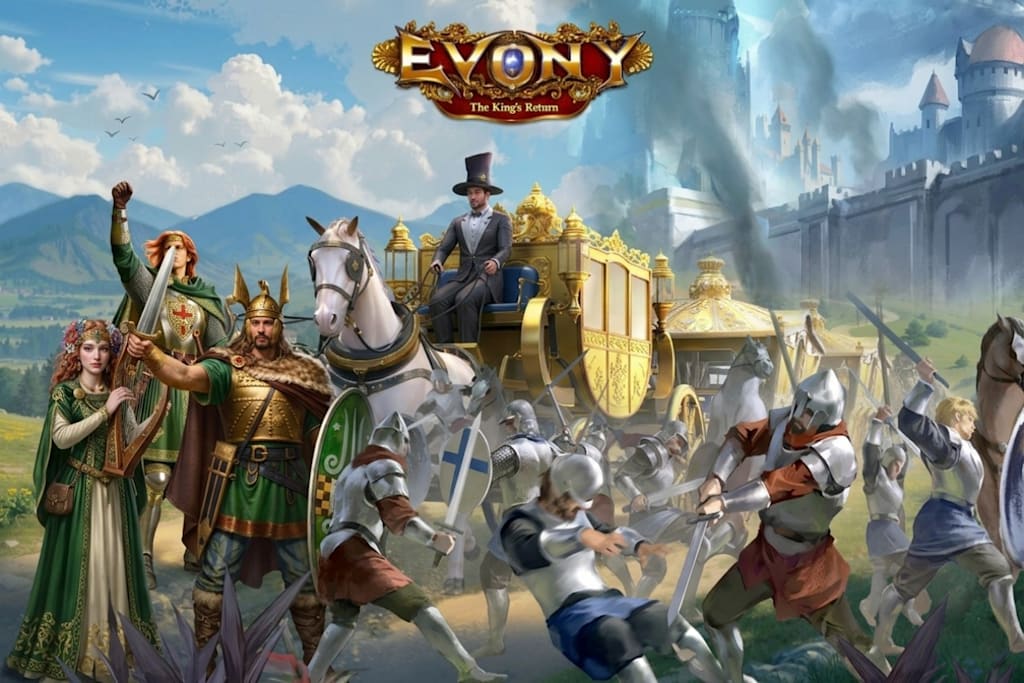
In 2026, long-running live service strategy titles face a simple problem: stagnation. Systems get bloated, events feel recycled, and players gradually disengage. Yet Evony: The King’s Return continues to resist that downward pull. It does not reinvent the genre, but it constantly recalibrates its systems to keep players cycling between planning, waiting, executing, and reacting. The result is a game that still functions as a surprisingly durable good strategy game, even years into its lifecycle.
What stands out most this year isn’t a single breakthrough feature. It’s the way systems and events are layered together, turning routine gameplay into a steady rhythm of decisions and rewards that players keep coming back to manage and refine.
Seasonal Events as Controlled Chaos
The 2026 event lineup—particularly the St. Patrick’s Day cycle—demonstrates how Evony builds complexity through repetition with variation. At the surface level, it looks like a familiar package of resource spending, summoning, and progression ladders. But underneath, it’s a carefully tuned economy of risk and timing.
The King’s Party Event introduces a progression loop where players upgrade a “Party Cake” using purchased gems, unlocking escalating rewards such as Civilization Scroll Chests, equipment materials, and even powerful generals like Hugh O’Donnell. Meanwhile, higher tiers tie progression to meaningful strategic milestones rather than pure spending efficiency.
The Historic General Summoning Event adds another layer of controlled randomness. Players chase Epic Historic Generals, with Tishtrya positioned as both a desirable outcome and a guaranteed ceiling after repeated attempts. This structure matters because it blends luck with predictability—an essential trait for any good strategy game that wants to maintain long-term engagement without alienating progression-focused players.
Elsewhere, the Revelry Carnival and Lost Treasures systems expand the idea of “map activity equals progression.” Killing monsters, gathering resources, and participating in alliance actions all feed into collectible currencies and layered reward trees. It is repetitive by design, but repetition is not necessarily a weakness here. Instead, it becomes the scaffolding for long-term planning.
This is where Evony still succeeds as a good strategy game: it transforms everyday actions into inputs for larger economic decisions.
Systems Design: Trade Carriages and Citizens
The introduction of the Trade Carriage and Citizen System marks a more structural evolution in gameplay. These are not temporary events; they are persistent mechanics that shift how cities function.
Trade Carriages introduces a risk-reward logistics layer. Players dispatch multiple carriages daily along unpredictable routes, exposing them to potential plunder. Protection requires escort teams, and even then, outcomes are not fully deterministic. Higher-quality routes require rerolls or special permits, introducing a soft layer of resource optimization.
Alliance Caravans extends this concept into a cooperative strategy. A 6-hour preparation phase allows members to coordinate participation, but final selection remains partially random. The result is a hybrid system: part planning exercise, part probabilistic outcome generator. It rewards communication, but never fully guarantees control.
This tension between control and uncertainty is a recurring design language in Evony, and it is part of what keeps it functioning as a good strategy game in a crowded market.
The Citizen System is more deterministic but equally important. Assigning citizens to buildings provides targeted buffs—ironworkers increase production, doctors accelerate healing, and higher-quality citizens significantly amplify output. On paper, this is a familiar city-management layer. In practice, it subtly shifts optimization from macro-level empire planning to micro-level assignment efficiency.
Together, these systems reinforce a core loop: players are constantly adjusting variables rather than simply executing fixed strategies. This continuous adjustment is what defines a modern good strategy game in a live-service environment.
Clash of Civilizations – Assault
If events and city systems define the economic layer of Evony, then Clash of Civilizations – Assault defines its competitive identity.
This mode is structured around map control, score accumulation, and server-wide ranking. Players engage with event monsters like Shadow of Dawn and occupy contested structures such as Dawn Temples and Eclipse Strongholds. Each action contributes to a score that determines access to higher-level battlefield content.
The key design feature here is escalation. Early participation is accessible, but only top performers qualify for the most competitive battlefield layer, where servers are matched against multiple opponents. Rewards are distributed both individually and through alliance performance.
What makes this system compelling is not just PvP competition, but logistical decision-making under pressure. Players must choose between farming monsters, reinforcing structures, or committing to full-scale territorial control. Each decision carries opportunity cost.
This layered pressure environment elevates Evony beyond a simple war simulation. It becomes a good strategy game because success depends less on raw strength and more on timing, coordination, and resource allocation within a shared battlefield.
Even technical improvements—such as lag optimization and UI clarity—signal that the system is evolving to support larger-scale strategic complexity rather than collapsing under it.
Long-Term Engagement and the Psychology of Return
What Evony understands well in 2026 is that longevity in strategy games is not about novelty alone. It is about structured anticipation.
Daily carriages, timed summoning events, rotating carnival systems, and alliance-based logistics all build a predictable cadence. Players are not just logging in to play; they are logging in to manage cycles. This transforms the game into a persistent planning environment rather than a series of isolated sessions.
This is also where its design becomes more controversial. The reliance on layered rewards, randomized outcomes, and progression gating can feel dense. At times, it edges toward overload. But from a systems perspective, this density is precisely what keeps it functioning as a good strategy game—there is always another layer to optimize and another system from which to extract value.
The presence of surprise rewards, rare generals, and branching event outcomes ensures that even familiar activities retain a degree of unpredictability. That unpredictability is not chaotic; it is structured. And structured unpredictability is one of the most effective tools in long-term game retention design.
Conclusion
Evony: The King’s Return in 2026 is not a minimalistic strategy experience. It is layered, occasionally overwhelming, and deliberately dense. But within that density lies its strength.
It continues to reward patience, planning, and alliance coordination. It continues to turn repetitive actions into strategic inputs. And it continues to balance control with randomness in ways that keep outcomes uncertain but not arbitrary.
That balance is why it still qualifies as a good strategy game, even in a market where many similar titles fade after their initial lifecycle peak. It may not always feel elegant, but it remains functional, engaging, and structurally committed to player decision-making.
In a genre where many games simplify over time, Evony has done the opposite: it has accumulated systems without losing its core identity. And in 2026, that accumulation is precisely what keeps it unexpectedly compelling.
About the Creator
Cool Gamer
With 5+ years in mobile gaming, I see it as more than fun—it enriches life. Here to share trends, insights, and joy. Let's have some fun!
Enjoyed the story? Support the Creator.
Subscribe for free to receive all their stories in your feed.
Comments