
Everyone Plays Gomoku. Almost No One Competes.
The game has a first-move problem, a rulebook few understand, and no money to fix either.
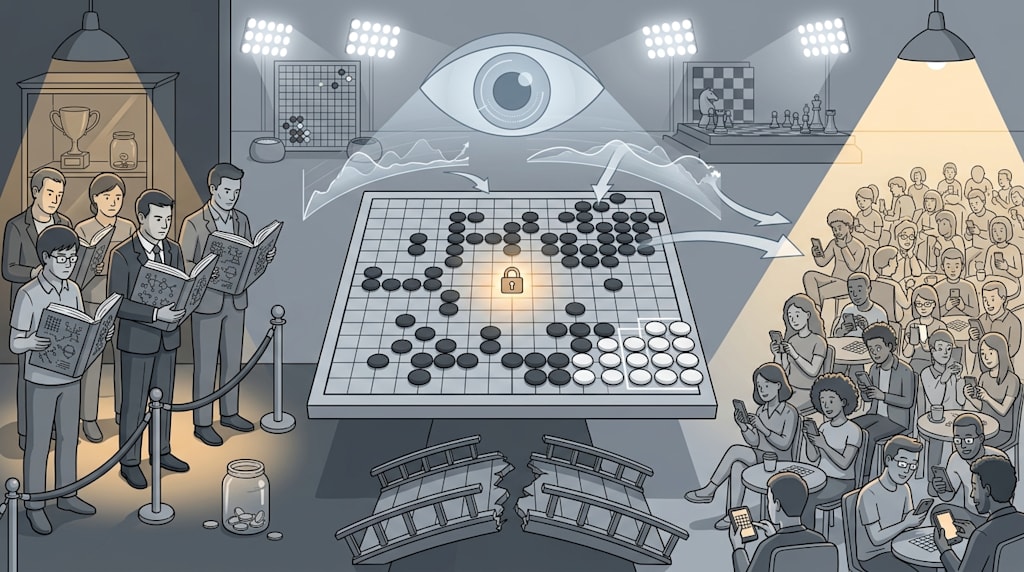
Gomoku is one of the most familiar board games in China. Almost everyone has played it. Almost everyone thinks they know how to play. The rules take a minute to learn. A game can end in five. That is why most people file it under casual entertainment, not competitive sport.
The strange part is what happened next. Gomoku has a huge player base. It has never built a stable professional circuit, a global audience, or a business that can support full-time players. Go and Chinese chess have leagues. Poker and chess have tours. Gomoku has a large and quiet group of fans.
Why?
The usual answer is that Gomoku is too simple. That answer is wrong. Once you study it, Gomoku gets complicated fast. The problem is structural. The rules, the competitive scene, and the public image all push against each other. The result is a game stuck in an awkward spot.
Your three observations, small board, forced center opening, and the split between Japanese Renju and casual Gomoku, map onto three layers: physical space, rule tradition, and community. They are not separate flaws. They are the same flaw showing up in different places.
The First Problem: Black Wins
Everything starts with the first move.
Under unrestricted rules, Black plays first. That advantage is enormous. Gomoku was solved long ago: Black wins. This is not one opening. Among the twenty-six common openings, twenty-five are forced wins for Black. The only relatively balanced opening is the Comet. Even that balance is fragile. One wrong step and the game tips.
So under unrestricted rules, Gomoku barely works as a competitive game. If both players know the right moves, the result is set from move one. Black has a forced win. White can only wait for a mistake. At high levels, Black rarely makes one.
The history of Gomoku rules is a history of patching that first-move advantage.
The first patch was the forbidden-move rule. Black cannot make double-three, double-four, or an overline. This weakened Black's attack and gave White counterplay. Some openings that were Black wins became balanced or White wins. The Comet, balanced under unrestricted rules, became a White win under forbidden moves.
But forbidden moves did not fix the root problem. Most openings still favored one side. So came five-move two-choice. The first three moves stay normal. Then White can swap to Black. On move five, Black offers two points. White removes one and leaves the other. This protects fairness and adds variation.
Take the Ruisin opening. Before five-move two-choice, Ruisin was a Black win. White played four at I9. Black played five at G9 or I7 and won. Under five-move two-choice, White can play four at I10. If Black still plays I7, Black finds no second winning point. Black settles for I6. White removes I7, leaves I6, and the position balances.
That example shows both the power and the cost of patches. Balance depends more on invented rules than on the game itself.
Later came Taraguchi, Soosõrv-8, and others. They do a finer job of balancing fairness and variation. They also make the rulebook harder to read. The rules start to look like a code only professional players can learn.
Ordinary players already struggle with forbidden moves. Five-move two-choice, swaps, candidate points, and Taraguchi are worse. Each rule set turns Gomoku into a different game. Your opening study can become useless overnight. Your forced win can become a forced loss.
This is the first structural contradiction. Fair competition requires complex rules. Complex rules keep the public out. The gap between professional and amateur play grows.
Go has the same first-move problem. Komi solves it with one simple compensation. Gomoku chose layers of patches. Its rule history became a history of mods. Each mod feels like a new game, not an evolution of the same one.
The Board and the Center Point
The second problem is the board itself.
A 15x15 board already limits variation. Go's 19x19 board has astronomical space. Gomoku's 15x15 board has far less. The smaller the board, the easier it is to exhaust opening study. The easier it is to exhaust, the more forced wins and forced losses appear.
Then there is the center-point rule. Why must the first move be at the center? The logic is weak. Playing near the center helps development. It does not follow that the first move must be exactly there. The rule is history, not necessity. Renju adopted it over time.
That convention costs variation. The 15x15 board is already small. Forcing the first move to the center cuts another large slice of opening possibilities. Players study within a narrow frame. The more they study, the fewer playable positions remain.
Some argue that opening up the first move would add variation and make balance easier. The competitive Renju system resists. Opening it up would invalidate existing opening theory, training methods, and tournament rules. Veteran players would lose the value of their study. Organizations would lose control.
So Gomoku loops. To look professional, it keeps a complex rule set and a fixed opening system. That system makes games look like recitation. It drains creativity and watchability.
Two Games Called Gomoku
The third problem may be the most damaging. Japanese Renju and casual Gomoku are two different games.
Renju is the competitive system. It has forbidden moves, swaps, candidate points, and detailed tournament rules. Its players train for years. They memorize openings and rule details. The group is small. Your estimate of under 100,000 people sounds close. The people who enter professional Renju events, study the rules, and memorize theory are a tiny slice of everyone who plays Gomoku.
Casual Gomoku is everything else. Hundreds of millions play it on phones, computers, during breaks, in teahouses. The rules are simple. Black wins with correct play. Most players do not care. They do not know Black has a forced win. They do not want rule reform. They play for fun.
That split is brutal. Professional Renju controls the rules but has few players. Casual Gomoku has the players but no interest in rules. Professionals think casual play is not serious. Casual players think professional rules are too much. Neither side builds with the other.
Worse, casual Gomoku runs on forced-win tricks. The internet is full of "Gomoku forced-win opening" and "three-step checkmate" tutorials. That content reinforces the idea that Gomoku is simple, childish, and about memorized tricks. New players win a few games as Black, lose a few as White, and quit.
Professional Renju has the opposite problem. Its rules are balanced but hard to enter. A casual player who wants to move up must learn forbidden moves, swaps, candidate points, opening classification, and theory. The curve is steep. Most quit before they start.
So Gomoku never converts its mass audience into competitive players. The professional circle closes. The casual circle stays casual. There is no bridge, only a gap.
No Money, No Professionals
Rules are only half the problem. The other half is money.
A sport needs talent. Talent needs income. Income comes from prizes, sponsors, broadcasts, coaching, and merchandise. Gomoku is behind on all of them.
China's top Gomoku event may pay a champion a few tens of thousands of yuan. A top player who wins everything in a year may still not cover a decent life. Most "professional" players have other jobs. Gomoku is a side project. Without a stable career path, young people will not spend ten or twenty years on it.
Media attention is thin. Mainstream outlets treat Gomoku as a lower-tier game. Go and Chinese chess have national leagues, TV coverage, and sponsors. Gomoku has occasional news, small online discussions, and fans running on love.
The international scene is just as awkward. The world Gomoku organization is not a member of the International Mind Sports Association. That keeps it out of events like the World Mind Sports Games. No top stage means no exposure. No exposure means no sponsors. No sponsors means no prize money. No prize money means no talent. The loop closes.
You might point to AI. AI is active in Gomoku. But AI mostly cracks the game. It does not grow it. When AI gives forced wins instantly, human opening study loses value. Matches become open-book exams. Watchability drops. Audiences want human creativity and human mistakes under pressure, not two players following AI recommendations.
AI Makes the Problem Worse
AI hurts Gomoku more than it hurts Go.
Go AI overturned opening theory and made Go more interesting. Go is too complex for AI to exhaust. Its recommendations often surprise humans. Audiences see new ideas.
Gomoku is smaller. AI can exhaust it faster. Many openings are immediately judged as wins or losses. Human players spend years on theory. AI solves it in a second. Two things follow.
First, training loses value. You do not need to understand. You memorize AI moves. The game becomes a memory contest.
Second, matches lose suspense. If the audience knows an opening is a Black win, and both sides play AI moves, the result is predictable. You wait for a mistake. High-level players with AI help make fewer mistakes.
Tools like Katagomo show win rates move by move. That transparency is useful for study. In competition, it kills drama. No drama means no audience. No audience means no business.
Where a Way Out Might Be
Gomoku needs fixes at several levels.
Rules. It needs a competitive rule set that is simple and balanced. Swap2 is worth watching. One side places two black stones and one white stone. The other side chooses Black, chooses White, or adds one black and one white stone and lets the opponent choose. This balances first and second move. It keeps variation. It has no forbidden moves and no complex candidate points. Casual players can follow it.
Swap2 has problems. It still uses unrestricted rules. The professional Renju world may not give up forbidden moves. AI can also study Swap2 openings. But Swap2 adds two stones, which creates tens of thousands of opening positions. That makes deep prep unrealistic.
Board. Could the center-point rule open up? Could the board grow? Both would add variation. Both would shock existing theory. Veteran players and organizations would resist.
Bridge. Professional Renju needs a path for casual players. That path cannot start with forbidden moves and candidate points. It should start with simple balancing rules. An entry-level competitive rule set could use a simple swap on top of unrestricted play. Then it could guide players toward professional rules.
Money. Gomoku needs a business model. It cannot copy Go or Chinese chess directly. It might work as light competition, like online card and board games. Platforms, social features, and short sessions could attract users. That path needs capital. Capital follows growth. Gomoku does not look like growth right now.
What Gomoku Is Stuck With
Gomoku's problems are systemic.
First-move advantage is the base defect. Rule patches are the structure above it. No money is the environment. The split between competition and casual play is the ecology. These problems feed each other. A single reform will not fix them.
Your three points, small board, forced center opening, and the Renju versus casual split, match three layers: physical space, rule tradition, and community. Together they explain why Gomoku has a huge base and almost no competitive influence.
Gomoku will not die. It is too easy and too familiar. As long as people want a quick game, Gomoku will be there. It will also struggle to become more than that. Its history traps it. Black wins, so patches appear. Patches make rules complex. Complexity pushes people away. Distance shrinks money. No money makes professionalization hard. Hard professionalization makes reform weak. Weak reform leaves Black winning.
That is a closed loop. Breaking it takes more than a few new rules. It takes a new philosophy and a new organization. Until then, Gomoku will stay where it is: a huge, quiet, underrated board game.
It is there. Everyone knows it. Few take it seriously.
About the Creator
Jin
Writer of reamstories
https://reamstories.com/jin
Enjoyed the story? Support the Creator.
Subscribe for free to receive all their stories in your feed. You could also become a paid subscriber, letting them know you appreciate their work.
Comments
There are no comments for this story
Be the first to respond and start the conversation.