
BLG Didn’t Lose Because of Arrogance
The “sin of arrogance” label is hiding the real story of the LPL Grand Final, and it starts with a jungle gap nobody wants to talk about.
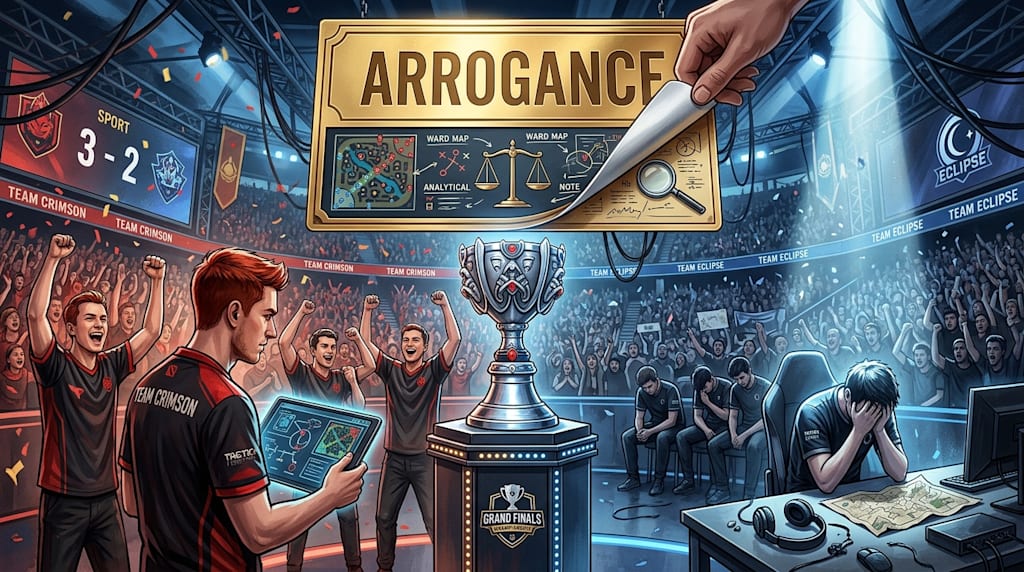
The sin of arrogance, or a fig leaf: BLG's defeat and the LPL's labeling dilemma
I. The birth of a label
On September 13, in the LPL Split 3 Grand Final, AL defeated BLG 3–1 to lift the organization's first Silver Dragon Cup. A week earlier, BLG had swept AL 3–0 in the winners' bracket final, even shutting them out 20–0 in Game 1. Seven days later, AL answered with a 20–1 in one game, the most complete revenge possible.
After the match, caster Miller, in his review video, offered an opinion that quickly trended: BLG had committed the "sin of arrogance." The gist was that winning the winners' bracket so easily put BLG in a "defending champion" mindset, causing deviations in draft preparation and player readiness. After dropping the first two games, they became impatient, and the jungle-support chain collapsed, costing them the rhythm entirely.
That explanation has some truth. BLG did look underprepared after the 3–0, while AL used the week to make targeted tactical adjustments. If we take this as the final answer, however, a problem arises: is "a team lost because it was arrogant" a verifiable analysis, or an unfalsifiable narrative?
The person who proposed this label had, after the previous MSI final, evaluated BLG's defeat in a completely different discursive mode. Then, Miller's criticism targeted specific problems of specific players: "an epic top-lane gap," "When will Bin understand that top lane is not just about laning?" This time, facing an equally glaring positional gap in the jungle, the evaluation rose to "the sin of arrogance," a moralized, holistic rhetoric.
The fans' dissatisfaction stems from this. The complaint is about inconsistent standards: when the problem was in the top lane, it was a player's ability issue; when the problem is in the jungle, it becomes the whole team's moral issue.
II. The real picture hidden by "arrogance"
If we remove "the sin of arrogance" from the analytical framework, what remains becomes clearer.
The gap in the jungle was the most striking positional feature of the entire BO5. Tarzan accumulated 15–6–33 over four games. In Game 1, his Qiyana went 7–2–5 and ran rampant. In Game 2, his Cho'Gath went 8–0–6 and became unkillable. In Game 4, his Maokai went 0–0–14, a purely supportive style, yet still maxed out the tempo. Xun accumulated 4–17–23 over four games. In Game 2, his Naafiri went 0–5–1 and was completely negative. In Game 4, his Lee Sin went 0–6–2 and became the breakthrough point. Calling this "bad form" undersells it. Tarzan delivered a four-game demolition. He also won the Grand Final FMVP for this performance.
Xun himself faced this issue directly in the post-match press conference: "I played too impatiently, and many decisions were not calm enough." His self-review had nothing to do with "arrogance." It pointed to a more specific and more common competitive problem: when a jungler is continuously suppressed in his own jungle, he chooses more aggressive ways to force back the tempo, resulting in playing more anxiously, and the more anxious he gets, the more he feeds. Miller himself mentioned this chain of mental imbalance (Xun anxious, ON anxious too, jungle-support chain feeding, whole-team rhythm collapse), but it was wrapped under the label of "the sin of arrogance" and lost its due analytical weight.
The draft problems were also concrete and debatable. In Game 2, picking Kai'Sa in the top lane was widely considered BLG's most "floaty" move. The more important issue is the composition's logic. BLG had a composition with extremely low margin for error. Mid and bot needed to gain lane advantages, side lanes needed to split-push and pull, small skirmishes needed to rely on individual mechanics to deal damage. In theory, it was playable, but the premise was that every position executed perfectly. Yet when Xun's Lee Sin forced an R-flash engage in a position where his teammates could not possibly follow, when Karma did not pair with Caitlyn but instead ran around with Lee Sin, the problem was no longer "was the composition good or bad" but "the execution of the composition completely derailed."
BLG's draft was indeed debatable, but attributing the draft problem to "arrogance," that is, "they looked down on the opponent so they drafted carelessly," is a lazy attribution. It skips over the analysis of composition logic, execution details, and in-game decisions, and directly issues a moral judgment.
III. The history of the "sin of arrogance": a repeatedly used narrative template
The first large-scale use of the "arrogance" narrative in the LPL dates back to LGD at the 2015 World Championship.
That year, LGD entered Worlds as the LPL Summer Split champion and were seen as a title favorite. They lost their first three group-stage matches, stubbornly refused to ban the meta-strong Mordekaiser, and were eliminated in groups. Post-mortem analysis almost unanimously pointed to "inflated ego" and "arrogance." The players had just won the league title, carried themselves with arrogance, and after Doublelift's Mordekaiser was crushed in scrims, they developed the illusion that "Mordekaiser is nothing special."
The pattern repeats: hype, underperformance, a post-mortem about mindset, then the same cycle next time. Since then, almost every LPL team that lost a major match as a "heavy favorite" has been fitted with this template. S8 RNG, S11 FPX, and S12 TES all followed it.
Repeated use of this template creates a dangerous illusion: it seems that as long as they are "not arrogant," the championship would definitely belong to the LPL team. Its implicit premise is that these teams were already superior to their opponents in raw strength, and they lost only because something went wrong on their own side. This narrative both overestimates the LPL teams' actual strength level and systematically underestimates the opponents' growth and preparation.
In the BLG vs. AL final, after losing 0–3 in the winners' bracket final, AL used one week to complete a thorough tactical counter: Tarzan's Cho'Gath and Qiyana were prioritized in draft, the team's objective-fight decisions became more decisive, and bot laner Hope proved his teamfighting ability in the deciding game with a pentakill on Miss Fortune. AL won a hard-fought battle with better preparation and firmer execution. Calling this "BLG arrogance" is unfair to AL and does not constitute a real reflection for BLG either.
IV. The structural problem behind casters' discourse
Miller's commentary sparked controversy for two reasons: the inconsistent standard this time, and the deeper structural problem it exposed in LPL commentary. That problem is a lack of language habits for honestly discussing "gaps in strength."
In the LPL public sphere, admitting that "the opponent is simply stronger than us" is extremely difficult. So when an LPL team loses a key match, the narrative always turns inward to find moral reasons: "arrogance," "inflated ego," "mental collapse," "disrespecting the opponent." It rarely turns outward to admit that the opponent was indeed better in tactical preparation, player form, and on-the-fly execution.
This habit has roots in an earlier period. The LPL has long constructed its narrative around "defeating the Korean region," narrowing victory and defeat into a kind of national confrontation. That framework makes it impossible for explanations of failure to escape "something went wrong on our side." Admitting the opponent is strong is, to some extent, equated with admitting one is weak. So "the sin of arrogance" becomes a safe harbor: it explains the failure and preserves the dignity of "we could have won."
The price of this dignity is enormous. It replaces real analysis with emotional labels and drowns specific tactical problems in vague moral judgments. When you explain everything with "arrogance," you also give up the chance to understand anything.
V. BLG does not need a "sin"
BLG's 2026 trajectory says enough: they defeated JDG 3–1 in the Split 1 final, swept TES 3–0 in the Split 2 final, lost 1–3 to AL in the Split 3 final, and missed out on sweeping all league titles for the year. They lost 2–3 to HLE in the MSI final, and defeated G2 3–1 at First Stand to win the organization's first international title. This is a team with strength, with results, but also with obvious weaknesses. Its ceiling is high enough, but its floor is equally unstable.
Using "the sin of arrogance" to explain this team's defeat is intellectual laziness. It replaces analysis of the jungle matchup gap, draft logic, composition execution, and mental contagion with an untestable moral judgment. It simplifies discussion and empties it.
The label's implicit logic is itself arrogant: the championship was supposed to belong to BLG, and as long as BLG did not commit this "sin," AL would have no chance. As the user pointed out, "the sin of arrogance is the real arrogance." This presupposition is a great disrespect to AL and a disregard for the most basic fact of competitive sports: championships are never "gifted"; they are "won."
BLG does not need a conviction. It needs serious analysis of why the jungler's form plummeted off a cliff on the most important stage, why the coaching staff's draft logic looked like a different team in the final compared to the regular season, and whether the failure of jungle-support synergy was a psychological problem or a tactical one. These questions are far more complex than the label "the sin of arrogance," but only by facing this complexity can BLG truly transform on the next stage.
The record will show what BLG did.
About the Creator
Jin
Writer of reamstories
https://reamstories.com/jin
Enjoyed the story? Support the Creator.
Subscribe for free to receive all their stories in your feed. You could also become a paid subscriber, letting them know you appreciate their work.
Comments
There are no comments for this story
Be the first to respond and start the conversation.