
Your Home Is a Bug Paradise. You're the All-You-Can-Eat Buffet.
Why slippers and swatters are the least effective weapons in the war on bugs, and the boring, silent habits that actually work
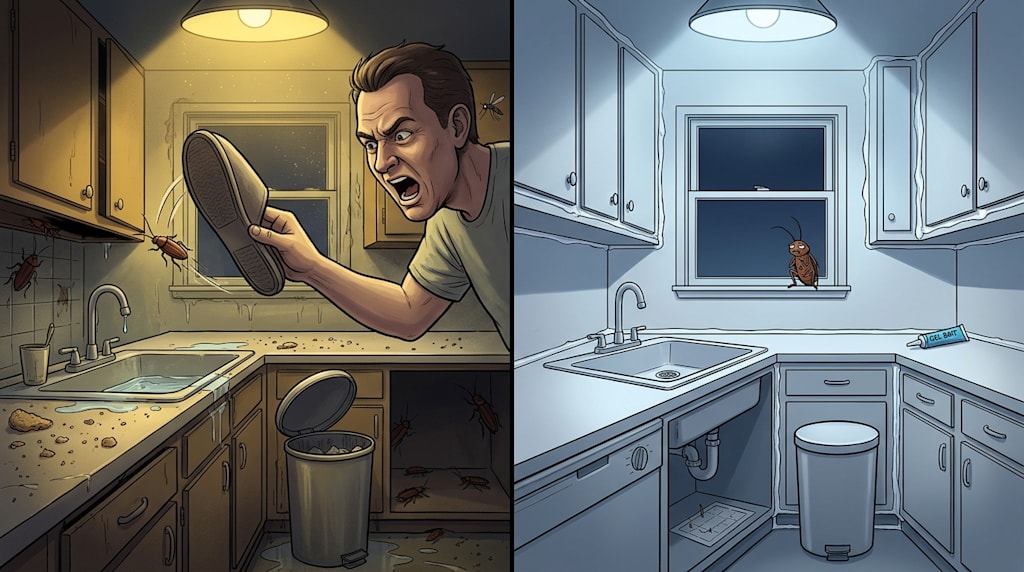
At three in the morning, the kitchen light flicks on, and the cockroach launches itself from the edge of the sink and disappears into the gap under the cabinet. The slipper slaps the tile. Loud. Nothing hit. The human stands under the light, breathing hard. The cockroach is already inside the crack, recalibrating its antennae. This scene repeats in countless kitchens every night. The human thinks a war is underway. The cockroach just registers that a shadow moved.
But to read this scene as "humans in impotent rage, insects laughing at the thought" is to zoom in too close, so close that you see the slipper and nothing beyond it.
Start with the cockroach's place in nature. It frightens no one because it is not a top predator. But it does not survive by frightening anything. Spiders, ants, geckos, frogs, birds, rodents, parasitoid wasps. The list is long, and the cockroach is a daily protein source for many of them. A dragonfly can eat hundreds of flying insects a day. A small bat's nightly catch can silence anyone who has slapped mosquitoes until their wrist aches. The cockroach's survival strategy was never "make them fear me." Its strategy is to make itself hard to see. Hide by day, come out at night, avoid light, flee vibration, squeeze into cracks the thickness of a coin. These are not the arrogant habits of a creature that fears nothing. They are avoidance techniques filtered out by predators and disturbance over a very long time. To call avoidance cowardice, and survival invincibility, is the easiest slide in anthropomorphic rhetoric.
The human swinging a slipper may not look ridiculous to a bug. A slipper does kill some unlucky individuals. The problem is it does not kill the population. Slapping a hundred mosquitoes a day is a rounding error in the diet of a bat, a dragonfly, or a swallow. But the decisive factor in modern pest control was never the slap. Slapping is the end of the line, an emotional outlet, the loudest sound in the war. It is not the main force.
What is the main force? A dry kitchen. A drain trap with an insect-proof core. Food waste that does not sit overnight. A sink wiped dry, a countertop with no standing water. The gap under the cabinet sealed with silicone. Bedding through a hot-water wash once a week. These things make no sound. They cannot be photographed for social media. But they strip away, one by one, the three things a cockroach needs: water, food, and crack shelter. A dry, sealed, trash-cleared home is not a paradise for a German cockroach. It is a desert. The slipper is just a patrol at the edge of that desert. It is not the rain.
"The skin flakes, saliva, sweat, and drool you shed every night are enough to feed a whole insect family." That sentence has imagery, but it confuses scale with limiting factors. Dust mites do eat skin flakes. Mosquitoes do drink blood. Cockroaches do use food residue and water. But the bottleneck for indoor pests is usually not "the little bit of skin a human sheds." It is humidity and cracks. Dust mites need relative humidity above roughly 60 percent to reproduce well. Mosquitoes need standing water to complete the larval stage. Cockroaches need warm, damp cracks and accessible food and water. A clean but damp home, with the drain open and a thin film of water always on the counter, can still raise an army. An old but dry, sealed, trash-cleared home will have far lower pest density. Clean is not an arrogant slogan. Clean is a set of physical conditions: dry, sealed, cleared daily, hot water, maintenance. To call that set of conditions "arrogance" is to mistake an engineering problem for an attitude problem.
"Humans have cleared out the geckos, frogs, swallows, and spiders, leaving only two ridiculous slippers." That is also only half right. Human dwellings reduce large predators. But the indoor ecosystem is not "an insect paradise with no natural enemies." It is "a casino where a few adapted species can break the bank." German cockroaches adapt to kitchen warmth and cracks. Dust mites adapt to mattress humidity. Mosquitoes adapt to the standing water in balcony flower-pot saucers. Silverfish adapt to damp cardboard boxes. Spiders and geckos have not been cleared from many homes; they have simply learned to hide in corners people do not often look at. Humans did not empty nature. Humans rewrote nature into a set of rules that allows only a few species to thrive. In those rules, the slipper is not the predator. Dryness is the threat.
The part about pesticides and resistance points to a genuine problem. Pesticides screen for resistant individuals. German cockroach resistance, mosquito resistance, resistance in some flies: these are unavoidable issues in integrated pest management. But "too strong a screen accelerates evolution, so the bugs thrive even more" cannot be generalized. Resistance is not a free superpower. It often comes with a fitness cost. Resistant individuals may grow more slowly, live shorter lives, or compete poorly against susceptible individuals in a pesticide-free environment. Long-term overuse of a single chemical will breed resistant populations. But rotating modes of action, gel bait placement, source reduction, and community coordination can push densities down. Overall indoor pest pressure in modern cities is far lower than in the pre-industrial era. The issue is that "zero bugs" is unrealistic. What humans have to accept is a long-term management war, not a one-time extermination campaign.
Lice and fleas drifting away from humans did not happen because they suddenly became hygiene-conscious. Hot-water laundry, frequent changing of clothes, pet parasite preventives, and public health systems dismantled their resource chains link by link. This example proves the point: environmental management works far better than impotent rage. What wipes the laugh off a bug's face is the gel bait in the corner, the insect trap in the drain, the food waste cleared daily, the hot water in the washing machine, the preventive drops on a pet's back. The slipper-swinging posture does none of that.
So the more accurate conclusion is this: the strength of insects comes from their talent for treating human dwellings as a predictable resource and shelter, not from "fearing no one." The strength of humans comes from remaking the environment, cutting off resources, and using chemicals precisely, not from the slipper. The cockroach is not nature's invincible one. The mosquito is not humanity's conqueror. The slipper is even less the main force of the war. The war between humans and insects is a long management campaign about dryness, sealing, garbage, standing water, and resistance. It was never a joke.
Bugs can laugh at humans swinging slippers. But they had better not laugh at what humans look like when they get serious. When humans get serious, the sink, the drain, and the trash can move first. The slipper comes later.
About the Creator
Jin
Writer of reamstories
https://reamstories.com/jin
Enjoyed the story? Support the Creator.
Subscribe for free to receive all their stories in your feed. You could also become a paid subscriber, letting them know you appreciate their work.
Comments
There are no comments for this story
Be the first to respond and start the conversation.