
Why Your Mobile App Development Team Might be Slow: The 4 Release-Engineering Bottlenecks Nobody Benchmarks
A practical look at the release-engineering gaps that delay mobile app launches after development is done.

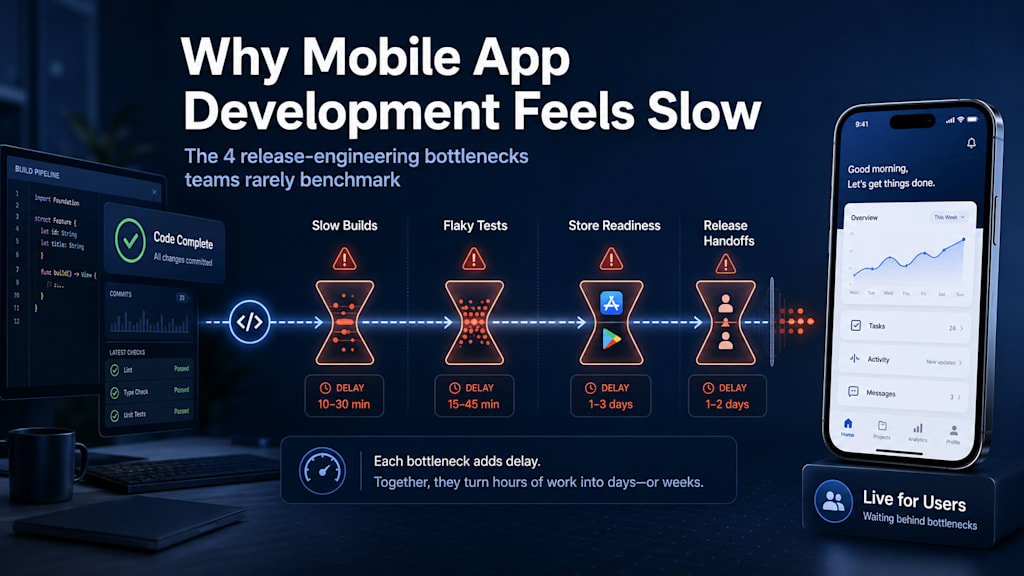
Mobile leadership teams typically evaluate engineering performance through sprint velocity, ticket closure rates, and feature output. While these indicators show development activity, they do not show how quickly the feature/application reaches the users.
The distinction matters because the mobile market does not wait. Mobile app revenue is projected to climb from $522.7 billion in 2024 to $673.8 billion in 2027, and the enterprise mobile app development market reached approximately $193.9 billion in 2025, with a 6.46% compound annual growth rate forecast through 2030. In that environment, a feature that exists in main but takes a week to reach users represents a real cost to revenue and retention.
The core point of this article is straightforward. A mobile app development team may not be slow. But the release system around it may be. The most expensive bottlenecks in mobile app development tend to sit downstream of code writing, within an unmeasured release-engineering layer.
Why Mobile App Development Teams May Appear Slow
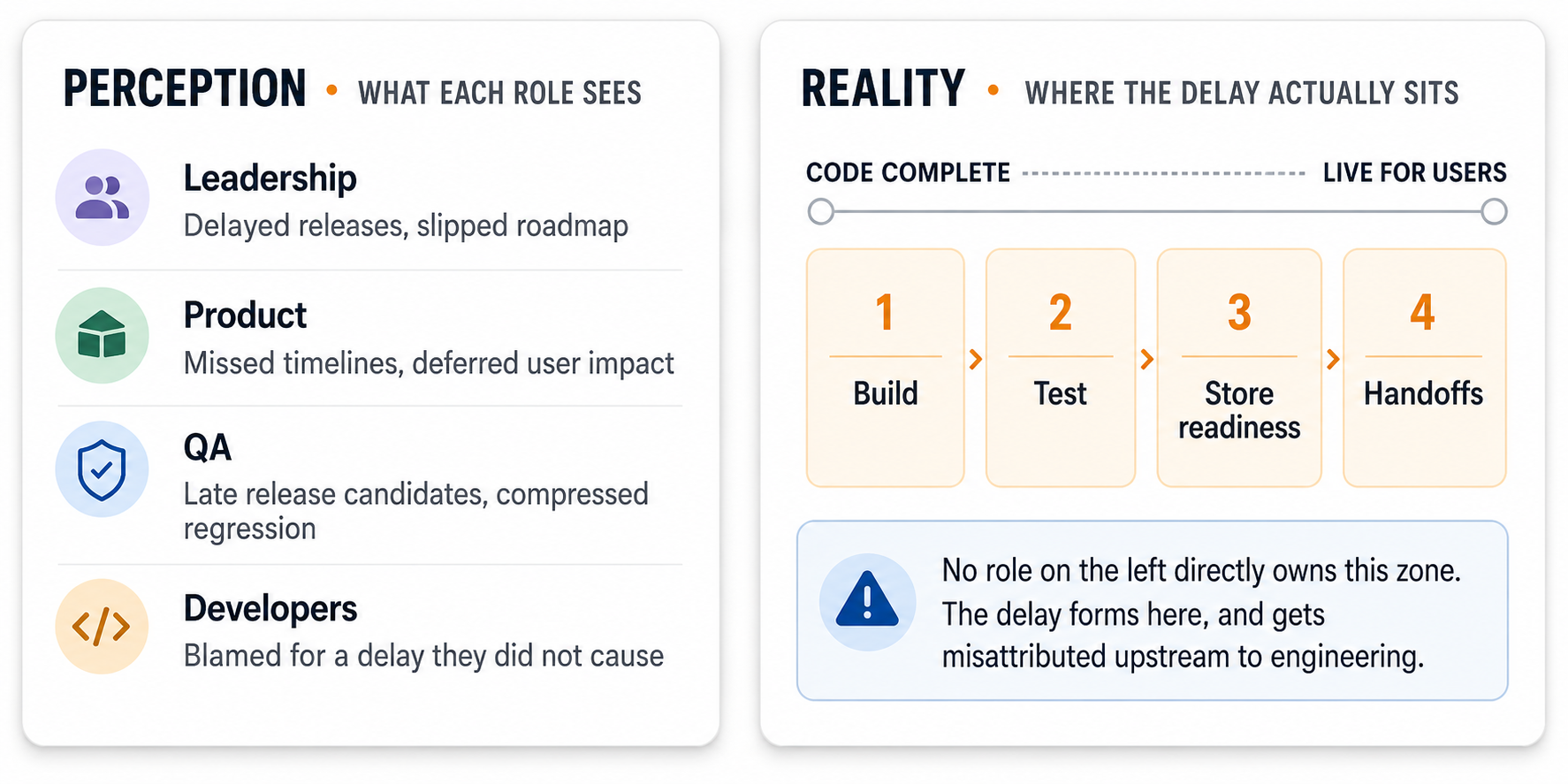
The perception of slow mobile delivery rarely starts inside engineering. It starts at the edges of the organization, in places where the delay is visible but its cause is not apparent.
Leadership sees the symptoms first:
- A release was pushed back
- A quarterly roadmap that no longer aligns with the deployment calendar
- A feature announced internally but not yet shipped
Product teams encounter the same gap from a different angle: sprint commitments are met on paper, while user-facing impact remains delayed. QA receives release candidates late and absorbs the schedule pressure into compressed regression windows. Developers, who finished their work on time, find themselves explaining a delay they did not cause.
Across leadership, product, and QA, the assumption is often the same: engineering is slow. What gets missed is that developers may have finished the code days earlier. The visible delay usually stems from release-stage challenges in mobile app development, not from feature development itself. They sit between "code complete" and "live for users," in the part of the pipeline that no role in the list above directly owns.
Runway's 2025 State of Mobile Release Management Report, based on responses from 300 mobile engineers, quantified the gap in a way that explains the perception problem. Even teams that have invested heavily in automation report wasting between six and ten hours per release on coordination and handoff work that lives outside development. The hours are real; they show up in the schedule but do not appear in the developer's ticket log.
The result is a recurring misdiagnosis. The team is judged on the wrong window. Performance metrics measure how fast code is written. Delivery delays arise from what happens to code after it is written.
The 4 Release-Engineering Bottlenecks Slowing Mobile App Development
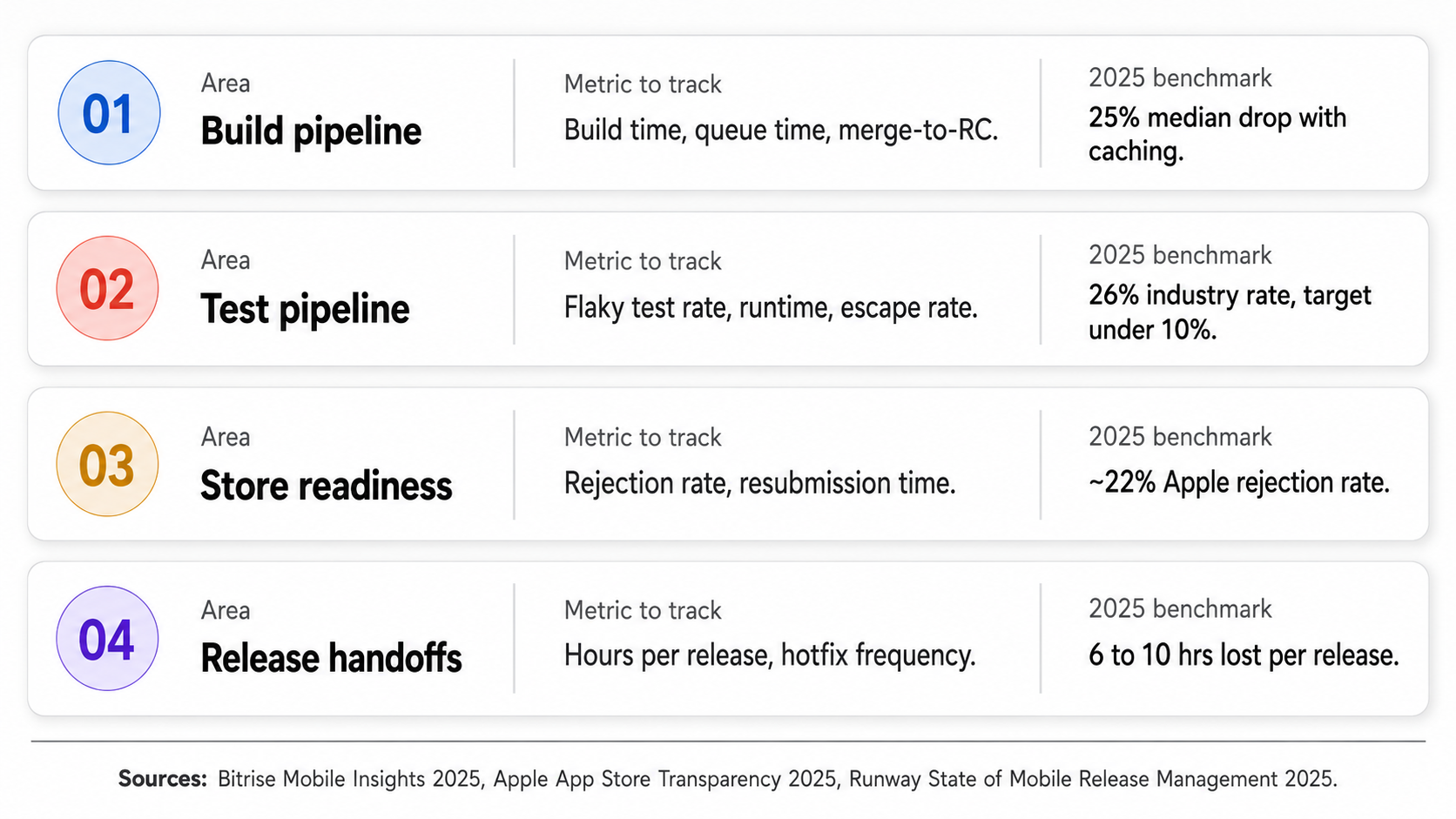
Mobile app release bottlenecks cluster in four well-defined areas. Each one creates a specific kind of delay, and each one absorbs hours that get charged to engineering time without being attributable to engineering effort.
Build Pipelines That are Too Slow
Mobile builds carry more steps than typical web pipelines. Each build resolves dependencies across iOS and Android, compiles multiple app variants, processes assets and binaries, runs signing flows, and packages artifacts for each target store (App Store or Play Store). As feature surfaces and toolchains grow, those pipelines get heavier.
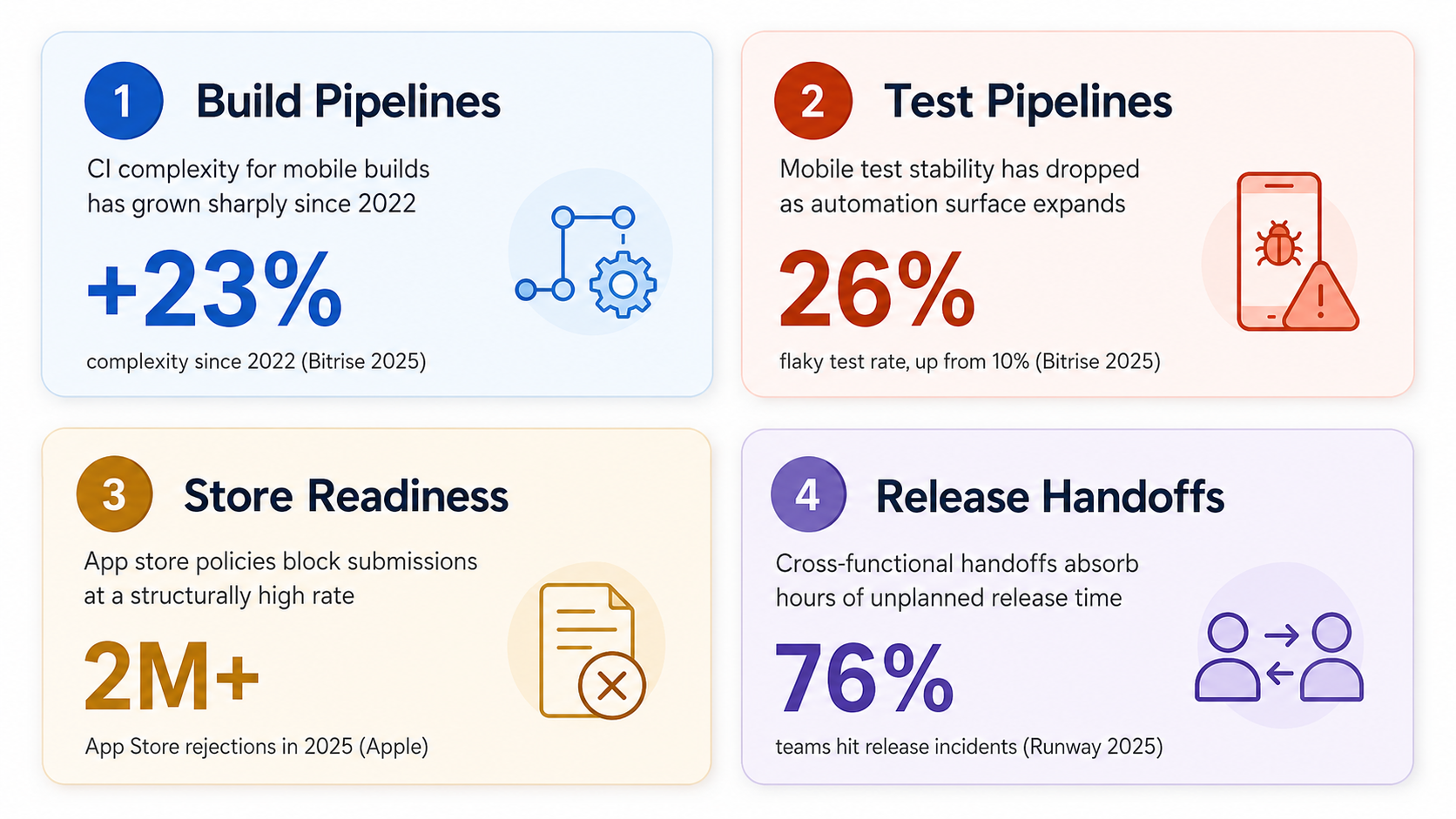
Bitrise's 2025 Mobile Insights report, drawn from more than 10 million builds analyzed over three and a half years, found that mobile CI pipeline complexity rose 23% during the period studied. Long build queues, intermittent build failures, dependency installation overhead, and slow artifact generation push the time-to-release candidate well past what sprint planning assumes. When that gap is invisible, the delay is attributed to whoever was holding the build at the moment of failure rather than to the system that slowed it down.
Unstable Test Pipelines
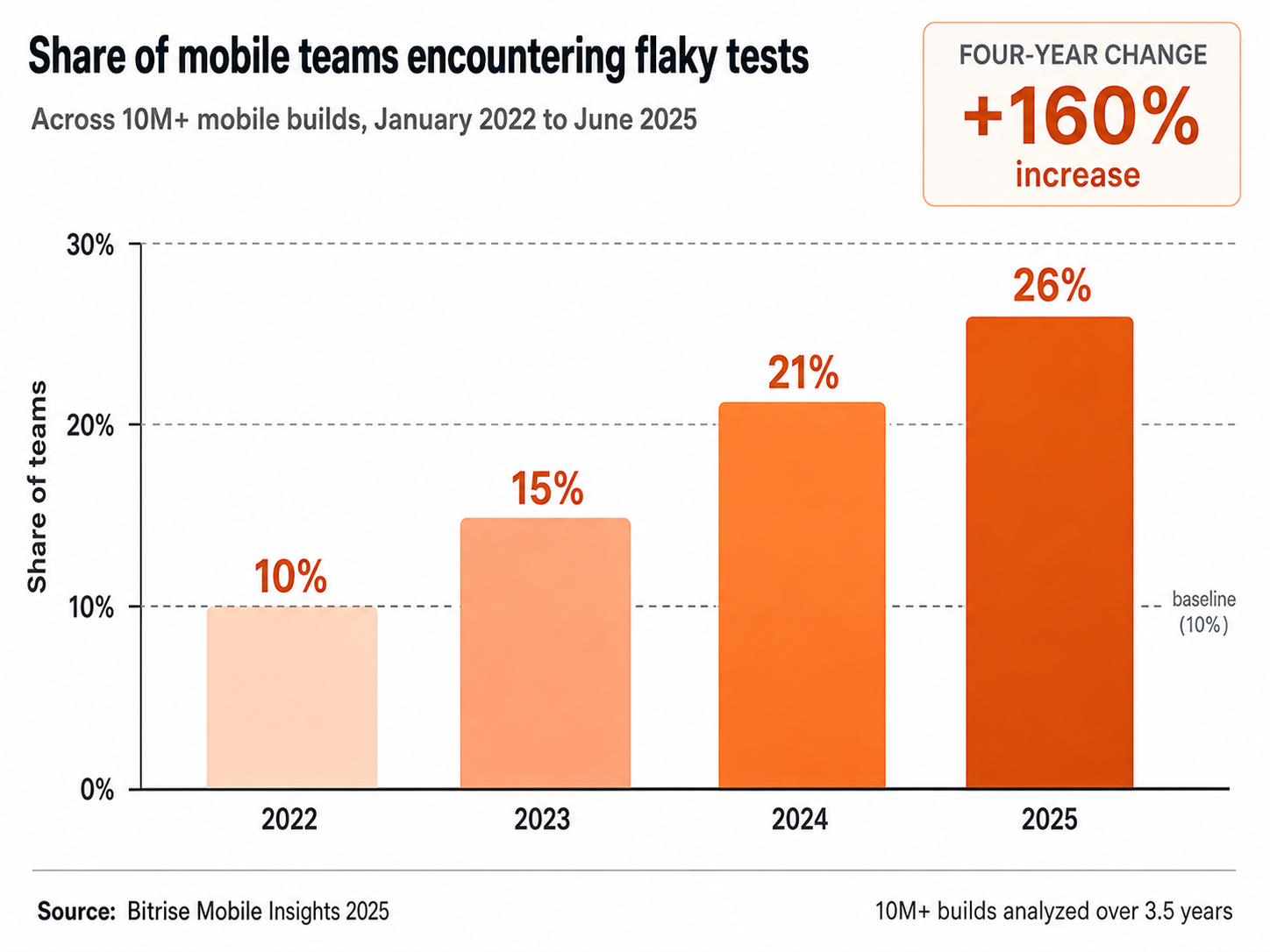
Mobile QA must account for device fragmentation, OS versions, screen sizes, permission states, and network conditions that web apps never encounter. When tests fail intermittently or regression cycles stretch, the automation suite stops functioning as a release gate and starts functioning as a delay.
The 2025 data clearly illustrate the trajectory. The Bitrise study showed that the share of mobile teams encountering flaky tests rose from 10% in 2022 to 26% in 2025, a 160% increase. A peer-reviewed 2025 study (Parry et al., arXiv, April 2025) found that developers spend roughly 1.28% of their working time repairing flaky tests, and a separate 2025 industry survey reported that test maintenance, including fighting flakiness, consumes approximately 40% of QA team time.
The result is predictable: trust in the suite erodes, manual regression replaces automated coverage, and timeline pressure absorbs the cost without ever being priced.
Store Readiness
A finished build is not a submittable build. Certificates expire, provisioning profiles drift, privacy manifests need updates, SDK declarations need refreshes, and store metadata, screenshots, and release notes must align with platform rules that change every cycle. When store readiness is treated as a final checklist rather than a continuous workstream, it becomes a release-week emergency.
The 2025 platform data establishes the scale. Apple reviewed more than 9.1 million App Store submissions in 2025 and rejected over 2 million, including 1.2 million new apps and nearly 800,000 pending app updates. Google Play blocked approximately 1.75 million policy-violating apps from being published during the same period.
Each rejection adds a resubmission cycle, a documentation review, and an unplanned negotiation among engineering, legal, and product, with the release date slipping while the finding is cleared.
Poorly Managed Release Handoffs
A mobile release is a cross-functional event. Engineering closes the build, QA signs off, product confirms scope, analytics validates tags, support prepares macros, marketing readies assets, and legal clears customer-facing content. Without explicit ownership for each handoff, the release can be technically ready and operationally blocked at the same time.
The Runway 2025 report also captured what poor coordination costs in practice. 76% of teams regularly experience release incidents that lead to delays and firefighting; 77% require hotfixes every 3 to 5 releases; and two-thirds of respondents identified coordination as the weak link in their release process, reporting a lack of tooling to address it. These numbers describe a system that ships, but ships expensively, with hours of unplanned work absorbed at every cycle.
How to Fix These 4 Mobile App Development Bottlenecks
The fix is not to push mobile app developers to type faster. It is to measure the path from "code complete" to "user rollout" with the same discipline already applied to development tracking. Each of the four bottlenecks responds to a small, specific set of metrics, and each measurement points to a concrete intervention.
Measure Build Pipeline Performance
Track build duration at the median and the 95th percentile, queue time before a build starts, build failure rate, dependency installation time, and the end-to-end time from merge to release candidate. These numbers expose where time is being lost: cold caches, runner contention, dependency churn, or compilation steps that have outgrown the original pipeline design.
Build pipeline benchmarking is the lowest-risk lever in any mobile app performance optimization initiative that targets delivery speed, since the changes are technical, isolated, and easy to validate against historical run data. The 2025 Bitrise data set showed that teams adopting build caching cut median build times by 25%, with the slowest builds improving by 30%. Top-performing mobile teams using release automation now ship biweekly or faster, with 54% of them on that cadence.
Measure Test Pipeline Reliability
Track the flaky test rate per suite, total test runtime, coverage of release-critical user flows, manual regression hours per release, and the defect escape rate from QA to production. The goal is to separate tests that protect the release from tests that produce noise.
Once these numbers are visible, the response options are well-defined: quarantine flaky tests rather than letting them block builds, rewrite high-value flows using more stable patterns, and retire low-signal tests rather than carry them as overhead. If 40% of QA time is consumed by flakiness and rerun churn, recovering even half of that would reclaim engineering capacity greater than most hiring rounds deliver.
Measure Store Readiness Earlier
Track signing issue frequency, missing or outdated metadata, privacy declaration gaps, SDK compliance findings, store rejection rate, and resubmission time. The goal is to make submission readiness a measured state available throughout the cycle, not a last-week status check.
Treating compliance as a workstream that runs in parallel with development, rather than after it, converts a recurring delay into a routine pre-flight check. Mature teams maintain a live submission readiness dashboard that tracks certificate expiry, privacy manifest status, and SDK changes across both stores.
Measure Release Handoffs
Track code-freeze-to-submission time, submission-to-rollout time, approval delays, unresolved cross-functional dependencies, hotfix frequency, and rollback readiness. Each of these points refers to a specific handoff that either has clear ownership or does not.
The Runway 2025 findings made the cost explicit: even teams with significant automation investments lose 6 to 10 hours per release when coordination is informal. Assigning one release owner, defining ownership for code freeze, QA sign-off, store submission, and rollback decisions, and publishing a release-train schedule removes most coordination loss. Once the four areas above are measured separately, the team can identify the actual delay and respond with a specific intervention rather than a general one.
Building the measurement, tooling, and discipline this requires across all four areas is a substantial commitment. Internal teams often hit a familiar wall here. Scalability becomes a problem when each release cycle requires the same coordination effort regardless of feature volume, and costs compound rather than amortize. Expertise gaps emerge because building engineering, mobile test automation, app store compliance, and release management are distinct specialties, and very few engineers cover all of them in depth. Cost pressure follows, because staffing the full set of disciplines in-house often exceeds the budget allocated for mobile delivery, particularly outside of large product organizations. This is the point at which many organizations turn to hire mobile app developers with release engineering depth.
The Takeaway: Faster Releases Start With Better Visibility
Slow mobile app development is not always a developer productivity problem. The 2025 data from Bitrise, Runway, Apple, and Google consistently point to delays that occur after development is complete, in the layer that converts code into a release-ready app. Build pipelines, test reliability, store readiness, and release handoffs; each responds to a small, well-defined set of metrics. Once those metrics are tracked alongside the development metrics that already get attention, mobile app release engineering bottlenecks stop being invisible. They become problems with owners, baselines, and clear paths to improvement. The teams that consistently act on this metric are the ones that close the gap between code completion and going live for users.
About the Creator
Murli Pawar
Murli Pawar is the VP of Digital Engineering at SunTec India, leading enterprise-wide technology innovation & solution delivery. He specializes in software architecture and modernization, helping enterprises enhance agility & scalability.
Enjoyed the story? Support the Creator.
Subscribe for free to receive all their stories in your feed.
Comments
There are no comments for this story
Be the first to respond and start the conversation.