
Why You Get Carsick Looking at Your Phone, but Not When You Drive
Your eyes, inner ear, and muscles are sending three different reports. The driver has the script. The passenger doesn’t.
Why You Get Carsick Looking at Your Phone, but Not When You Drive
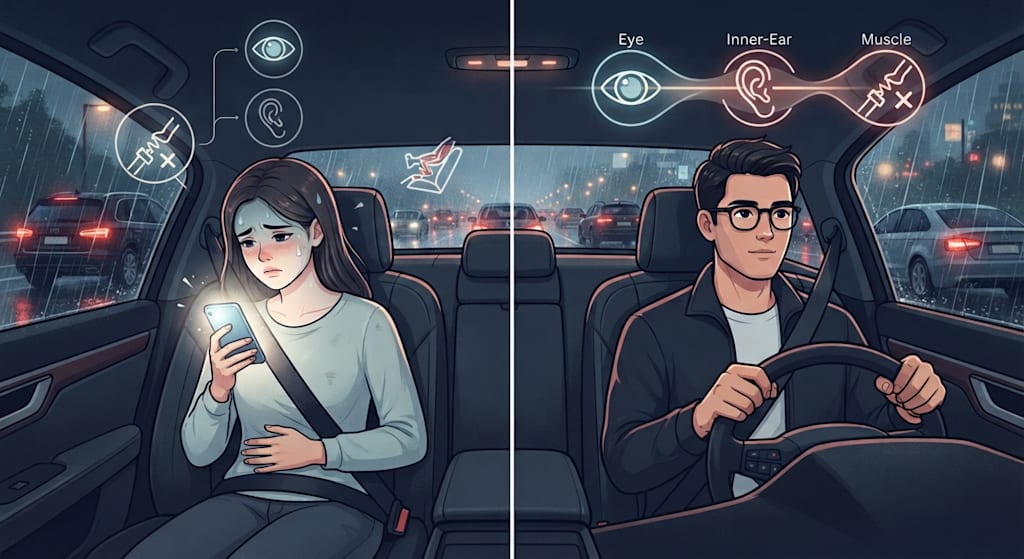
Rain hammered the car window. The ride-hailing car was stuck in evening rush hour. You sat in the back, head down, replying to a message. The words on the screen blurred. The car ahead braked, and your stomach rose. The car started again, and your temple throbbed. You looked up at the windshield, and it got a little better. The driver rested a hand on the wheel, talking to someone beside him, as if nothing were wrong.
The car’s motion hadn’t changed. What changed was the three reports your brain was receiving.
The eyes say you’re not moving; the inner ear says you are
The body has three navigation systems. The eyes see the world. The inner ear’s vestibular system senses rotation, acceleration, deceleration, and gravity. Muscles, joints, and skin report posture. When you walk, the three signals confirm one another. You step, your eyes see scenery recede, your inner ear feels forward motion, your muscles know they are working. The brain feels assured.
In a car, the body is passive. This is especially true when you look down at a phone. The phone is almost still relative to your hand and face. Your eyes fix on small nearby text and report: we are not moving. The inner ear feels the car braking, turning, bumping, and reports: we are moving. The seatbelt pulls tight; muscles report: the body was jerked. The three reports don’t match.
The brain receives contradictory signals and cannot assemble a coherent picture. It doesn’t know you are in a car. It only knows the signals are scrambled. To an ancient brain, severe sensory contradiction may mean poisoning. Neurotoxins disrupt the senses, causing dizziness, visual distortion, and loss of balance. So the brain launches defenses: nausea, vomiting, cold sweat, and salivation.
Looking at a phone maximizes the conflict
A phone is a nearby stationary reference. You stare at it, and the moving scenery in your peripheral vision is ignored. But peripheral vision is very sensitive to motion. The more you look at the phone, the more you cut off your visual connection to the outside moving world.
Reading text is worse than watching video. Text requires fine fixation. The eyes work harder, and peripheral vision is squeezed flatter. That’s why many people can watch video in a car but immediately feel bad when they read a novel, reply to messages, or scroll text.
EV regenerative braking makes it worse. When the driver lifts off the pedal, the car slows noticeably. The passenger has no expectation. The body suddenly pitches forward. The vestibular system alarms, while the eyes are still on the screen. The conflict is greater.
The driver has the script in hand
Switch to the driver’s seat. Same car, same road, no less motion. Why do drivers rarely get carsick?
You see the red light and move your foot from the accelerator to the brake. Your body tenses first. Before the vestibular system reports deceleration, you already know you’re going to slow down. You turn the wheel, and your body counteracts centrifugal force first. Hands on the wheel, feet on the pedals, muscles constantly making micro-adjustments. You look far ahead, at the road, cars, and traffic lights. Distant scenery flows. The eyes say we are moving forward. The vestibular system says yes, we are accelerating. The body says yes, I am holding the wheel.
The three systems sit at one table. Prediction, control, and active posture press the conflict down.
If the front passenger keeps looking forward and actively predicts the car’s next move, it also helps a lot. A rear passenger looking out the side window sees scenery flying sideways, and vision and vestibular signals may not match. A back-seat phone-scroller sits farther back, where bumps are more obvious and vision is locked nearby. That is the greatest conflict.
A sway every five seconds is most likely to make you sick
Vibration frequency matters too. Low-frequency vibration around 0.2 Hz is most likely to cause nausea. That’s about one sway every five seconds. Car suspension undulations, ship rocking, and airplane turbulence sometimes fall near this range. Slow, large sways continuously stimulate the vestibular system. Vision and muscles cannot easily cancel them out.
Walking, running, and cycling usually have vibration frequencies above 1 Hz. The body is more actively involved in control, so nausea is less likely. Winding mountain roads, stop-and-go traffic, and swells on a boat all easily make people uncomfortable. The road isn’t out to get you. The frequency happens to hit the vestibular system’s weak spot.
Nausea and vomiting are the brain misjudging
Why do people salivate, sweat, feel nauseated, and vomit when carsick? These reactions seem unreasonable. From an evolutionary perspective, they are a defense mechanism. In the ancient environment, sudden dizziness, visual distortion, and loss of balance might mean you had eaten something toxic. Faced with confusion, the safest strategy for the brain is to expel the stomach’s contents. Vomiting might at least reduce toxin absorption.
Carsickness is this program falsely triggered. The brain misreads sensory conflict as possible poisoning. You vomit miserably, and the brain thinks it is saving you. Your urge to get out, lie down, or escape are all the brain trying to stop an inexplicable contradictory signal.
In the mesh pocket behind the seat, a plastic bag rustles. On the rear floor mat is a crumpled supermarket receipt. The car keeps moving.
Some people get carsick more easily; some never do
Vestibular sensitivity differs. Some people’s systems alarm at the slightest sway. Others can ride a roller coaster without changing expression. Migraine sufferers, children, and women at certain stages may be more prone to motion sickness. Many people become less likely to get carsick after age 12, but not everyone.
Experience and habit matter too. Long-haul drivers are more likely to get carsick than short-haul drivers. Enclosed carriages, enclosed cargo trucks, and windowless ship cabins lack distant relatively stationary visual references. They easily make ordinary people carsick. The same goes for riding with eyes closed. Some people feel worse with eyes closed. Others are fine if they fall asleep.
Smell is a hidden factor. Gasoline, diesel, perfume, and food odors may become conditioned with carsickness. If you first got carsick while smelling gasoline, later the smell alone can make you nauseated. Riding hungry may irritate the stomach. Riding too full is worse. Anxiety and tension amplify carsickness. The more afraid you are of getting sick, the more likely you are to get sick.
Let the three signals sit back at one table
Carsickness isn’t beaten by toughing it out. The idea is to reduce sensory conflict and restore prediction and control.
When riding, look into the distance. Look at the horizon, the road ahead, and distant slowly moving scenery. Sitting in the front is better than the back. Front passenger is better than rear middle. Open a window to let air flow; the body feels the wind. Try not to look down at a phone, book, or nearby screen. If you must, listen to audio instead of reading text.
Some phones, including iPhones, have Vehicle Motion Cues. They overlay dots on the screen that move with the car. The screen is not completely still. It moves with the car too. Visual and vestibular signals become more consistent, and the carsickness from looking at a phone is reduced.
Don’t eat too much before riding, and avoid being too hungry. Eat less greasy, spicy, or strongly odored food. Ginger helps some people. Placebo effect works too. Telling yourself before boarding that you won’t get carsick, or eating ginger and believing it works, can reduce the probability. Desensitization training also works. Look at a book for five minutes every hour in the car, repeat many times. Once the probability of getting sick within five minutes drops, extend to ten minutes.
Medication can be used for severe carsickness. Many motion sickness drugs cause drowsiness and dry mouth. For occasional rides, prioritize behavioral adjustments: look far, sit in front, open a window, listen to audio, and don’t stare at a phone.
The car arrives. You put away your phone, and your feet touch the ground. Wind comes through the door gap, and your stomach slowly settles back. Next time you ride, put the screen face down on your lap first. Look up at the road outside the windshield. It is moving, and your body is moving too. The brain doesn’t have to guess anymore.
About the Creator
Jin
Writer of reamstories
https://reamstories.com/jin
Enjoyed the story? Support the Creator.
Subscribe for free to receive all their stories in your feed. You could also become a paid subscriber, letting them know you appreciate their work.
Comments
There are no comments for this story
Be the first to respond and start the conversation.