
Why the Sun Is Not the Galaxy’s Black Hole
A plain-language guide to stellar systems, galaxies, and the comparison that keeps confusing readers.
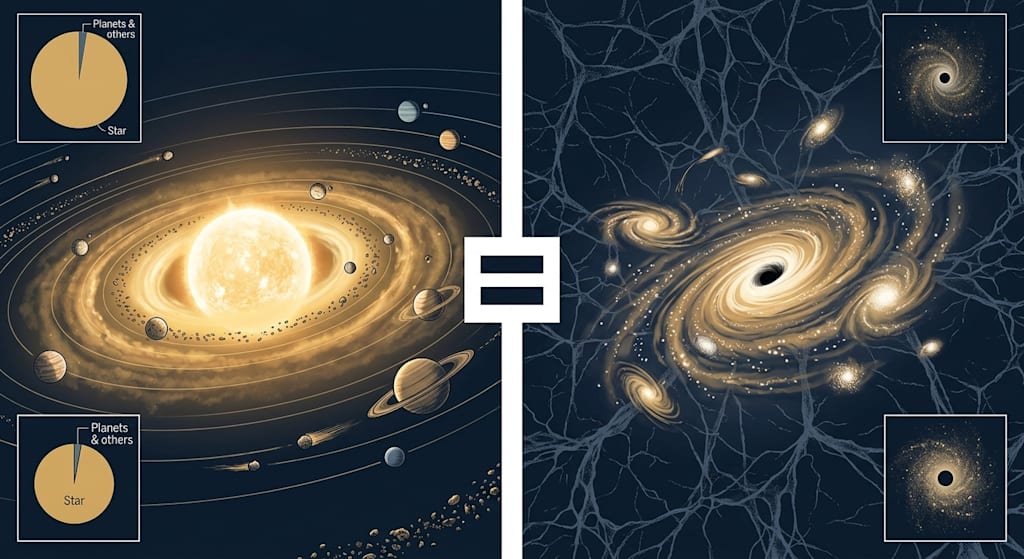
In Chinese, “solar system” (太阳系) and “Milky Way” (银河系) both contain “系” (xì). They read smoothly and look related. That similarity invites a wrong conclusion: the Solar System is a “系,” the Milky Way is a “系,” the Sun sits at the center of the Solar System, and the Milky Way has a supermassive black hole at its center. So the Sun must occupy roughly the same role as that black hole.
The analogy looks tidy. It also forces two objects from different levels, different origins, and different structures into one mold.
The English name “Solar System” contains the word “system.” It means a celestial system centered on the star we call the Sun, together with planets, moons, asteroids, comets, dust, and other bodies. “Galaxy” comes from older European usage, where it described the Milky Way’s milky appearance in the night sky. A galaxy is not a stellar system. It is a large collection of stars, gas, dust, dark matter, and other components.
Both terms use “系” in Chinese. One is a stellar system. The other is a galaxy. They are different kinds of object, so the Sun and a galactic central black hole do not hold comparable positions.
Stellar systems: the star comes first, the leftovers come later
To see why the Sun dominates the Solar System, start with how stellar systems form.
Stars form in molecular clouds. A small disturbance can trigger a large collapse. Matter falls toward the center and forms a hot region. The gas gets hot enough that an opaque core forms, held up by pressure. This stage is called a protostar.
A protostar is not yet a star. It keeps pulling in surrounding matter through gravity. Its center keeps contracting. Eventually it becomes bright enough to see in visible light, then starts hydrogen fusion in its core. At that point it becomes a true star.
While the protostar is becoming a star, a disk of gas and dust forms around it. This is the protoplanetary disk. The star keeps pulling material from the disk. The disk lasts tens of millions of years at most. Inside the disk, material collides and sticks together. Some of it can form planets. The star’s feeding and the planets’ growth happen at roughly the same time.
Massive stars blow away their surroundings quickly. Planets rarely form there through accretion. Stars like the Sun have less power. Planets can grab material where they can and grow fast. When the disk disappears, the stellar system is basically set.
Planets and smaller bodies are mostly leftovers from star formation. That is why the star dominates. The Sun holds about 99.86% of the Solar System’s mass. The number is huge because the Solar System is a star plus the material left over from its birth.
Galaxies: mergers on a dark matter scaffold
Galaxy formation follows a different path.
A stellar system starts with a star, then gets planets. A galaxy does not start with a central black hole. A central black hole is not required. Many galaxies have none at their center.
The Triangulum Galaxy, M33, sits in the Local Group. Its center is a dense region of ionized hydrogen. It has no clear supermassive black hole, though it may have an intermediate-mass black hole. A galaxy can exist without a supermassive black hole at its center.
The main explanation for galaxy formation relies on dark matter. In the standard cosmological model, ordinary matter is about 5% of the universe. Dark matter and dark energy make up the rest. We do not know what dark matter is, but evidence for it is strong. In the Bullet Cluster, the mass distribution inferred from gravitational lensing does not match the X-ray and visible-light images. That mismatch supports dark matter.
Dark matter shapes galaxy formation. After the Big Bang, matter and dark matter were spread almost evenly. Quantum fluctuations created denser patches. Dark matter gravity pulled ordinary matter into those patches. Molecular clouds formed. The first stars lit up inside them. Protogalaxies appeared. Small protogalaxies then collided and merged into larger galaxies.
During those mergers, the center grew denser. A supermassive black hole could form there. The black hole then helped shape the galaxy’s appearance and growth. Still, the black hole did not drive galaxy formation. It is one product of galaxy formation and evolution.
A central black hole is not a galaxy’s sun
The Sun and a galactic central black hole differ in a basic way. The Sun caused the Solar System to form and dominates it. A central black hole did not cause its galaxy to form and does not dominate it.
Remove the Sun and the Solar System disappears. The Sun holds most of the mass and supplies the gravitational center. Planets, moons, and small bodies orbit it. Its presence sets the system’s structure.
Remove the central black hole and the galaxy can remain. The black hole can be absent. It can be small. It can form late. It can affect the galaxy and shape it, but the galaxy does not rest on it.
A stellar system is a star plus the belongings left from its birth. A galaxy is a huge structure built, smashed, and merged on a dark matter scaffold by stars, gas, dust, and dark matter. The central black hole is a special product at the center of that structure. It is not the structure’s parent.
Mass ratios do not settle the question
Someone might argue that the Sun holds 99.86% of the Solar System’s mass, and a central black hole sits at a galaxy’s center. Why not compare them?
The ratios follow different logic.
The Sun’s large share comes from the Solar System’s origin. The system is built around a star. Planets, moons, and small bodies are leftovers. Their combined mass is tiny next to the star.
A central black hole usually holds a tiny share of its galaxy’s mass. Count only ordinary matter and the ratio is low. Add dark matter and the ratio falls further. Galaxies vary a lot. Some lose stars in mergers or interactions. A stripped galaxy can leave a dense nucleus, which raises the black hole’s share.
M60-UCD1 is an example. This dwarf galaxy lies about 49 million light-years from Earth. Its mass is about one two-thousandth of the Milky Way’s. Its center holds a supermassive black hole of about 20 million solar masses. That is five times the Milky Way’s central black hole. The black hole accounts for about 10% of the galaxy’s dynamical mass. M60-UCD1 is one of the densest known galaxies in terms of black hole mass. The example shows that black hole mass ratios depend on a galaxy’s history.
The Sun’s share of the Solar System and a black hole’s share of a galaxy come from different formation and evolution paths. The numbers do not make the two roles comparable.
Terminology makes the confusion worse
Some astronomical terms are vague in Chinese, especially after translation. They create ambiguity for general readers.
Take “burning.” Hydrogen burning in a stellar core is nuclear fusion, not chemical combustion. Take “metals.” In astronomy, the word usually means elements heavier than helium. It does not mean metals in the everyday sense. “Dwarf star” and “parsec” also invite literal readings that lead readers astray.
“Solar System” and “Milky Way” both contain “系.” In Chinese, “系” can mean system or galaxy. In astronomy, stellar systems and galaxies sit at different levels. Mixing them up makes the Sun sound equivalent to a central black hole.
The comparison collapses
The opening claim was that the two “系” are not the same thing. The numbers make the point. The Sun holds 99.86% of the Solar System’s mass and drives the system’s formation. The central black hole of M60-UCD1 holds about 10% of its galaxy’s dynamical mass, and that is an extreme case. Most galactic central black holes hold far less. The Sun is the parent body of the Solar System. A central black hole is one product inside a galaxy.
Comparing the Sun with a central black hole is like comparing a star with the foundation of a galactic city. Both sit near a center. They are not the same kind of thing.
About the Creator
Jin
Writer of reamstories
https://reamstories.com/jin
Enjoyed the story? Support the Creator.
Subscribe for free to receive all their stories in your feed. You could also become a paid subscriber, letting them know you appreciate their work.
Comments
There are no comments for this story
Be the first to respond and start the conversation.