
Why Shenzhou Burns Up and Crew Dragon Flies Again
The difference comes down to where the expensive parts sit, and what each mission was built to do
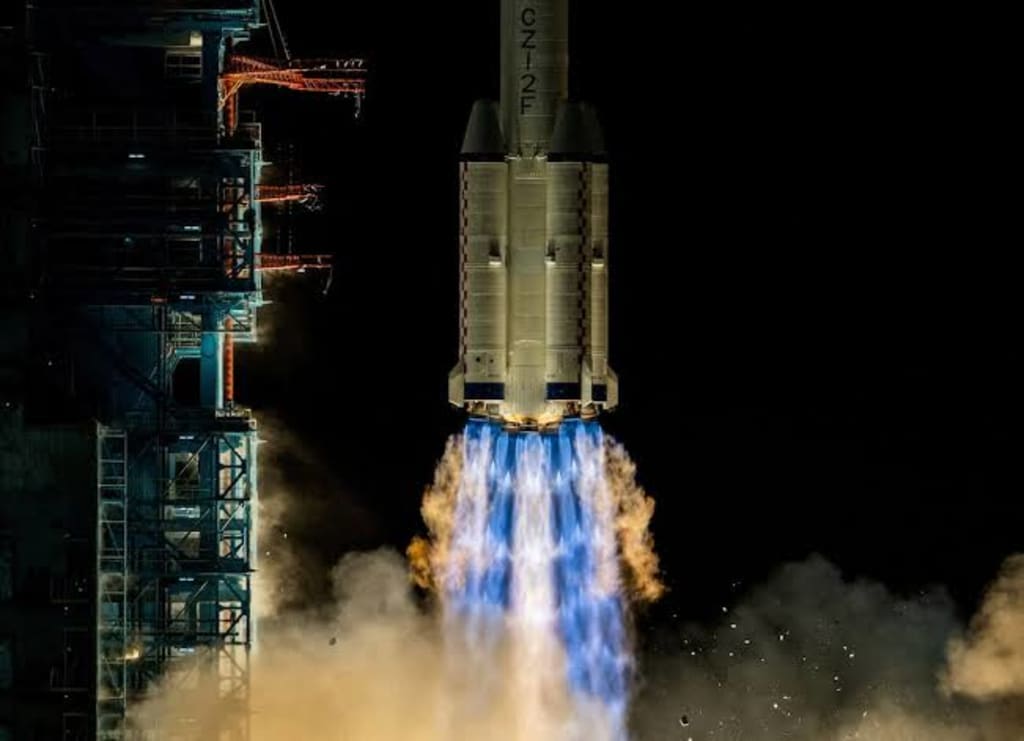
Inside the Soyuz descent module, three seats fill the cabin. A cosmonaut’s knees almost touch the instrument panel. There is no room to stretch. Soviet engineers designed the module this way because they were thinking about the Moon. The descent module had to be small and light. It only needed to carry three people from lunar orbit back to Earth. Living quarters, experiments, propulsion, and power would go in other modules.
Shenzhou inherited that layout. The orbital module sits at the front. The reentry capsule sits in the middle. The service module sits at the back. Each module has its own job. The reentry capsule does one thing: bring the crew home alive. Seats, instruments, life support. That is it. The service module carries the engines, fuel tanks, solar arrays, radiators, and most of the core life-support hardware.
On return day, the reentry capsule separates from the service module. The service module enters the atmosphere and burns up. The capsule deploys parachutes and lands in the Gobi Desert. The hatch opens. Inside, there are only seats and instrument panels. The heat shield is half burned away, black, like a used piece of charcoal. It will not fly again.
When a Crew Dragon capsule lands, the hatch opens onto a different scene. Seats, instrument panels, flight computers, environmental control and life support systems, attitude control thrusters, parachute containers, and the eight SuperDraco abort engines are all still there. SpaceX crews remove them one by one, inspect them, refurbish them, replace worn parts, and install them again.
Only one thing is thrown away: the trunk. That cylinder sits behind the crew capsule. Half of its outer surface is covered with solar panels, half with radiators. The middle is empty, used for unpressurized cargo. Before reentry, it is jettisoned and burns up. Everything else comes back.
That is why Crew Dragon can be reused. The expensive parts are inside the crew capsule. What gets thrown away is a metal tube.
After a Shenzhou capsule lands, the service module is gone. Engines, fuel tanks, solar panels, radiators, gone. What remains inside the capsule is not worth much. The heat shield is burned. The seats can be removed. The instruments can be salvaged. But the cost of recertifying, reassembling, and retesting them is higher than building new ones. So a recovered Shenzhou capsule is mostly good for a museum.
A recovered Crew Dragon capsule goes into a refurbishment facility. Engines are removed and test-fired. If the data looks good, they go back in. Flight computers are removed, their circuit boards inspected, their software refreshed. Seats are removed, reupholstered, and fitted with new straps. The heat shield is not ablative. It is made of reusable tiles. After inspection, if there are no major problems, it stays. When the process is finished, the ship can fly again.
SpaceX has said Crew Dragon is designed to support more than ten flights. Four capsules are enough.
Endeavour. Resilience. Endurance. Freedom. Four. NASA’s commercial crew contract, International Space Station rotations, private missions, all handled by these four in turn. One is docked in orbit. One is in the refurbishment bay. One is being prepared for launch. One is on standby. It works like a fleet schedule. Assign the shifts and go.
In 2022, SpaceX announced that the fourth Crew Dragon had been built and that no more would follow. The reason was simple: four are enough. Building more would take resources away from Starship.
Shenzhou cannot be reused, but the technology is not the blocker. Reuse was never the point. The three-module design puts expensive hardware in the service module. The reentry capsule comes back as an empty shell. An empty shell has no reuse value. Crew Dragon’s two-module design puts expensive hardware in the crew capsule. It all comes back. The trunk is thrown away, and that is fine.
Two structures, two results.
In the Gobi Desert, the hatch of a Shenzhou capsule opens. The crew is helped out. The capsule stays where it landed, its heat shield black, like a used piece of charcoal. At Cape Canaveral, a Crew Dragon capsule is lifted by crane onto a truck and driven back to the refurbishment facility. The hatch opens. Inside, the equipment is neatly arranged, waiting to be removed and inspected.
One burns its service module. One throws away a metal tube. Both choices got the job done.
The hardware explains only part of the story. Shenzhou was built for a national human spaceflight program. Its first job was to prove that China could send people into space and bring them home safely. Its second job was to support a space station. Safety and reliability came before cost. A one-time-use capsule is simpler. It does not need to survive two reentries. It does not need to be recertified after a desert landing. It does not need a refurbishment line. For an early program, that is a rational choice.
Crew Dragon was built for a commercial contract. NASA wanted to buy rides, not own and operate a spacecraft. SpaceX wanted to make a profit. The most effective way to lower the cost of human spaceflight is to fly the same hardware again and again. So Crew Dragon was designed around recovery. The expensive parts go into the capsule. The cheap part is jettisoned. The capsule is refurbished and flown again. Four vehicles can cover years of missions. The cost per seat drops.
There is also a matter of inheritance. Shenzhou follows Soyuz. Soyuz follows the Soviet lunar program. The three-module layout is a family trait. Crew Dragon had no such inheritance. It could use modern integrated design. It could put abort engines on the side of the capsule instead of using a launch escape tower. It could put life support, propulsion, and avionics in one place. It could make the trunk a disposable cargo pod.
Mission definition explains the split.
Shenzhou: national mission, safety first, one flight per capsule.
Crew Dragon: commercial contract, cost first, many flights per capsule.
Reusability is the direction of the future. China is developing a new-generation crew spacecraft, Mengzhou, whose capsule is designed to be reusable. It will support space station missions and crewed lunar missions. China is not staying with the one-time model forever. It is iterating as its needs change.
But Shenzhou’s place in history is secure. It took China from no human spaceflight to a permanent presence in low Earth orbit. Its three modules and one-flight design were the right choice for their time.
Crew Dragon’s reusability depends on NASA contracts, ISS missions, and SpaceX’s fast iteration. Refurbishment takes work. Certification takes work. The business model supports it.
Shenzhou is like a reliable government car: after the mission, the key parts are spent. Crew Dragon is like a commercial airliner: the core asset flies again and again. Each machine met its mission.
One burns a service module. One throws away a metal tube. Two choices. Two successful spacecraft.
About the Creator
Jin
Writer of reamstories
https://reamstories.com/jin
Enjoyed the story? Support the Creator.
Subscribe for free to receive all their stories in your feed. You could also become a paid subscriber, letting them know you appreciate their work.
Comments
There are no comments for this story
Be the first to respond and start the conversation.