
Why Sandbags Stop Bullets That Punch Through Steel
A bullet’s energy has to go somewhere. Sand makes it take the long way.
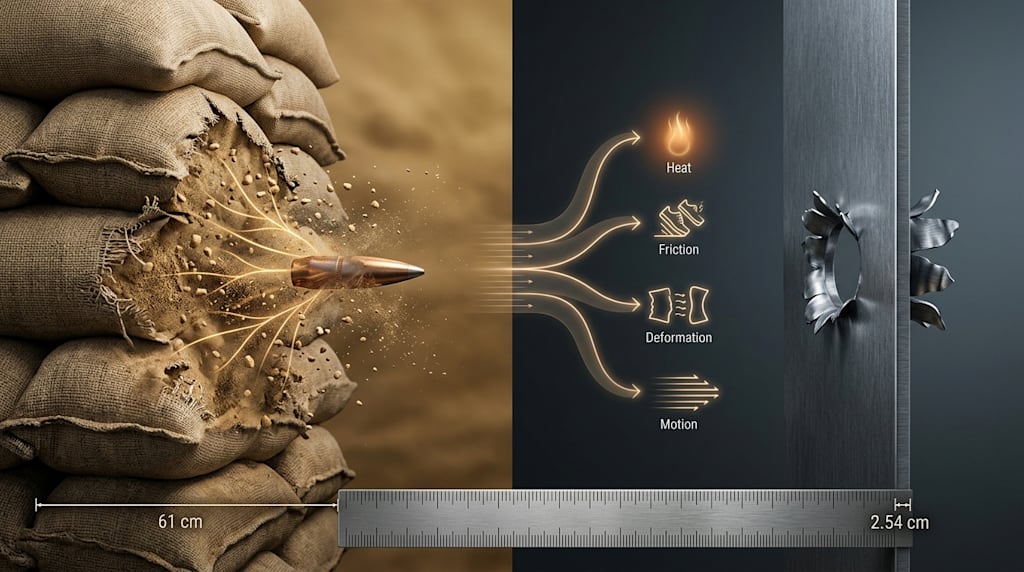
A rifle round hits a sandbag. The bag jumps. Sand puffs from the weave. The bullet does not come out the other side. A few feet away, the same round punches through a steel plate and leaves torn metal behind. The plate is hard. The sand is soft. The sand stops the bullet. The plate does not.
That contrast looks like a paradox. It is not. Armor is about energy. Hardness is secondary.
A bullet carries kinetic energy. The formula is E=0.5mv^2. Velocity is squared. A 12.7 mm machine-gun round with a 40-gram bullet at 800 to 900 meters per second carries roughly 13,000 to 16,000 joules. That energy is concentrated on a small area. The result is enormous local pressure. Whether the bullet penetrates depends on how quickly that energy can be drained.
Thin steel fails because it cannot drain energy fast enough. A 2.54 cm armor plate is not thick. A 12.7 mm round can punch through it in one shot. The steel undergoes shear, plugging, petaling, and plastic deformation. The bullet forces a small section of metal out of the way. The plate is strong, but there is not enough of it.
Sand is different. A sandbag is not a solid block. It is a mass of grains. When a bullet enters, it does not meet one uniform surface. It meets thousands of individual particles. Each particle rubs, shifts, and collides with its neighbors. The bullet must push sand aside, crush grains, and overcome friction. The energy that was concentrated in the bullet is spread into the sand. Heat is generated. Grains rearrange. The bullet yaws, tumbles, and sometimes breaks.
The burlap or woven bag matters too. It confines the sand. If the sand were loose, the bullet could shove it aside and keep going. The bag provides confinement. It keeps the grains under pressure. Wet sand is better than dry sand. Packed sand is better than loose sand. A thick wall is better than a thin one. The mechanism is friction, mass, confinement, and a long path.
U.S. military tests with a 12.7 mm M2 Browning at 75 meters show the gap. Reinforced concrete 25.4 cm thick took 50 rounds to produce a hole 30.5 cm across. Reinforced concrete 45.7 cm thick took 140 rounds to produce a hole 17.8 cm across. A three-layer brick wall 30.5 cm thick took 15 rounds to produce a hole 20.3 cm across. A single-layer brick concrete wall 30.5 cm thick took 25 rounds to produce a hole 25.4 cm across. A 2.54 cm armor plate was penetrated in one round. A double sandbag wall 61 cm thick took five rounds for initial penetration. A wood wall 40.6 cm thick was penetrated in one round.
The sandbag wall stopped the first few rounds. It took five rounds to open a path. That sounds impressive until you compare thickness. The sandbag wall was 61 cm thick. The armor plate was 2.54 cm thick. The armor plate failed in one round. The sandbag wall held for five.
But sandbags are not efficient armor. A 30 cm brick wall required 15 rounds. A 25 cm reinforced concrete wall required 50 rounds. The sandbag wall was twice as thick as the brick wall and still needed fewer rounds to penetrate. Sandbags work because they are cheap, heavy, and easy to stack. They do not work because sand is a superior material.
Mass per square meter shows the same gap. Sand has a bulk density of about 1,600 kilograms per cubic meter. A 61 cm sandbag wall has an areal density of 0.61×1,600≈976 kilograms per square meter. Armor steel has a density of about 7,850 kilograms per cubic meter. A 2.54 cm steel plate has an areal density of 0.0254×7,850≈199 kilograms per square meter. The sandbag wall uses nearly five times the mass per square meter. The steel plate is far more efficient per kilogram.
This is why modern armor is not made of sand. Tanks use composite armor, ceramic tiles, spaced steel, and explosive reactive armor. These materials are engineered to break the bullet, deflect it, or absorb its energy in layers. A ceramic face can shatter a hardened penetrator. A composite backing can catch the fragments. A fiber layer can stop spall. The goal is to force the projectile through a series of difficult transitions. Each transition costs energy.
Sandbags still have a place. They are available anywhere. A soldier can fill them with local soil. They stop rifle rounds, machine-gun rounds, and artillery fragments. They absorb blast. They can be repaired. They can be stacked in hours. They are not efficient, but they are practical. A tank cannot be built from sandbags. A trench can.
The same principle explains water and air. A bullet fired into deep water slows rapidly. Water is about 800 times denser than air. It strips energy from the bullet through drag, cavitation, and instability. Shallow water will not stop a rifle round. Deep water will. Air is much less dense. A bullet can fly for kilometers, but it does not fly forever. Air resistance drains its energy. Gravity pulls it down. The maximum range of a bullet is the distance at which air and gravity have taken enough energy to make it harmless. Air is armor, just very poor armor. It requires enormous thickness.
A sheet of paper will not stop a knife. A book of several hundred pages will. The paper did not become harder. The path became longer. The knife must cut through page after page. Each page takes a small amount of energy. The total adds up.
A projectile stops when its kinetic energy is gone. The energy is gone when it has been transferred to the material along its path. The material can deform, crack, melt, rub, or move. The projectile can yaw, flatten, or break. The path can be straight or angled. The angle matters. An angled plate presents a longer path through the material. A heavy, confined, granular material presents a tortuous path.
So the question “Why can a bullet penetrate steel but not a sandbag?” has a simple answer. The steel was thin. The sandbag was thick. Hardness can shatter a bullet, but hardness alone does not stop it. If the plate is thin, the bullet can still push through. Sand is soft. Softness does not mean weakness. Sand is heavy, frictional, and self-confining. It turns concentrated energy into heat, motion, and deformation.
A 12.7 mm round can tear through 2.54 cm of armor steel. It stops in 61 cm of sand. Given enough distance, air will stop it too. Water will stop it faster. A thick book will stop a knife for the same reason.
The bullet does not bounce off sand. It digs in, tumbles, and stops. The steel plate fails because there was not enough of it. The sandbag wins because it makes the bullet travel a long, heavy road.
About the Creator
Jin
Writer of reamstories
https://reamstories.com/jin
Enjoyed the story? Support the Creator.
Subscribe for free to receive all their stories in your feed. You could also become a paid subscriber, letting them know you appreciate their work.
Comments
There are no comments for this story
Be the first to respond and start the conversation.