
Why men have nipples: a body built before it knew your sex
Male nipples are not a backup plan or a genetic mistake. They are leftover space in a shared blueprint, and they show how evolution actually works.
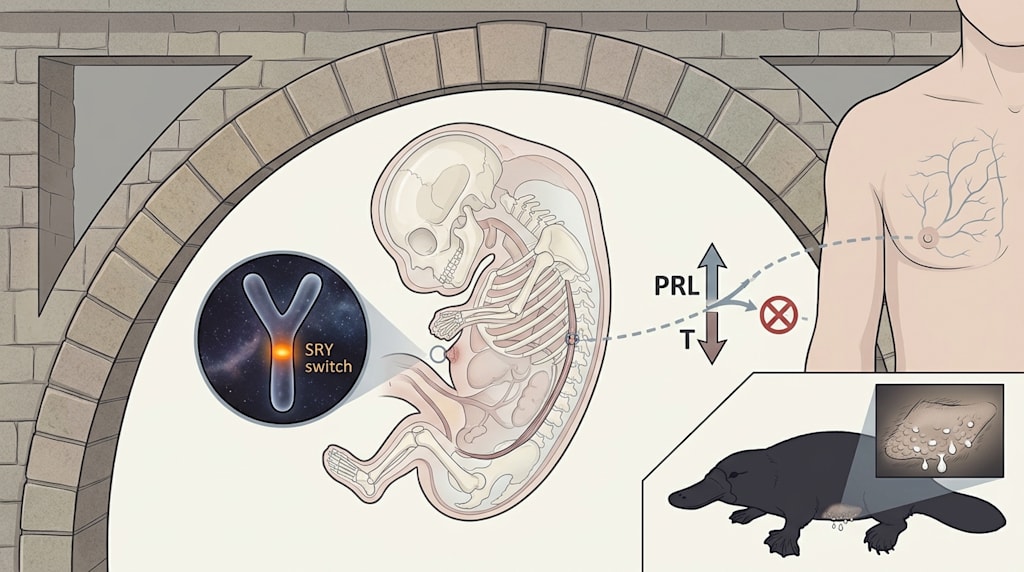
If an engineer designed a human body from scratch, he would probably delete the male nipple. It does not nurse a child or help a man reproduce. Most days it sits on the chest and does nothing you would notice. The structure looks like a drafting error, a piece of female anatomy left on the male body because the genome was too lazy to draw a separate plan.
Laziness is close to the truth, but the mechanism is different. The genome is not lazy. It works from an existing developmental sequence, and that sequence builds nipples before it builds a sex. Male nipples are not a reserve tank for some future use. They are a by-product of a shared blueprint. Gould called this kind of leftover an arch spandrel.
The spandrel
Picture a semicircular arch bridge. Above the curve of the arch and beside the roadway, two triangular spaces appear at each end. Architects call them spandrels. Nobody designed them as decoration. They are the leftover space created when a curved arch is built between straight supports. Later, builders may put sculptures there. The spandrel comes first as a structural consequence.
Stephen Jay Gould used the spandrel in a famous essay, “The Spandrel of San Marco and the Panglossian Paradigm,” to argue against reading every biological trait as a carefully selected adaptation. Not every feature exists because it has a purpose. Some features are side effects of the way a developmental system is put together. Male nipples are a clear case.
The sequence
Human embryos do not begin as male or female. They begin with structures that can develop in either direction. Early in development, the embryo forms mammary ridges. From those ridges, nipple primordia appear. This happens before the gonads have committed to testes or ovaries. Only later does the SRY gene on the Y chromosome switch on testicular development. Testosterone and other hormones then modify the reproductive ducts and external genitalia.
By the time the male path is fully under way, the nipple primordia are already there. The embryo does not go back and erase them. It modifies the gonads and genital ducts. It does not run a separate deletion program for the chest. Female embryos continue along the mammary path. Male embryos keep the same early nipple structure, with the breast tissue largely inactive.
This order explains the pattern. Male nipples are not added to the male body. They are present before the body becomes male, and later development does not remove them. The male body inherits them from the shared embryonic plan.
From an evolutionary standpoint, a structure that costs almost nothing and does not interfere with survival or reproduction is unlikely to be removed by natural selection. Male nipples cost almost nothing and do not interfere with movement or fertility. Building a special mechanism to delete them would require additional genetic regulation. If that regulation went wrong, it could interfere with female breast development and lactation. The safer path, in evolutionary terms, is to leave the structure alone.
The exceptions
“All male mammals have nipples” is a common overstatement. Most placental mammals do have male nipples, but not all mammals do. Monotremes, the platypus and the echidna, have no nipples at all in either sex. Females secrete milk through patches of skin on the abdomen, and the young lick it from the fur. Some other mammals have reduced or missing male nipples.
The pattern is not a law of mammalian biology. It is a default that many lineages have kept because there was no strong pressure to remove it. The human male nipple belongs to that default.
What they can do
The male nipple is not a nursing organ. It contains nerve endings, and it can be sensitive. For some men, nipple stimulation is part of sexual response. For many others, it is not. The sensitivity varies, and it is not a reliable part of male sexual function.
The breast tissue underneath the nipple is usually inactive, but it is not absent. Men can develop gynecomastia, an enlargement of breast tissue, when hormone levels shift because of medication, liver disease, endocrine disorders, or other causes. In rare cases, men can secrete small amounts of milk. This is not enough to nurse an infant, and it is not a normal function. Men can also develop breast cancer, though the incidence is far lower than in women.
So the male nipple is not absolutely functionless. It has touch sensation and a small amount of glandular tissue, and it can become a site of medical attention. As a feeding organ, it is a leftover. As a sensory and medical structure, it is not zero.
The future
There is a theoretical path for male nipples to become functional. The pathway for breast development is still present in the male body. The tissue is there. The hormonal switch is off. If a population faced an extreme situation, a condition that made most women unable to lactate while a rare variant allowed some men to produce milk, then a male lactation trait could, in theory, spread. A trait that improves infant survival can be selected for, even if it starts as an unusual variant.
The probability is low. Stable male lactation would require sustained high prolactin levels and estrogenic signaling. Those hormones suppress testosterone. A male who lactates would likely become weaker and less competitive. Long nursing bouts would cut into foraging and mate-seeking. In most environments, that combination is a serious reproductive disadvantage.
For females, relying on male lactation would also be risky. It would require a male to stay and cooperate over a long period. A male who can leave and seek other mates has little incentive to stay. A female who hands over the feeding role increases the risk that the infant goes hungry if the male disappears. In a species without strong pair bonds or social enforcement, male lactation is not a safe arrangement.
The male nipple is therefore unlikely to become a regular nursing organ. It remains a neutral remnant. Keeping it costs almost nothing. Deleting it would cost more. It shows up in medicine and culture only now and then.
The small circle
The nipple stays where the embryo put it: a small circle of skin on the chest, with nerve endings and a few ducts. It was built before the body knew which sex it would become. It is not a promise or a backup plan, and evolution is not saving it for later. Think of the triangular space beside an arch. The nipple is a consequence of the way the body is assembled. It stayed because leaving it there does no harm.
About the Creator
Jin
Writer of reamstories
https://reamstories.com/jin
Enjoyed the story? Support the Creator.
Subscribe for free to receive all their stories in your feed. You could also become a paid subscriber, letting them know you appreciate their work.
Comments
There are no comments for this story
Be the first to respond and start the conversation.