
Why Ants Survive Falls That Would Kill You
Terminal velocity and the square-cube law explain why being small changes everything about gravity.
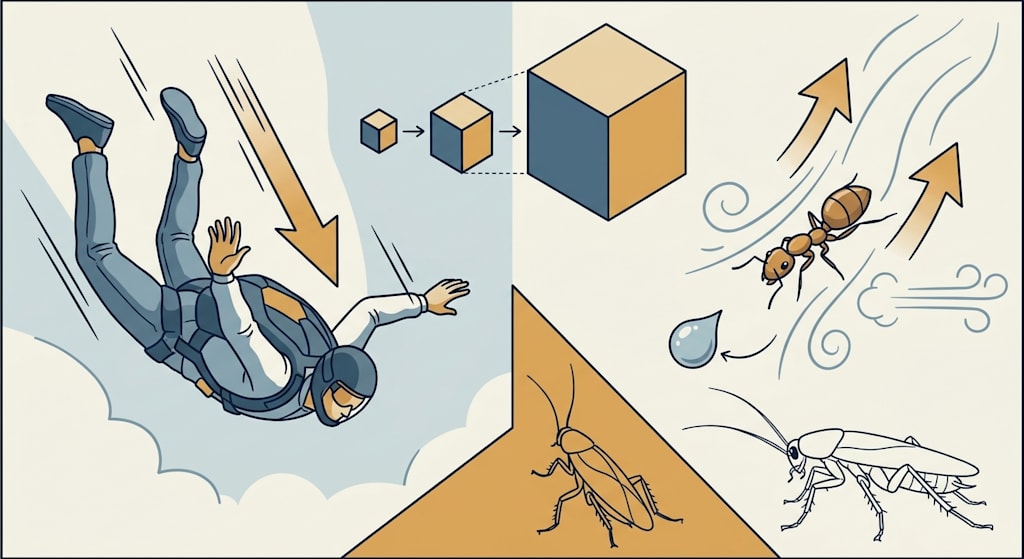
A skydiver falls. At first gravity wins, and the speed climbs. Then the air pushes back harder. At some point the upward drag equals the downward weight, acceleration drops to zero, and the body settles into a steady descent. For an 85 kg skydiver with arms and legs spread, that steady speed is about 44 m/s, roughly 158 km/h. A human hitting the ground at that speed is in serious trouble.
Now drop an ant from a table. It lands, tumbles, rights itself, and keeps running. Drop it from several meters. The result is often much the same. The ant is not armoured like a tank. It is not built from some secret impact-proof material. It is small. That single fact changes the physics of the fall.
Terminal velocity: the fall does not keep speeding up
Free fall in a vacuum is simple: gravity accelerates the body without limit. Earth is not a vacuum. As speed rises, the body meets more air each second. Drag grows roughly with the square of speed. At terminal velocity, drag balances weight. After that, the speed stays close to constant.
For a human, terminal velocity is high enough to make a fall lethal. For a milligram-scale ant, the balance arrives at a much lower speed. Kaspari’s 2005 study, covering 49 ecosystems, found worker ants with average masses ranging from 0.06 mg to 2.34 mg. At that mass, the ant’s weight is tiny. The air resistance acting on its body is large relative to that weight. From the human view, an ant is falling. From the ant’s scale, the air is carrying it down.
Strictly speaking, a short fall may not last long enough for the ant to reach terminal velocity. That detail does not rescue the human comparison. The ant’s terminal velocity is low, so even a fall from several meters produces a small impact energy. Some tree-dwelling ants go further: they adjust their posture in the air and glide. Yanoviak, Dudley, and Kaspari recorded directed aerial descent in canopy ants in 2005. The ants can change direction, steer toward a trunk, and plan a route home while falling.
The square-cube law: why small bodies meet more air
Galileo set out the basic geometry in 1638. Take a cube and multiply its length, width, and height by ten. Its surface area grows by 102=100102=100. Its volume grows by 103=1000. Volume outruns surface area.
Animal mass, with body proportions and density held roughly constant, scales with volume. The frontal area that meets the air scales with area. Shrink an animal by a factor of ten in every linear dimension. Its mass falls to one-thousandth of the original. Its frontal area falls only to one-hundredth. Relative to its weight, the animal now has a much larger area for air to push against. With shape and drag coefficient roughly unchanged, terminal velocity drops sharply.
This is the physical gap between a cow, a mouse, and an ant. They obey the same laws. They do not meet the same consequences. A large animal falls fast because air cannot slow it enough. A tiny animal falls slowly because air matters much more relative to its weight.
Small bodies also carry load differently
Landing survival depends on more than fall speed. It also depends on how the body handles the impact.
Muscle force scales with physiological cross-sectional area. Body weight scales with volume. Shrink an animal, and weight falls faster than the area available to produce force or support load. Small animals therefore tend to show extreme relative strength. An ant can carry dozens of times its own body weight. The arithmetic of scale does the work.
Reverse the operation. Take a 3 cm cockroach and scale it up to 1.8 m. The linear scale factor is 60. Mass grows by 603=216,000. The cross-sectional area of its legs grows by 602=3,600. The load per unit area on those legs rises by a factor of 60. A cockroach that once sprinted across a kitchen floor would struggle to stand. This is why the giant-insect scenes in Ant-Man do not survive a physics check. The film is fun. The legs are not.
Insect cuticle is a composite of chitin fibres and proteins. It is stiff, light, and tough for its mass. It has limits. A milligram body still has a low terminal velocity and a high ratio of supporting area to weight. Both advantages come from being small.
What the ant sees
Scale changes the feel of the world. A human sees water as soft and air as almost nothing. An ant meets a different environment. A drop of water can become a sticky sphere held together by surface tension. A human breath can become a gale that lifts the ant off a leaf and carries it into the grass.
The ant’s advantage comes from three things: a low fall speed, high relative structural strength, and a body small enough for air to matter. A fall that would break a human is, for an ant, a short trip through a thick medium.
A fingertip flicks. The ant is gone. Up, sideways, into the grass, a dot in the wind.
About the Creator
Jin
Writer of reamstories
https://reamstories.com/jin
Enjoyed the story? Support the Creator.
Subscribe for free to receive all their stories in your feed. You could also become a paid subscriber, letting them know you appreciate their work.
Comments
There are no comments for this story
Be the first to respond and start the conversation.