
Why American Highways Are Straight to Heaven (And Why China's Won't Stop Bending)
I used to believe the "3-kilometer rule" was gospel. The truth isn't in the rulebook—it's in the dirt beneath the asphalt.
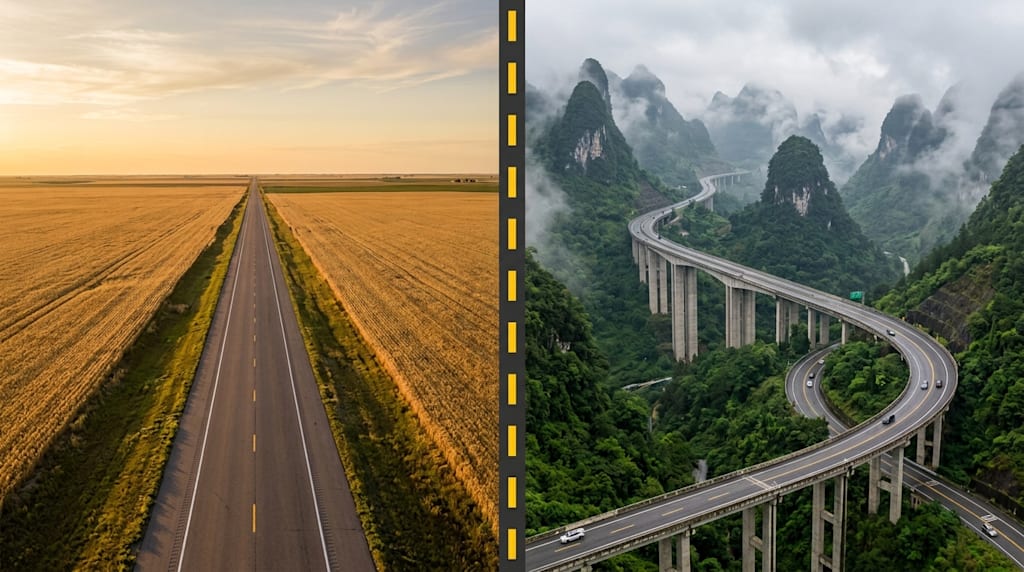
Search online for images of America's U.S. Route 50, and almost every photo looks the same: a black ribbon of asphalt slicing through desert or grassland, vanishing straight into a horizon that seems drawn with a ruler. Flat. Unbroken. Without a single rise or fall. Stare at it long enough, and you start to feel an odd illusion: if you were driving on that road, you could let go of the wheel forever, until you fall asleep.
Meanwhile, in Chinese driving forums and online car culture, a persistent claim circulates: on any expressway, there must be a natural curve every 3 to 5 kilometers. Otherwise, drivers will suffer from visual fatigue, speed recklessly, and cause accidents.
So why does America's road to "heaven" refuse to turn?
The first thing to clear up: flip through China's current Highway Route Design Specification and you won't find any clause saying "a curve is required every 3 to 5 kilometers."
What that claim actually refers to is a design recommendation that has been misremembered as a hard rule. Many countries' design guidelines do suggest a maximum permissible length for straight segments. Japan and Germany recommend no more than 20 times the design speed (so at 120 km/h, that's about 6.7 kilometers). The U.S. once wrote 3 miles (about 4.8 kilometers) into its manuals. Russia set the figure at 8 kilometers. But all these numbers are advisory, not mandatory. A recommendation can be overridden by terrain; a mandate, if broken, is a violation.
Why does the recommendation exist at all? Because it's useful. On a twenty-kilometer stretch without a single turn, you can take your hands off the wheel for three seconds. The human brain, starved of visual variety, drifts into microsleep in about fifteen minutes. That's not a matter of willpower; it's a physiological fact.
But "useful" does not mean "obligatory." If the land itself is flat, forcing a curve into it just makes a mess.
The second layer is terrain itself.
Drive west from Chicago, across Nebraska and Kansas, all the way to the foot of the Rocky Mountains. Six hours behind the wheel, and the elevation change is less than a hundred meters. That land was scraped flat by ancient glaciers. To this day, nothing taller than three meters grows there. In a place like that, the most economical way to build a road is to lay it straight along the grid lines. It was meant to be straight. It has nothing to do with the designer's aesthetic taste.
Now take the Ya'an–Xichang Expressway in China's Sichuan province. Between Yingjing and Hanyuan, the elevation difference between two adjacent bridge piers can exceed fifty meters. That's not because the designer wanted you to ride a roller coaster. It's because the Hengduan Mountains, squeezed from north to south, have left folds in the earth like crumpled paper. You can't cross them without going around. On that kind of terrain, trying to force a straight line would mean tunneling through a mountain every single kilometer. The cost isn't doubled. It's multiplied by ten.
So the biggest difference between Chinese and American highways isn't in design philosophy. It's in the land itself. America's plains cover more than half its territory. China's mountains and hills account for two-thirds of its landmass. The shape of their roads on a map was decided by the earth long before any survey team ever reached the ground.
The third point deserves a direct response because it's an even more widespread myth. Many people claim that every 5 miles on the U.S. Interstate system must include a perfectly straight section so that fighter jets can use it as an emergency runway.
That claim has no basis in the historical records of American highway engineering. The pavement thickness, crown slope, and longitudinal grade of Interstate highways do not meet the takeoff and landing requirements for most fixed-wing combat aircraft. The roads that were actually integrated into emergency runway systems were a portion of Europe's (especially Germany's) autobahns. That was a NATO contingency plan from the Cold War, and a separate story from the U.S. Interstate system.
Why does the myth persist? Probably because the visual fact of "straightness" seems to demand a cooler explanation. But it doesn't. The ground is flat enough. That's the whole reason.
Finally, let's come back to that "heavenly road" captured in photographs. The next time you see a picture of a dead-straight American highway, look closely at the sides. If it runs through desert, the vegetation will gradually shift from low shrubs to taller cacti. If it cuts across farmland, the crops will change from corn to wheat. Those subtle transitions are the real "curves." Only they're not the road bending; they're the land quietly changing its face where you're not looking.
A road is honest. Its twists and straightness carry no moral weight. They are simply a truthful reflection of the ground it passes through.
About the Creator
Jin
Writer of reamstories
https://reamstories.com/jin
Enjoyed the story? Support the Creator.
Subscribe for free to receive all their stories in your feed. You could also become a paid subscriber, letting them know you appreciate their work.
Comments
There are no comments for this story
Be the first to respond and start the conversation.