
Where does a compressed spring’s energy go when you drop it in acid?
It doesn’t vanish. It snaps, splashes, and becomes heat you’ll never feel.
1. The spring in the beaker
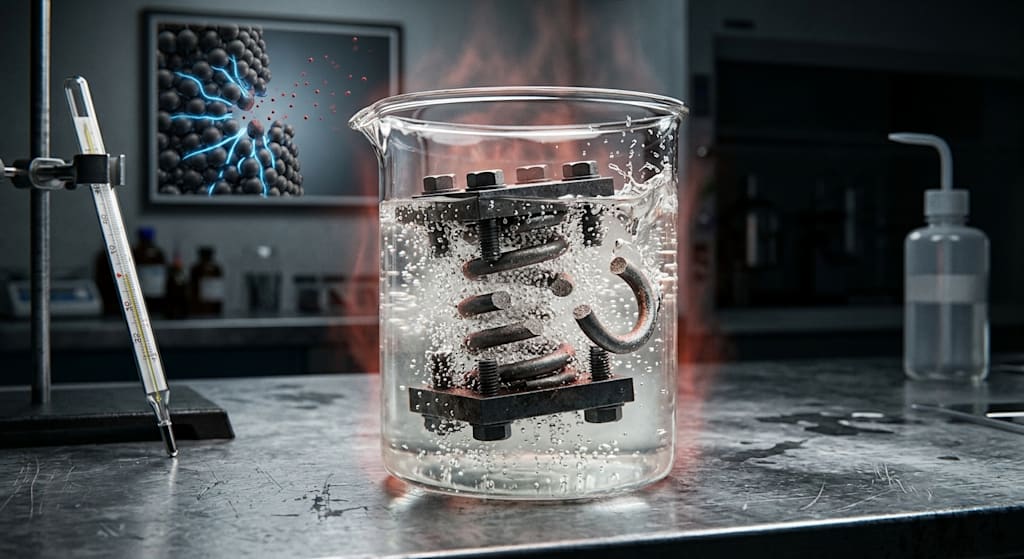
On the lab bench there is a spring. Two steel plates compress it to half its original length. Four bolts hold the plates tight, so the spring cannot open. A beaker of dilute hydrochloric acid sits nearby. The liquid level just covers the spring. Bubbles form on the steel surface. They are small and dense, and they crawl up along the wire.
Ten minutes later, the spring breaks at one spot. It does not thin evenly and then snap. It cracks open suddenly. It breaks into three pieces. One piece springs against the beaker wall with a ding. The acid sloshes. The bubbles keep rising.
The question starts here: where did the elastic potential energy stored in the spring go?
2. Energy conservation: the books must balance
Treat the spring, acid, beaker, air, and lab bench as one system. The total energy of that system is conserved. Elastic energy does not disappear. It changes form.
When the spring is compressed, it becomes shorter. At the microscopic level, atoms in the metal lattice move away from their equilibrium positions. Metallic bonds stretch, compress, bend, and shear. Electromagnetic interactions increase. The system’s potential energy rises. That is elastic potential energy.
It is not only at the surface. Strain energy density is higher at the surface and at stress concentrations, but it exists throughout the spring. The inside of the wire, the bends, and the end coils each store elastic energy at different densities.
When acid dissolves metal, those atoms enter the solution. The elastic energy stored in them becomes reaction heat, changes in the chemical energy of the products, or a lower barrier for local reactions. Elastic energy is a small term. Small terms still count.
3. What the acid is doing
Dilute hydrochloric acid reacts with iron. Iron atoms lose electrons, become ferrous ions, and enter the solution. Hydrogen ions gain electrons, become hydrogen atoms, and two hydrogen atoms combine into hydrogen gas. The bubbles are hydrogen.
Iron is oxidized. Hydrogen ions are reduced. The reaction releases heat. Metallic iron and acid start with chemical energy. After the reaction, ferrous chloride and hydrogen have different chemical energy. The excess becomes heat.
Iron atoms under stress have higher energy than unstressed atoms. The lattice is bent. Chemical bonds are weaker. Atomic chemical potential is higher. Corrosion starts more easily at these places. Crack tips are especially vulnerable.
4. If the acid dissolved it uniformly
Imagine an ideal case. The spring is fixed by an absolutely rigid fixture. It cannot spring open. The acid is perfectly uniform. It dissolves the steel wire layer by layer. There is no localized corrosion, no cracks, and no fracture.
Then each layer of the spring releases a little elastic energy as it dissolves. That energy becomes reaction heat, changes in product chemical energy, or tiny deformation and heat in the fixture and container. The acid warms slightly. A thermometer may not show it.
After the spring dissolves completely, that bit of elastic energy has basically all become heat. Quiet. Uniform. No ding.
The real world is not like this.
5. Stress corrosion: cracks find their own path
A real spring in acid corrodes at the surface first. But stress is not uniform. Bends, scratches, inclusions, and grain boundaries concentrate stress. Cracks start at the most dangerous place.
The crack tip has the highest stress. Atoms are pulled away from equilibrium. The energy needed to break bonds drops. Acid seeps into the crack. Fresh metal is exposed. The reaction continues. The crack grows. The load-bearing cross-section shrinks. A smaller cross-section raises local stress. Higher local stress accelerates corrosion and crack growth.
This is positive feedback.
Steel in acidic water also often suffers hydrogen embrittlement. Corrosion produces hydrogen atoms. They diffuse to the crack tip. The material’s fracture toughness falls. The load it could once bear, it can no longer bear. The crack grows faster.
So the spring does not thin uniformly. It breaks suddenly at the deepest crack. Near the fracture surface there may be some plastic deformation, or the break may be brittle. It depends on the material, the acid, the stress, and the temperature.
6. The moment of fracture
When the remaining cross-section can no longer hold, the spring fractures.
The constraint disappears. The compressed steel segments begin to spring open. Elastic energy stored in the lattice rapidly becomes macroscopic kinetic energy. Fragments fly out and hit the beaker wall. Sound energy. Acid splashes. Droplets gain kinetic energy. The fracture creates new surfaces. Surface energy rises. Local plastic deformation does plastic work.
If the fixture is very tight, the fragments cannot fly open. The elastic energy transfers to the fixture and container. The fixture vibrates, gives a muffled sound, and warms slightly. Stress waves travel through the system and are damped into heat.
Eventually, kinetic energy, sound energy, plastic work, and surface energy all become heat. The acid, beaker, air, and lab bench rise in temperature by a tiny amount. Total energy has not decreased.
7. Energy ledger
At the start, the system holds elastic potential energy in the compressed spring, chemical energy in the spring metal, chemical energy in the acid, and internal energy in the container, fixture, and environment.
At the end, the system holds chemical energy in the corrosion products, heat from the reaction that warms the acid, kinetic energy in the spring fragments, sound energy, new surface energy at the fracture, plastic deformation energy, residual elastic potential energy in the fragments, and changed internal energy in the container, fixture, and air.
The residual elastic energy in the fragments will continue to release during later corrosion. The kinetic energy of the fragments, the sound energy, and the plastic work eventually become heat too. So most of the energy ends up as internal energy in the environment. The acid’s temperature may rise by a few hundredths of a degree. The thermometer does not move. A hand near the beaker feels nothing.
Energy has not disappeared. It has changed from concentrated, ordered elastic potential energy into dispersed, disordered heat.
8. Potential energy is not kinetic energy
Potential energy is the energy a system has because of relative position, configuration, and interactions. Kinetic energy is the energy a system has because of motion.
A stone lifted high has gravitational potential energy. A compressed spring has elastic potential energy. Chemical energy is mainly changes in electromagnetic interaction potential energy when electrons and atoms recombine. Thermal energy includes the random kinetic energy of microscopic particles and microscopic interaction potential energy.
In classical mechanics, mechanical energy equals kinetic energy plus potential energy. That is correct. But reducing all energy to kinetic and potential energy is too crude.
9. Is all energy kinetic and potential energy?
In non-relativistic classical mechanics, mechanical energy can be divided this way. At the microscopic level, internal energy can also be decomposed into microscopic kinetic energy and microscopic potential energy. Chemical energy and thermal energy can, to some extent, be understood in this language.
But the idea cannot be generalized forever.
Electromagnetic radiation energy: photons have no rest mass, and their energy is related to frequency. Nuclear energy comes from changes in binding energy caused by strong and weak interactions. The mass-energy formula E=mc² shows that mass and energy are equivalent. An object’s rest mass itself corresponds to enormous energy. That is not kinetic or potential energy in the ordinary sense.
So, more accurately: in everyday mechanics and many chemical processes, energy can transform between kinetic and potential energy. But energy has many forms. Potential and kinetic energy are just the two we are most familiar with.
10. After the beaker cools
The acid is still bubbling. The spring fragments sink to the bottom. Small bubbles cling to their surfaces. The fracture surfaces are dark. The edges have some burrs. A few drops of acid splashed on the beaker wall and slowly run down.
The thermometer shows room temperature. A hand near the beaker feels no temperature difference. The elastic energy has already become something else. It is scattered in the room.
About the Creator
Jin
Writer of reamstories
https://reamstories.com/jin
Enjoyed the story? Support the Creator.
Subscribe for free to receive all their stories in your feed. You could also become a paid subscriber, letting them know you appreciate their work.
Comments
There are no comments for this story
Be the first to respond and start the conversation.