
What Came First: The Chicken or the Egg?
The age-old question "Which came first, the chicken or the egg?" has puzzled philosophers, scientists, and curious minds for centuries.
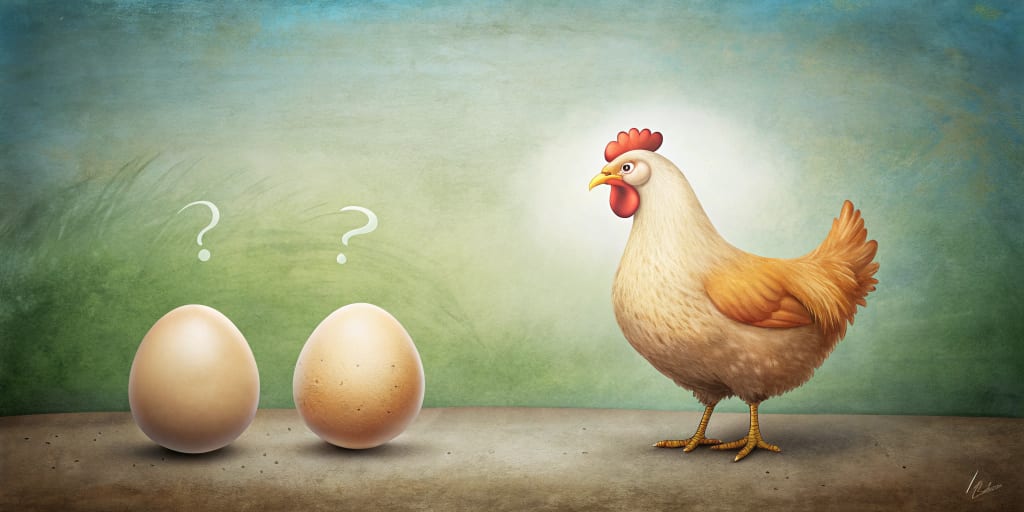
This seemingly simple query touches on complex topics such as evolution, causality, and the nature of existence itself. Let's explore this conundrum from various perspectives.
The Evolutionary Perspective
From an evolutionary standpoint, the egg came before the chicken. Here's why:
The first chicken egg was laid by a bird that was not quite a chicken - a proto-chicken.
This egg contained the genetic mutation that created the first true chicken.
Therefore, the egg containing the first chicken came before the first chicken itself.
According to evolutionary biologists, species evolve gradually over time. The transition from non-chicken to chicken didn't happen in a single generation but through countless small genetic changes over millions of years [1].
The Philosophical Angle
Philosophers have debated this question for millennia. Aristotle pondered it in the 4th century BCE, concluding that both the bird and egg must have always existed [2]. This perspective aligns with the idea of an eternal universe, which was popular in ancient Greek philosophy.
Scientific Insights
Modern science provides some interesting insights:
Egg-laying animals existed long before chickens. Dinosaurs, for instance, laid eggs millions of years before the first chickens evolved [3].
The proteins necessary for egg formation have been found to originate in ovarian cells. A study in 2010 identified a protein called ovocleidin-17, which is crucial for eggshell formation and is produced in the chicken's ovaries [4].
Cultural Significance
The chicken-or-egg dilemma has become a metaphor for circular cause and consequence dilemmas. It's often used to describe situations where it's not clear which of two related events or things caused the other.
Interesting Facts Related to Chickens and Eggs
To add some flavor to our discussion, here are some intriguing facts related to chickens and eggs:
- Ancient Egg: The oldest known bird egg fossil dates back to about 120 million years ago, discovered in China. It belonged to a bird from the Cretaceous period [5].
- Egg Production: A typical hen can lay about 250-270 eggs per year. However, wild chickens in their natural habitat only lay about 10-15 eggs annually [6].
- Chicken Ancestors: The modern chicken is believed to have descended from the red junglefowl (Gallus gallus), native to Southeast Asia. Domestication likely began around 8,000 years ago [7].
- Egg Colors: The color of an egg's shell is determined by the breed of the chicken. It doesn't affect the egg's nutritional value or taste [8].
- Chicken Population: As of 2023, there are an estimated 25.9 billion chickens in the world, making them the most numerous bird species on Earth [9].
- Double-Yolk Eggs: The chance of finding a double-yolk egg is about 1 in 1,000. However, young hens are more likely to produce them as their egg-laying cycles are still stabilizing [10].
- Chicken Intelligence: Chickens can recognize over 100 individual faces and have demonstrated self-control, which is considered a sign of intelligence [11].
- Egg Strength: Despite their fragile appearance, eggs are incredibly strong. Their unique shape can withstand significant weight when pressure is applied to both ends [12].
These facts highlight the fascinating world of chickens and eggs, further emphasizing the complexity and wonder behind the age-old question of which came first.
Conclusion
While the debate continues in popular culture, from a scientific perspective, the egg came first. Eggs were around long before chickens, and the first "chicken egg" - containing the genetic makeup of the modern chicken - was laid by a near-chicken ancestor. However, the question remains a fascinating thought experiment that encourages us to think about causality, evolution, and the nature of existence.
References:
- [1] Dawkins, R. (1976). The Selfish Gene. Oxford University Press.
- [2] Aristotle. (350 BCE). On the Heavens.
- [3] Benton, M. J. (2005). Vertebrate Palaeontology. Wiley-Blackwell.
- [4] Freeman, C. L., et al. (2010). Structural control of crystal nuclei by an eggshell protein. Angewandte Chemie International Edition, 49(30), 5135-5137.
- [5] Wang, X., et al. (2004). Gastroliths in Yanornis: an indication of the earliest radical diet-switching and gizzard plasticity in the lineage leading to living birds. Naturwissenschaften, 91(12), 571-574.
- [6] United Egg Producers. (2023). Facts & Stats. https://unitedegg.com/facts-stats/
- [7] Sawai, H., et al. (2010). The origin and genetic variation of domestic chickens with special reference to junglefowls Gallus g. gallus and G. varius. PLoS One, 5(5), e10639.
- [8] Hargrave, P. A. (2009). Egg shell color genes. University of Massachusetts Amherst.
- [9] Food and Agriculture Organization of the United Nations. (2023). FAOSTAT Statistical Database.
- [10] British Egg Information Service. (2022). Egg Facts and Figures.
- [11] Marino, L. (2017). Thinking chickens: a review of cognition, emotion, and behavior in the domestic chicken. Animal Cognition, 20(2), 127-147.
- [12] Holt, P. S., et al. (2011). The Egg: A Microcosm of Life Sciences. Poultry Science, 90(1), 1-3.
About the Creator
Enjoyed the story? Support the Creator.
Subscribe for free to receive all their stories in your feed.
Comments
There are no comments for this story
Be the first to respond and start the conversation.