
Weird Google Searches and Mites That Mate On Your Face
Late entry for FYI in my ABCommunities Challenge, week ending 06/05/25

As a writer, I’ve had to run some pretty strange searches through Google (remember, there are other options available—but just avoid Bing, as it’s a bit crap). I’m sure this is something all my fellow writers can relate to. In the past few months, I’ve had to search for the following things for stories and poems:
- Suicide pods
- How suicide pods work
- How quickly suicide pods kill you
- Death row inmate routines
- Death row prisons
- Crimean War
- Highland Clearances
- Where Highland soldiers were fighting in the Crimea
- Goðafoss waterfall
- Yucatán Peninsula
- What are cenotes?
- What is solarpunk fiction?
- What are the most common phobias of New Yorkers?
- What does April mean?
- What does the brain need to survive?
- What part of the brain controls breathing and the heart?
- What are those little bugs that live on our skin?
- Do Demodex mites have sex?
See? Some are less weird than others. Some are bloody strange. In the past, I’ve also searched for information related to suicide, murder, police procedures, and all sorts of medical details. It goes with the territory, especially if you’re trying to describe things accurately. Which I try to do.
At least, these days, my weird searches aren’t cluttered with porn like they might have been a few years ago. So that’s a win.
Now, I know what you’re all thinking...
"Wait a minute, Paul! Tell us about the bugs, please oh pretty please!"
Okay, if you insist.
Demodex Mites: Tiny, Sexy, and Living on Your Face
As part of my research for my ABCommunities entry in the Filthy community, “Under Your Skin,” I needed to find out what kind of bugs live on our skin.
Here’s what I learned.
What Are Demodex Mites?
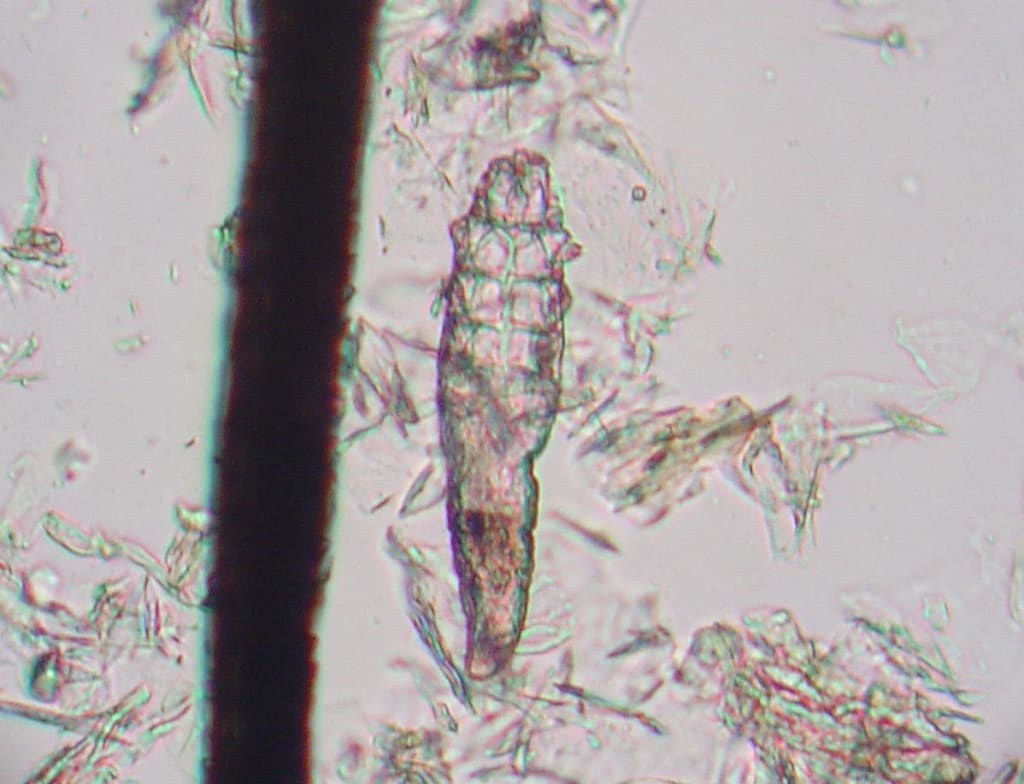
Demodex is a genus of tiny mites that live in or close to the hair follicles of all mammals. Yes, humans included. They love us.
There are approximately 65 species of these mites. The two that live on humans are Demodex brevis and Demodex folliculorum, often known as skin mites, face mites, or eyelash mites.
Although they’re mostly found on the face, they can inhabit other parts of the body too. So, in my story, when they showed up on the main character’s thighs—that was 100% scientifically accurate. Boom.
Demodex Mite Stats
Adult Demodex mites range from 0.3 to 0.4mm in length. D. brevis is slightly shorter than its D. folliculorum cousin.
They have sexy, semi-transparent, elongated bodies made up of two fused parts, with eight short, segmented legs attached to the front. Their bodies are covered in scales to help them grip our follicles—no matter how much we move.
Their mouthparts include pin-like structures used to eat skin cells and oils that build up around follicles.
Fun fact: Female D. folliculorum are larger and rounder than males. Wahey, you say? No? Okay.
Do Demodex Mites Have Sex?
Yes, baby—it’s about to get steamy. You might want to grab a cold cloth or hop in a cold shower after this.
Both male and female mites have special genital openings. So yes, they mate. On your face. In a follicle opening. That’s their version of Inspiration Point.
After mating, eggs are laid inside the sebaceous glands or hair follicles. Still on your face. About 3 to 4 days later, six-legged larvae emerge, and they develop into adult mites within 7 days. A full adult mite lives for several weeks.
Are Demodex Mites Dangerous?
For the most part, these microscopic mites that live on you, eat on you, and get it on... on your face... are harmless.
Wait, Paul. For the most part?
Yes.
Research is still ongoing, but here’s what we know:
- There’s a correlation between Demodex infestations and acne vulgaris, suggesting they may promote acne.
- Preliminary studies have suggested a possible link between these mites and rosacea.
- Demodex mites have been implicated in blepharitis, an inflammatory condition affecting the eyelids. While some people use tea tree oil to treat it, there’s no conclusive evidence that it works.
- Blepharitis causes swelling, redness, and flaking or crusting around the eyelids. It’s chronic, uncomfortable, but not contagious or vision-threatening.
- Whether Demodex mites cause visible reactions in healthy people might depend on genetic factors.
- Newer studies suggest a potential role for these mites in seborrheic dermatitis, allergic rhinitis, and psoriasis in immunosuppressed individuals.
In Conclusion...
So, there you have it. We started with a light discussion about the weird things writers search for and ended up deep in the mating habits of microscopic face-dwellers.
You're welcome.
*
Thanks for reading!
Author's Notes: Yep. I chose to do that for my first piece in the FYI community, as part of my ABCommunities Challenge. I wasn't sure what stockpile of useless information I've gathered in my brain over the years would be best for a piece, so I decided to go with the above. Again, you're welcome.
Here are some other things:
18/48
About the Creator
Paul Stewart
Award-Winning Writer, Poet, Scottish-Italian, Subversive.
The Accidental Poet - Poetry Collection out now!
Streams and Scratches in My Mind coming soon!
Enjoyed the story? Support the Creator.
Subscribe for free to receive all their stories in your feed. You could also become a paid subscriber, letting them know you appreciate their work.
Comments
There are no comments for this story
Be the first to respond and start the conversation.