
Was the Origin of Animals a Coincidence? Rewind the Tape and See What Happens
A swallowed bacterium, a frozen planet, and one unlikely cell changed everything.
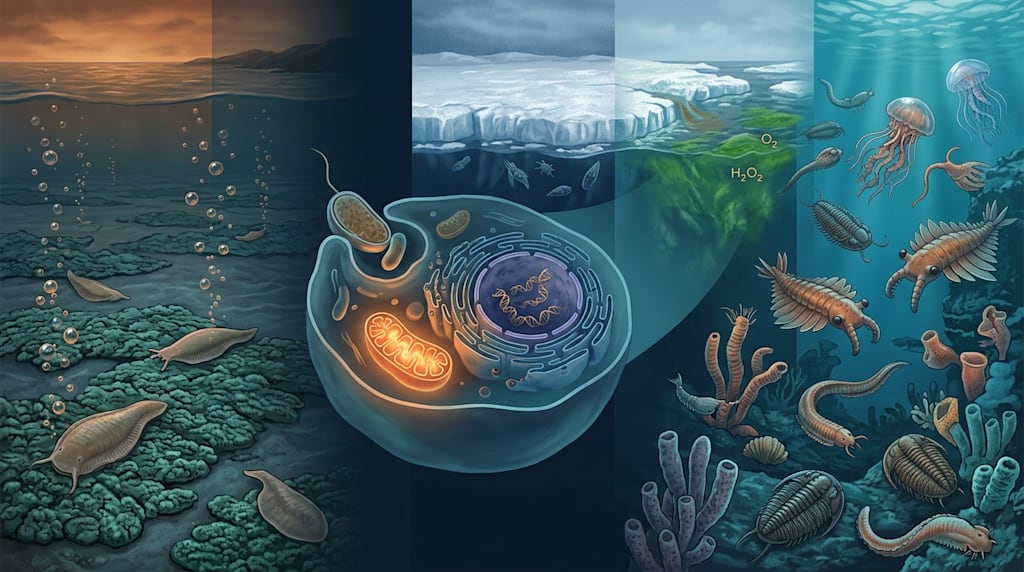
About 2.1 billion years ago, shallow seas held free oxygen for the first time. A group of organisms lived there and died there. They are called the Francevillian biota. They were flat, soft, and slow. The fossils suggest they were among the first life forms to use oxygen for respiration. That would have given them an energy advantage. For hundreds of millions of years, they persisted. Then they vanished.
Their disappearance was a lesson in how evolution works. The Great Oxidation Event, roughly 2.6 to 1.8 billion years ago, filled the atmosphere and oceans with oxygen. It also pulled greenhouse gases out of the air. The planet cooled. Glaciers expanded. Snowball Earth events followed. Under thick ice, oxygen became scarce. The Francevillian biota had specialized in oxygen-based metabolism. They died because the world changed. Their lineage died out. No descendant is alive today. Their closest living relatives, if any, trace back to the same ancient root as everything else: the last universal common ancestor, or LUCA.
This raises a question that has haunted evolutionary biology for decades. Was the origin of animals an accident? If the tape of life were rewound and played again, would animals fail to appear?
The answer depends on where you rewind the tape.
A failed dawn
The Francevillian biota were not animals. They were a separate experiment in complex life. They flourished and disappeared before the ancestors of animals had taken shape. Their story matters because it shows what is possible. Given oxygen, time, and a stable environment, single cells can assemble into larger, more complex forms. The Francevillian biota did it. They were an early draft.
A change in the world killed them. The oxygen window closed. The ice came. The rules changed. The Francevillian biota had bet everything on aerobic respiration. When oxygen disappeared, so did they.
The animals we know today made a different bet. Their ancestors survived the snowball Earth events in refuges under the ice, in pockets of liquid water where oxygen was scarce. They did not rely on a constant supply of oxygen. They kept their bodies small and their metabolisms low. They waited.
When the ice melted, the world changed again. Nutrients flooded the oceans. Photosynthetic algae bloomed. Oxygen levels rose. The ancestors of animals, already equipped with the cellular machinery for complex life, walked into an open field.
The first key: a bacterium that was not digested
To understand whether animals are accidental, we have to go back further than the Francevillian biota. We have to go back to the origin of the eukaryotic cell.
Life appeared on Earth by about 3.8 billion years ago. For the next nearly two billion years, bacteria and archaea ruled the planet. They were not lazy. They diversified into every conceivable niche. They invented photosynthesis, nitrogen fixation, and countless metabolic pathways. But they never became complex. They never built a nucleus. They never became multicellular in any lasting way. They stayed small.
The reason is energy.
Bacteria make ATP, the energy currency of life, on their cell membranes. The more membrane surface area a cell has, the more ATP it can produce. But as a cell grows larger, its volume increases faster than its surface area. A bigger cell has proportionally less membrane. It cannot produce enough energy to support a larger genome, more proteins, or a more complex internal structure. This is a trap. To get more energy, a cell needs more membrane. To get more membrane, it needs to get bigger. To get bigger, it needs more energy. The circle closes. Bacteria stayed in it for nearly two billion years.
Then, about two billion years ago, something happened that broke the circle. An archaeon engulfed a bacterium. Normally, the bacterium would have been digested. This time, it was not. It survived inside the host. It kept its own membrane. It kept its own internal space. Over time, it became a permanent part of the host cell. It became the mitochondrion.
The mitochondrion is a bacterium that survived digestion. It has its own inner membrane, folded into complex ridges called cristae. Those cristae are packed with ATP synthase, the molecular machine that produces ATP. The proton gradient that drives ATP synthesis is maintained across the mitochondrion’s inner membrane, between its own matrix and its own intermembrane space. This gradient is isolated from the rest of the cell. It does not leak. It does not blur. It works.
A single cell can hold hundreds or thousands of mitochondria. Energy production is no longer tied to the size of the cell’s outer membrane. A cell can grow large, carry a huge genome, and still have enough ATP to run the machinery. The energy trap is broken.
The second trap is information. In a eukaryotic cell, DNA is kept inside a nucleus. Transcription happens in the nucleus. Translation happens in the cytoplasm. RNA leaves the nucleus before it is translated. That separation opens a space for RNA processing: splicing, editing, chemical modification. One gene can produce dozens or hundreds of different proteins. This is the molecular basis for cell differentiation. Without it, a multicellular body could not build different cell types from the same genome.
Energy and information. Two bottlenecks, broken at once.
One fact matters here. All eukaryotes, from animals to plants to fungi to algae, trace back to a single common ancestor. The origin of the eukaryotic cell happened once. If it were easy, it should have happened many times. Bacteria engulf bacteria constantly. Endosymbiosis is not rare in nature. But the full integration of a bacterial symbiont into a host cell, with gene transfer, regulation, and permanent interdependence, happened only once. Life waited nearly two billion years for it. Then it never happened again.
That is the accidental key. The eukaryotic cell is a one-time invention. Rewind the tape to before that moment, and there is no guarantee it happens again. Animals, plants, fungi, and every complex organism on Earth depend on that single event.
One ancestor, one accident
Every animal that has ever lived, from sponges to flatworms to insects to humans, descends from a single population of single-celled eukaryotes. That population lived sometime in the Neoproterozoic, roughly 800 to 700 million years ago. It was not yet an animal. It was a protist, a cell with a nucleus and mitochondria, capable of swimming, feeding, and dividing. It had sex. It had a cytoskeleton. It had the molecular toolkit for adhesion and signaling.
But it was alone.
For hundreds of millions of years, eukaryotes remained single-celled. Some formed colonies. Some formed temporary aggregates. Some even showed simple cooperation. None crossed the line into true multicellularity, where cells lose the ability to survive on their own and become parts of a larger whole.
That line was crossed by the ancestors of animals. And it was crossed not once, but several times independently: animals, plants, fungi, and several groups of algae all evolved multicellularity. Only animals evolved the particular combination of heterotrophy, mobility, and nervous systems that we associate with animal life.
The first step was aggregation. Cells stuck together after division. They produced adhesion molecules: collagen, integrins, cadherins. These molecules held cells together without fusing them. They allowed cells to communicate. They allowed a cell to know where it was and what its neighbors were doing.
The second step was division of labor. Some cells specialized in movement. Some specialized in digestion. Some specialized in reproduction. This required selective gene expression: all cells carried the same genome, but different cells expressed different subsets of genes. This is only possible in a cell with a large, regulated genome, which is only possible with mitochondria.
The third step was the body axis. Sponges have no front or back. They are filter feeders, not hunters. But the ancestors of animals became hunters. They chased food. Chasing requires direction. Direction requires a front end. A front end requires sensory organs. Sensory organs require a nervous system.
Heterotrophy drove movement. Movement drove direction. Direction drove the concentration of senses at the front. The concentration of senses drove the evolution of a brain. This sequence is not arbitrary. It follows from the basic problem of being an animal: you cannot make your own food, so you must find it. And food runs away.
The icebox and the oxygen window
The animals we know today did not appear in a warm, comfortable world. They appeared at the end of a global catastrophe.
Between about 720 and 635 million years ago, Earth froze. Ice sheets reached the equator. The oceans were covered by ice hundreds of meters thick. Photosynthesis slowed. Oxygen levels dropped. Most of the planet became uninhabitable for complex life.
But life did not disappear. It survived in refuges: under the ice, near hydrothermal vents, in cracks and crevices where liquid water persisted. The ancestors of animals were among the survivors. They were small. They were simple. They did not need much oxygen. They waited.
When the snowball Earth events ended, the world changed rapidly. The ice melted. Nutrients washed into the oceans. Algae bloomed. Oxygen levels rose. For the first time in hundreds of millions of years, the deep ocean was oxygenated.
The ancestors of animals were ready. They had mitochondria. They had the genetic toolkit for multicellularity. They had cells that could stick together, communicate, and specialize. And now they had oxygen. They exploded.
The Ediacaran biota, which appeared around 635 million years ago and disappeared around 541 million years ago, were the first large, complex organisms. They were soft-bodied. They were slow. They had no shells, no eyes, no jaws. But they were multicellular. They had different cell types. Some were mobile. They were the first draft of animal life.
Then came the Cambrian explosion.
The Cambrian lock-in
About 541 million years ago, in a span of about 10 to 20 million years, almost every major animal body plan that exists today appeared in the fossil record. This is the Cambrian explosion. Before it, animals were soft, slow, and simple. After it, there were predators with eyes, prey with shells, burrowers, swimmers, and filter feeders. The basic architecture of the animal world was fixed.
Several factors came together. Oxygen levels rose further, providing enough energy for active, mobile bodies. Predation appeared, triggering an arms race. New ecological niches opened, and the first animals to fill them diversified rapidly.
The Cambrian explosion locked in the body plans. After it, no new animal phyla appeared. Every animal that has evolved since, from trilobites to dinosaurs to whales, is a variation on a theme that was already present in the Cambrian. The door opened once, and then it closed.
Accident and necessity
The eukaryotic cell was an accident. It happened once, after nearly two billion years of waiting. If the tape were rewound to before that event, there is no reason to think it would happen again. The specific integration of an archaeon and a bacterium, the transfer of genes, the evolution of the nucleus and mitochondria, the emergence of a single common ancestor for all complex life, these are contingent. They depend on a long chain of unlikely events.
But once the eukaryotic cell existed, the rest was not so accidental.
Given oxygen, given time, given a stable environment, eukaryotes tend to become multicellular. The Francevillian biota did it 2.1 billion years ago. The Ediacaran biota did it again 600 million years ago. The Cambrian explosion produced the animal body plans. Each of these steps required specific conditions, but the direction was not random. Heterotrophy creates pressure for movement. Movement creates pressure for senses. Senses create pressure for nervous systems. Multicellularity creates pressure for division of labor. Division of labor creates pressure for gene regulation. The logic is built into the problem.
If the tape were rewound to the Cambrian, the specific animals would be different. There might be no vertebrates, no arthropods, no mollusks. The names would change. The body plans would change. But the ocean would still have predators and prey. It would still have swimmers and burrowers. It would still have eyes and jaws and shells. The functions would be similar, even if the forms were alien.
If the tape were rewound to before the eukaryotic cell, however, the outcome is less certain. Without that one accident, complex life could have failed to appear at all. Earth might still be a world of bacteria and archaea, with no animals, no plants, no fungi. The accidental key is the bottleneck. Once the key turns, the door opens. But the key was forged only once.
Replaying the tape
Stephen Jay Gould once asked what would happen if we rewound the tape of life and played it again. His answer was that the result would be radically different. Humans would not evolve. Maybe vertebrates would not evolve. The history of life is full of contingency, and small changes early on can produce enormous differences later.
Gould was right about the specifics. If you rewind to the Cambrian, you will not get humans. You will not get dinosaurs. You will not get anything you can name. The accidental events, the mass extinctions, the lucky survivors, the random mutations, would all be different.
But Gould may have underestimated the power of convergence. The laws of physics and chemistry do not change. The problems of life do not change. You still need energy. You still need information. You still need to find food, avoid being eaten, and reproduce. In an oxygen-rich world, eukaryotes will still face the same pressures. Some will become multicellular. Some will become mobile. Some will develop senses. Some will develop nervous systems.
The Francevillian biota failed, but they tried. The Ediacaran biota failed, but they tried. The Cambrian animals succeeded, and they locked in the pattern. If the tape were rewound, the same pressures would produce a similar pattern. Not the same animals. Not the same names. But a world with animals, or something very much like them.
The origin of animals was an accidental key opening a necessary door. The key was the eukaryotic cell, forged once in four billion years. The door was complex multicellular life, waiting for oxygen and opportunity. Once the key turned, the door opened. And after the Cambrian, it never closed again.
About the Creator
Jin
Writer of reamstories
https://reamstories.com/jin
Enjoyed the story? Support the Creator.
Subscribe for free to receive all their stories in your feed. You could also become a paid subscriber, letting them know you appreciate their work.
Comments
There are no comments for this story
Be the first to respond and start the conversation.